When the White House staged its Science: A New Golden Age summit on October 8, eleven companies lined up to announce a combined $2.4 billion for the Department of Energy’s Genesis Mission. The number traveled fast. What traveled more slowly was the breakdown, which tells a different story for investors in nearly every name attached to it.
Who Is Actually Inside the Mission
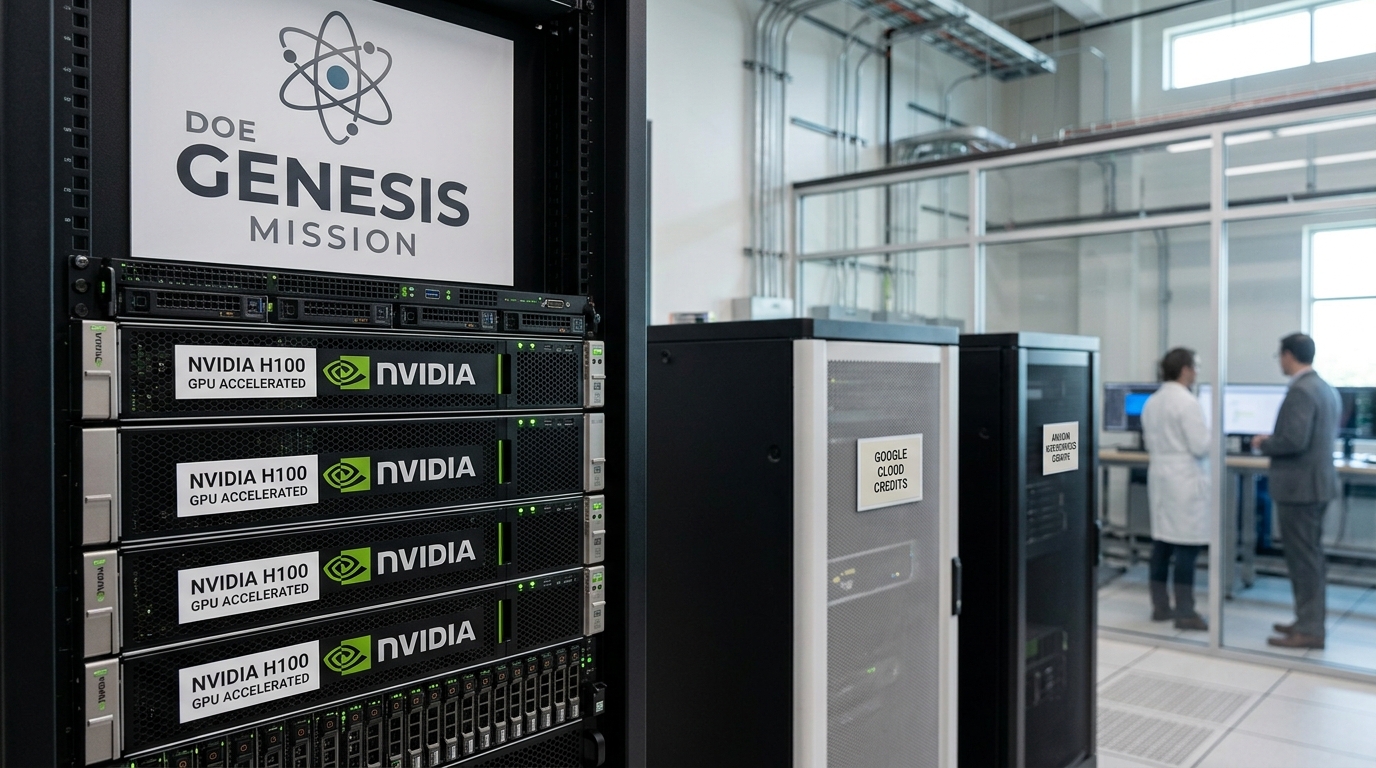
Start with Nvidia. Nvidia announced a $1 billion commitment over five years to support super intelligence for science and quantum computing across the U.S., including support for higher-education research institutions, investments to accelerate American quantum leadership, and support for cloud providers serving U.S. government mission needs. Critically, Nvidia framed this as expansion of its role as a Genesis Mission industry partner, building on existing work with the DOE. That existing relationship matters: Nvidia says the effort is in addition to supporting seven new systems across Argonne and Los Alamos national laboratories. This is operational infrastructure, not a press release pledge.
The contrast with the cloud providers is sharp. Amazon Web Services announced an initiative that will provide up to $50 million in AWS credits over three years (2026 to 2028) under its Genesis Mission Accelerator Initiative. Microsoft’s July 2026 announcement offered $40 million in Azure compute and AI credits distributed over three years, plus $20 million in solution engineering enablement services. Google committed $40 million in AI tokens and cloud credits for researchers in support of the Genesis Mission. For Amazon (AMZN), Microsoft (MSFT), and Alphabet (GOOGL), these are rounding errors relative to their capital expenditure bases. Amazon alone, as Reuters reported in November 2025, said it would invest up to $50 billion to expand AI and supercomputing infrastructure for U.S. government customers. The Genesis Mission credit lines are goodwill gestures, not growth drivers.
The Quantum Pure-Plays: Eligible, Not Selected
IonQ (IONQ) and Rigetti (RGTI) are the names most likely to spike on Genesis Mission headlines, and the ones investors should scrutinize most carefully. They were not identified as part of the White House’s October 8 group of eleven industry partners behind the $2.4 billion figure. What they do have is eligibility. The DOE’s Quantum Genesis Q Competition is designed to develop and deploy fault-tolerant, scientifically relevant quantum computing capability through a competition intended to accelerate that timeline. Rigetti has long-running DOE national lab ties dating to earlier federal quantum research efforts. IonQ has been among the most aggressive in publicizing error-correction milestones, making it a natural entrant. But eligibility is not a contract. Phase I provides fixed awards for early milestones worth up to $1.5 million per awardee. That is a far cry from the billion-dollar figures attached to Nvidia and AMD.
Rigetti’s fundamentals put the gap in starker relief. Second-quarter 2026 revenues jumped 185% year over year to $5.1 million, a strong growth rate on a tiny base. Second-quarter operating expenses increased to $30.3 million, pushing the operating loss to $28.1 million. IonQ has more revenue scale, raising its full-year 2026 revenue guidance to between $260 million and $270 million, supported by government and defense-adjacent demand rather than Quantum Genesis milestone awards.
What the $2.4 Billion Actually Represents
These commitments are not contract awards to the contributing firms, but they signal expanded demand for AI, cloud, advanced computing, and research capabilities across federal science programs. Much of the $2.4 billion is delivered as compute credits and tools rather than cash, and those credits are inherently tied to each vendor’s own platforms and services. The mission validates the infrastructure buildout already underway at Nvidia and AMD. It does not transform a quantum pure-play’s revenue profile overnight.
The Wealth-Building Takeaway
Proximity to a government science program is not a business model. Nvidia’s Genesis Mission role is embedded in national laboratory work and multi-project collaborations. Amazon, Microsoft, and Google made credit pledges that are meaningful to federal researchers but immaterial to shareholders. IonQ and Rigetti are legitimate contenders for quantum competition awards, but those are milestone payments measured in millions, not the billions the headlines implied. When a government initiative generates this much market noise, the discipline that protects wealth is the same one that always does: read the actual commitment, not the press conference number.