October 13, 2026
Bonus Content: Dairy Methane Is Worth $60 per Unit. The Gas Itself Is Worth $3.
Quick question…
Would you spend 60 seconds to save yourself $29.97?
That’s what my “How To Stop Revenge Trading in 5 Steps” report costs on our website right now. But today, I’m giving it away – no charge, no strings.
Inside, you’ll get 5 simple rules that stop the loss spiral, so one losing trade can’t snowball into an account-wrecking afternoon.
All you have to do is click here and tell me where to send it.
Good Trading,
Bill Poulos
p.s. This won’t stay free forever – $29.97 is a fair price and I’ll be going back to it.
Grab your copy here before that happens.
Dairy Methane Is Worth $60 per Unit. The Gas Itself Is Worth $3.
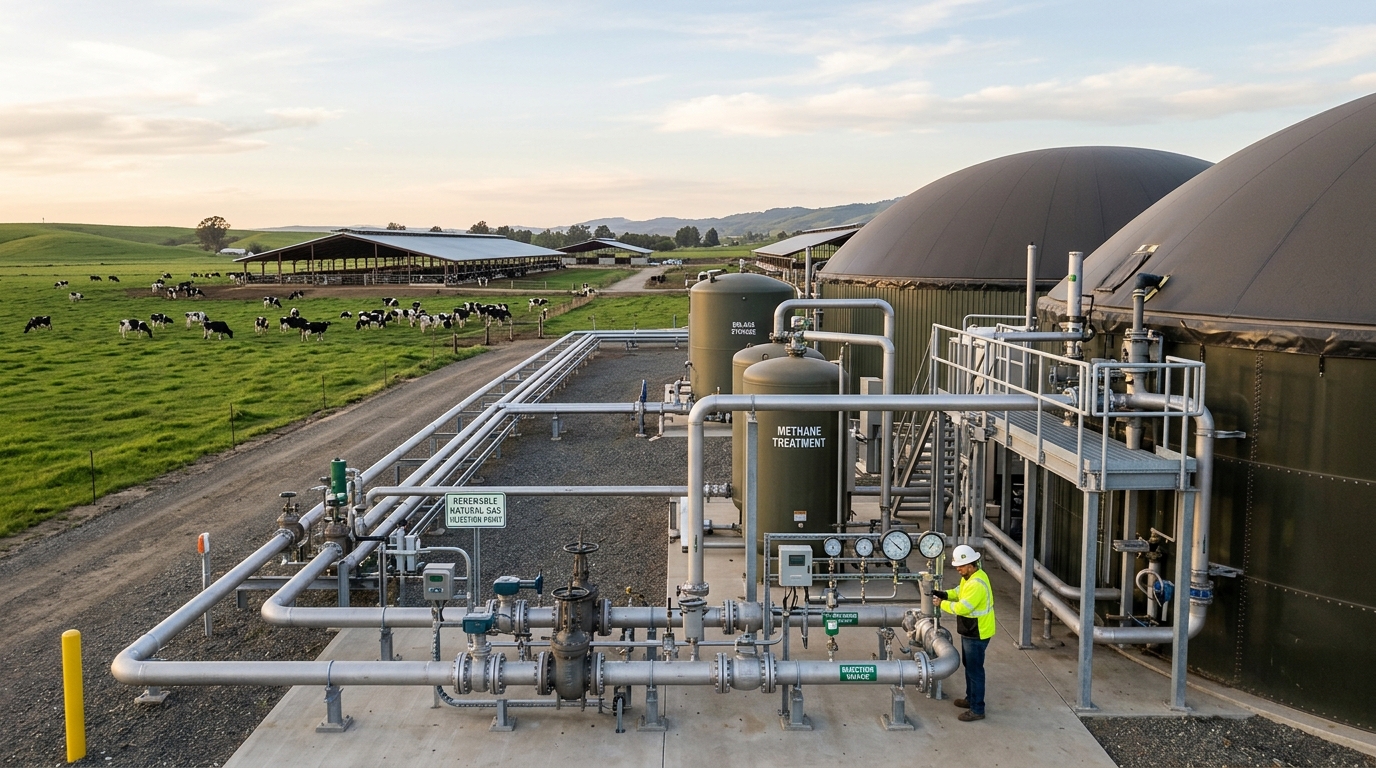
Forget the gas molecule for a moment. A million BTUs of natural gas at the city gate trades around $3. That same million BTUs, if it originated from a dairy lagoon, passes through an anaerobic digester, and gets injected into a pipeline, is worth somewhere between $60 and $90 once you layer on the federal and state credits attached to it. That gap is the entire investment thesis behind dairy renewable natural gas.
Why the Credit Stack Is the Business
Dairy RNG earns money in three places simultaneously. The physical gas itself. D3 cellulosic RINs under the EPA’s Renewable Fuel Standard, which averaged around $2.40 per RIN in 2025 and have edged higher in 2026. And California LCFS credits, which averaged $57.77 per metric ton of CO2 equivalent in 2025, with trades reaching as high as $75.50.
The economics work because dairy manure stored in open lagoons would otherwise vent methane directly into the atmosphere, a greenhouse gas roughly 80 times more potent than CO2 over a 20-year time frame. Capturing it before it escapes gives dairy RNG a deeply negative carbon intensity score, which is what lets a single project earn both federal and state credits on top of the commodity value. As one recent analysis put it bluntly, 80 to 90 percent of a dairy digester’s total revenue derives from environmental credits, not from the gas.
Where Institutional Capital Is Going
The private-market version of this trade is already well-capitalized. Vanguard Renewables, a portfolio company of Global Infrastructure Partners within BlackRock, is building farm-based projects through a 50-50 joint venture with TotalEnergies, advancing 10 projects into construction with a combined annual capacity of roughly 2.5 billion cubic feet of RNG. The Oakmulgee Dairy Farm project in Virginia broke ground in April 2024 and will produce more than 259,000 MMBtu per year, with output contracted to fuel AstraZeneca’s Maryland biopharmaceutical production facilities.
The public-market version is Clean Energy Fuels (NASDAQ: CLNE), America’s largest provider of renewable natural gas for transportation. The company completed its East Valley dairy project in Idaho in 2026, a site running on more than 35,000 cows with six anaerobic digesters. Q1 revenue came in at $117.6 million, and RNG gallons sold jumped 33.2% compared to the same quarter in 2025. The company has reported $29.5 million of investment tax credits sold through its bp joint venture.
The Honest Risk
CLNE trades around $1.47, down sharply from a 52-week high of $3.11, with a market cap just over $324 million. The loss column remains open: a net loss of $14.9 million in Q2 alone. The deeper risk is structural. D3 RIN prices are set by annual EPA volume quotas, and if the agency sets obligations below industry production capacity, prices can collapse. The credit-dependent revenue model that makes dairy RNG so lucrative is exactly what makes it fragile if the regulatory floor shifts.
Still, the American Biogas Council counted 496 operational dairy biogas systems as of June 11, 2026. Approximately 2,955 additional farms with 500 or more cows could support digester systems but have not built them. The untapped runway is large. The question for investors is which companies have locked in the infrastructure, the farm contracts, and the offtake agreements before that runway fills up.