September 17, 2026
Bonus Content: Lockheed’s $230B Backlog Is the Biggest in Its History. The Stock Is 23% Off Its High.
Dear Fellow Investor,
What does the “Smart Money” know that you don’t?
On September 30th, a 90-year-old law is set to pull the rug out from under the global gold market.
While retail investors are sleepwalking in paper ETFs…
Institutions like Bank of America and Jane Street are quietly loading up on a specific “Shadow Miner.”
They aren’t buying the metal.
It moves 10x faster than the metal.
They’re buying the vault.
The logic is simple: When the paper market defaults on September 30th, the price of physical gold won’t just rise – it will “teleport.”
I’ve identified the one stock at the epicenter of this $14 Trillion repricing event.
The math suggests a 1,000% surge is on the table as the “Paper Gold” illusion shatters.
See the 13F filings and the evidence here >>>
“The Buck Stops Here,”
Dylan Jovine, CEO & Founder
Behind the Markets
Lockheed’s $230B Backlog Is the Biggest in Its History. The Stock Is 23% Off Its High.
Wall Street spent most of 2026 punishing Lockheed Martin for a first quarter it deserved to lose. A Q1 earnings miss driven by cost issues on the F-16 and C-130 programs sent the stock skidding more than 20% from its March peak near $692. The question now is whether the punishment fit the crime, and the Q2 numbers suggest it did not.
Lockheed’s second quarter put the thesis back on solid ground. Revenue hit $20.06 billion, up 10.5% year-over-year and 3.8% above consensus. GAAP EPS came in at $7.94 against a $7.20 estimate. Free cash flow reached $2.9 billion for the quarter. The company raised full-year revenue guidance to a midpoint of $80.75 billion, about 2% above what analysts had modeled going in.
The Business
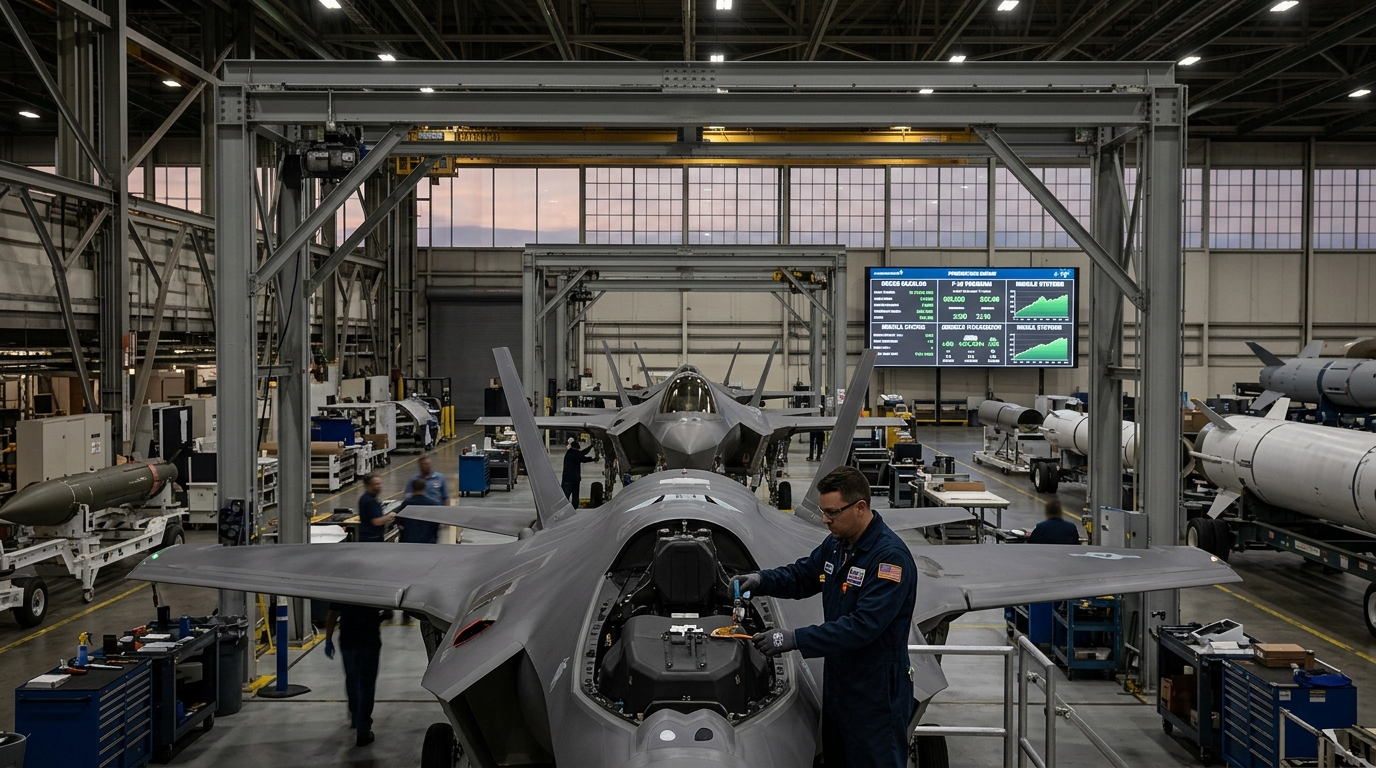
Lockheed builds the F-35 fighter, PAC-3 and THAAD interceptors, Sikorsky helicopters, and the classified missile defense architecture the Pentagon is scaling aggressively right now. The Missiles and Fire Control segment is the engine. It grew 18% in Q4 2025 alone, and backlog in that segment has nearly doubled to $87.9 billion, fueled by a $35 billion seven-year contract action for THAAD interceptors awarded in the first half of 2026.
Total backlog reached a record $230.4 billion as of June 28, 2026, up $36.8 billion in just six months. Lockheed expects to convert roughly 30% of that into revenue over the next 12 months, and 50% within 24 months. Book-to-bill hit 3.2x in the most recent quarter.
Why Wall Street Is Paying Attention
On September 8, UBS upgraded the stock to Buy and lifted its price target to $674 from $581, implying roughly 28% upside from the September 4 close of $525.28. The bank’s argument centers on what it calls a structural shift: UBS projects 150% revenue growth from 2025 to 2030 in the missiles segment alone, based on multi-year production frameworks for PAC-3, THAAD, PrSM, and JASSM/LRASM programs. It expects a 9% revenue compound annual growth rate through 2028, above consensus, with double-digit earnings-per-share upside by then.
Days after the upgrade, the Navy disclosed a $257.3 million contract modification for MK 48 heavyweight torpedo components involving Lockheed. It is not a transformative contract on its own, but it illustrates the consistency of awards flowing into a backlog the market has been underweighting.
What’s Driving the Opportunity
Defense spending is not a near-term story. Global rearmament, the FY2027 Pentagon budget, and multi-year munitions contracts have created demand visibility that extends well beyond a single fiscal year. Lockheed’s full-year free cash flow guidance of $7.0 to $7.2 billion implies a free cash flow yield close to 5.8% at current prices. The dividend has been raised for 23 consecutive years, currently yielding roughly 2.6%.
What Could Go Wrong
The Q1 miss is not ancient history. Fixed-price contracts remain in the portfolio, and cumulative losses on a classified Aeronautics program have already accumulated roughly $1.8 billion. A second-half margin recovery is built into full-year guidance. If it doesn’t materialize, the EPS consensus unravels. Congressional budget delays are the other lever: UBS acknowledged the fiscal 2027 budget carries risk, though it argues awards are already flowing and outlay catch-up is underway.
The Bottom Line
Lockheed is trading at roughly 17.5 times 2026 earnings with a backlog that is the largest in the company’s history, a segment growing at rates not seen in a generation, and an upgrade from a bank that was neutral for years. The stock is 23% off its high for reasons that belonged to Q1. The Q2 report and the missile order book say the bear case is losing ground.