

November 3, 2026
Bonus Content: DRAM Has Doubled. Is Micron the Buy, or the Warning Sign?
On March 20, Ross Givens flagged a little-known stock with direct exposure to SpaceX’s growth trajectory…
A publicly traded position that moves with SpaceX’s commercial milestones…
Even though SpaceX itself remains privately held.
Within two months of Ross covering that stock…
It posted a gain of over 180%…
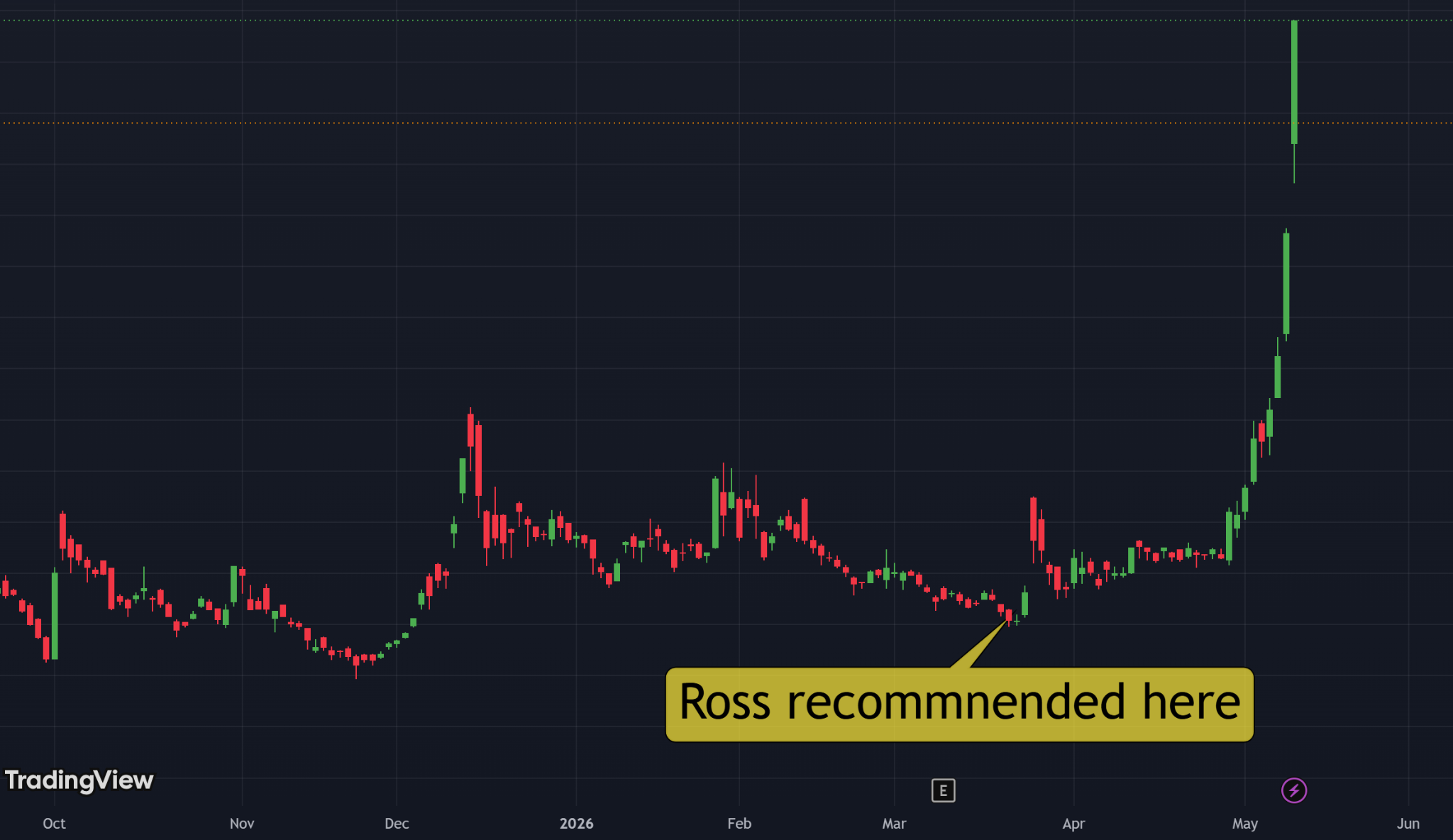
A move of that magnitude on a $5,000 position would have grown it to over $14,000.
And that’s not the only SpaceX-adjacent position Ross has covered.
If you want access to stock research like this…
Ross’s Black Ops Trading Club is currently open at a $5 entry price.
At $5, members receive specific stock research with asymmetric upside potential…
Plus live market analysis sessions twice a week.
For $5, you get a 20-year market veteran walking through current positioning and setups with you directly.
The $5 entry is not a permanent price point.
Click here to reserve your Black Ops Trading Club spot at the current $5 rate.
DRAM Has Doubled. Is Micron the Buy, or the Warning Sign?

DRAM prices have roughly doubled since the start of 2026. That fact landed in fresh Nikkei Asia reporting Monday, and it sits at the center of one of the most consequential calls in semiconductors right now: does the doubling make Micron an obvious buy, or does it mark the high-water line of a cycle that is already beginning to turn?
Why This Stock Now
The supply side delivered another jolt this week. TrendForce expects South Korean DRAM manufacturers to cut PC DRAM shipments in 2027 by more than 20% year over year, and says those cuts could exceed 40% depending on OEM demand and how much volume is locked into strategic customer agreements. TrendForce also expects PC DRAM contract prices will rise 13% to 18% quarter over quarter in Q4. That is not a correction; it is a deliberate shrinkage of the commodity segment to protect margins on AI memory. As the supply shortage of PC memory persists, Intel has lowered its fourth-quarter revenue forecast. Intel now expects the PC unit market to decline about 12% in 2026 and roughly 10% in 2027.
The Business
Micron is the only U.S.-based company developing and manufacturing leading-edge memory, and it is the only U.S.-based supplier of HBM products. That position has translated into a financial transformation that strains credibility. Total revenue for fiscal 2026 came in at $133.19 billion, up about 256% from 2025, with gross margin at 81.1%. Q4 FY2026 revenue reached $54.23 billion with an 87.0% gross margin, beating consensus.
The contracts are the structural story. Micron’s strategic customer agreements are multi-year take-or-pay deals that sharpen long-term supply planning. The company has said it has signed 26 of them, and currently estimates they cover over 35% of revenue through 2030. Customers are requesting assured supply beyond 2030, and Micron has said some agreements extend into 2031. Micron has said financial commitments from customers have reached $32 billion, the vast majority in cash deposits.
Why Wall Street Is Paying Attention
Samsung, SK hynix, Micron, and SanDisk are all pursuing longer-term supply agreements, often with multi-year terms. That is a meaningful shift in how the industry allocates scarce bits. Micron has said it has completed agreements covering the vast majority of its calendar 2027 HBM bit supply at prices significantly higher than a year earlier. On next quarter’s guidance, Micron guided for revenue of approximately $61.5 billion and adjusted earnings per share of $38.15.
What Could Go Wrong
Here is where the timing question gets uncomfortable. The pace of price gains is slowing: Q4 PC DRAM contract prices are expected up 13% to 18%, down from the 18% to 23% increase seen in Q3. Deceleration at the top of a pricing cycle is exactly what you would expect before a turn. Micron is not completely insulated from downturns, and with SCAs covering over 35% of revenue through 2030, a large majority of its sales will still be influenced by shifts in supply and demand.
The PC demand signal is not just a Micron risk — it is already showing up in Intel’s numbers. Soaring memory prices compressing consumer PC demand and forcing Intel to cut wafer starts is the same supply-demand dynamic playing out from the other side of the trade.
The Korean cuts also read two ways. Yes, they tighten near-term supply further. But if AI capex slows in 2027 and hyperscaler orders flatten, the same Korean producers who choked off PC DRAM can just as quickly swing capacity back. One analysis grades both Samsung’s and SK hynix’s LTAs as B-level contracts: delivery in 2027 looks safe because the shortage itself enforces the agreements, but how much they protect profit in a downturn cannot be calculated until price floors and penalty terms are fully disclosed.
The Bottom Line
Micron’s numbers are real: $133 billion in fiscal 2026 revenue, 26 take-or-pay contracts, $32 billion in customer deposits, and guidance that keeps accelerating. That is not a speculative thesis. What it is, at this moment, is a company whose best news may already be priced in after a run of several hundred percent. The DRAM doubling is both the engine of Micron’s earnings and the signal most likely to attract the capacity response that ends a cycle. Prices are expected by some forecasters to stay elevated into 2028, which gives the bull case genuine runway, but the deceleration in quarterly contract price gains and Intel’s crumbling PC outlook are cautions worth taking seriously before adding here. Micron is the most compelling memory stock available. Whether it is the most compelling stock right now depends almost entirely on what you believe happens to hyperscaler spending in 2027.