Dear Reader,
Every now and then, I come across a company that seems to be getting stronger while Wall Street looks the other way.
That’s exactly what happened recently.
This company just reported the highest earnings in its history.
Management raised the dividend to a record level.
And executives are now targeting even greater profitability in the years ahead.
What’s remarkable is that most investors have never seriously considered owning the stock.
Meanwhile, it continues collecting billions of dollars from some of the biggest names in technology.
I believe the market may be underestimating what’s happening here.
Click here to see why I’m paying close attention.
To your wealth,
Alexander Green
Chief Investing Strategist, The Oxford Club
CoreWeave Brings Rubin NVL72 Online Before Rivals
The week heading into Wednesday looked rough for CoreWeave. Chip stocks had fallen more than 20% from their late-June record, and the PHLX Semiconductor Index had entered a bear market, raising concerns that the AI-driven rally was losing momentum. Bernstein had named CRWV its top casualty in a potential training slowdown, assigning a $74 price target. The analyst note also said CoreWeave has about 25% of its active U.S. power and roughly 74% of contracted power in Tier 3 and Tier 4 markets. The stock closed Monday down nearly 7%.
Then CoreWeave did something no other cloud provider had done.
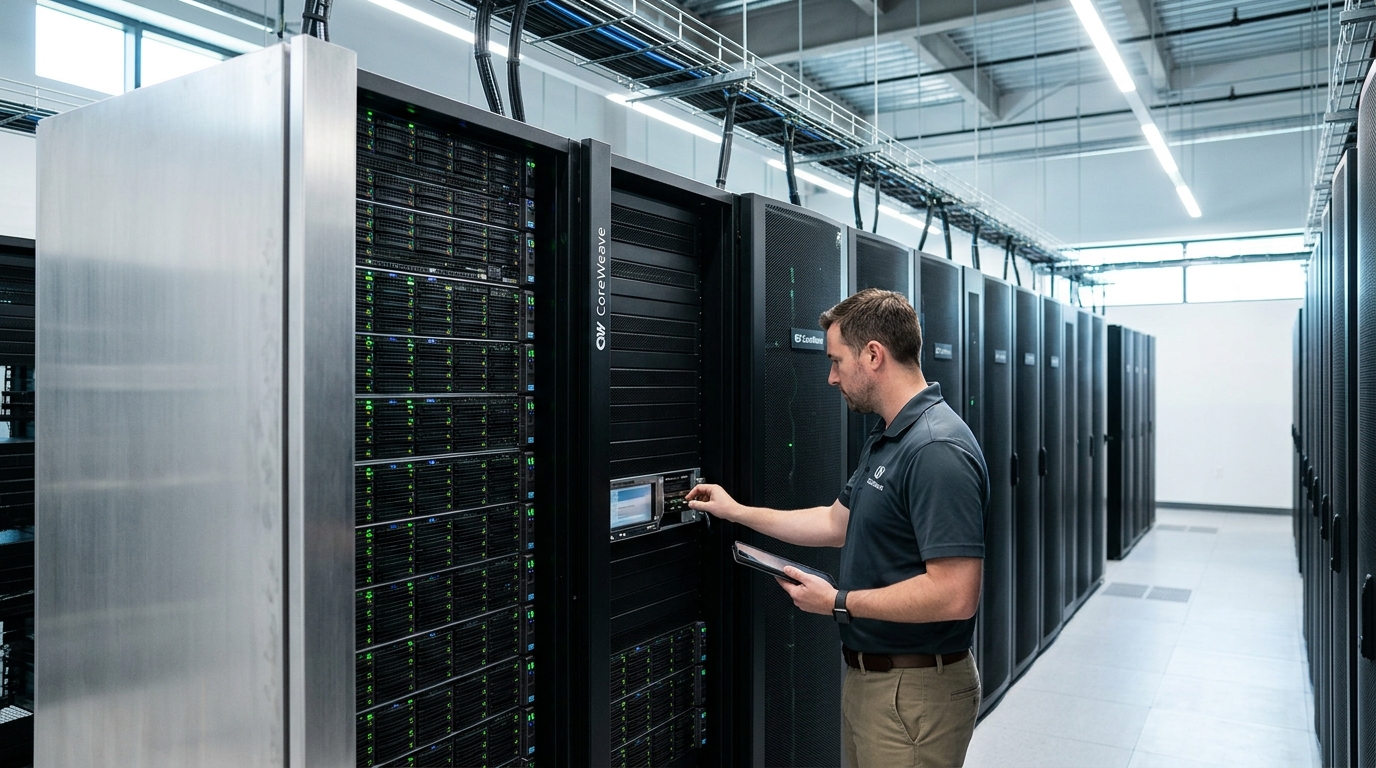
On September 16, 2026, the company announced the bring-up of multi-rack NVIDIA Vera Rubin NVL72 on CoreWeave Cloud, putting hundreds of NVIDIA Rubin GPUs into a single scale-out cluster for agentic AI. CoreWeave also said it was the first AI cloud provider to validate and bring up a Vera Rubin NVL72. The stock recovered most of the week’s losses, gaining as much as 4% on the announcement.
Why This Moment Matters
Multi-rack Vera Rubin NVL72 clusters allow training and inference jobs to run across hundreds of Rubin GPUs, and that matters for multi-step agentic workloads, which are sensitive to data-access latency because delays can compound across repeated model calls and tool use. This is not an incremental hardware upgrade. CoreWeave and NVIDIA have promoted major efficiency gains for Rubin versus the prior generation, including substantially higher tokens per megawatt and sharply lower cost per million tokens, though exact multiples vary by workload and configuration. For customers pricing inference at scale, that efficiency gap is decisive.
CoreWeave also introduced two new capabilities in CoreWeave AI Object Storage: cross-region write acceleration and a new Archive tier, designed to keep data latency from strangling what the GPUs can now deliver. The full stack move matters. A cluster of hundreds of Rubin GPUs sitting idle because storage can’t keep pace is not a product; it’s a bill.
The Institutional Picture
CoreWeave’s relationship with NVIDIA goes well beyond customer and supplier. In January 2026, CoreWeave and NVIDIA announced an expansion of their relationship to accelerate the buildout of more than 5 gigawatts of AI factories by 2030, with NVIDIA investing $2 billion in CoreWeave Class A common stock at $87.20 per share. That buy-in is now sitting below NVIDIA’s entry price, which says something about how aggressively the market has moved to discount AI infrastructure risk. CoreWeave reported second-quarter revenue rose 112% year over year, and management raised full-year 2026 revenue guidance to $12.4 billion to $13.2 billion, citing revenue backlog of about $104 billion as of June 30, 2026. The bulls are not arguing against a bad business. They are arguing that the market has overcorrected.
Other Wall Street firms do not necessarily agree with Bernstein’s outlook. CoreWeave’s consensus rating remains a “Moderate Buy,” with an average price target around the low-$140s.
The Real Constraint
Being first to Rubin is a durable advantage only if CoreWeave can keep deploying Rubin at scale. That is where the power question lands. Public sizing guidance for Rubin NVL72 systems commonly puts rack power around 190 to 230 kilowatts depending on configuration, versus roughly 120 to 130 kilowatts for GB200 NVL72 and around 40 kilowatts for Hopper-era racks. Each generation has roughly doubled rack power. For data center providers, Rubin is not a chip refresh. It is a forced redesign of power delivery, cooling, and the economics of building anything custom. CoreWeave has about 25% of its active U.S. power and roughly 74% of contracted power in Tier 3 and Tier 4 markets, regions that built for training workloads but were not designed around 200-kilowatt racks requiring all-liquid cooling at scale.
The risk is not necessarily CoreWeave’s existing contracted backlog, but whether future rural capacity can find enough customers if model-training demand cools. Rubin’s efficiency gains are a partial answer to that: NVIDIA has positioned Rubin as delivering dramatically lower cost per million tokens than Blackwell for interactive, deep-reasoning agentic AI, which shifts the workload mix toward inference and agentic use cases that CoreWeave is now explicitly targeting.
The Bottom Line
CoreWeave is the one stock today where the catalyst is not anticipated; it is already in production. No other neocloud can say it has run a multi-rack Rubin cluster as a commercial cloud service. That execution gap, first to validate, first to scale, is why CRWV snapped a five-session losing streak on Wednesday while the broader chip index was still digesting a bear market. The questions worth holding alongside that: power availability at roughly 190 to 230 kilowatts a rack sets a hard ceiling on how fast the Rubin buildout can extend, and as of June 30, 2026, the company reported $25.170 billion of non-current recourse debt plus $2.385 billion of non-current non-recourse debt, against $5.524 billion in cash and cash equivalents, a balance sheet that amplifies every scenario, good and bad. The business is executing. The debate is whether the infrastructure around it can keep up.