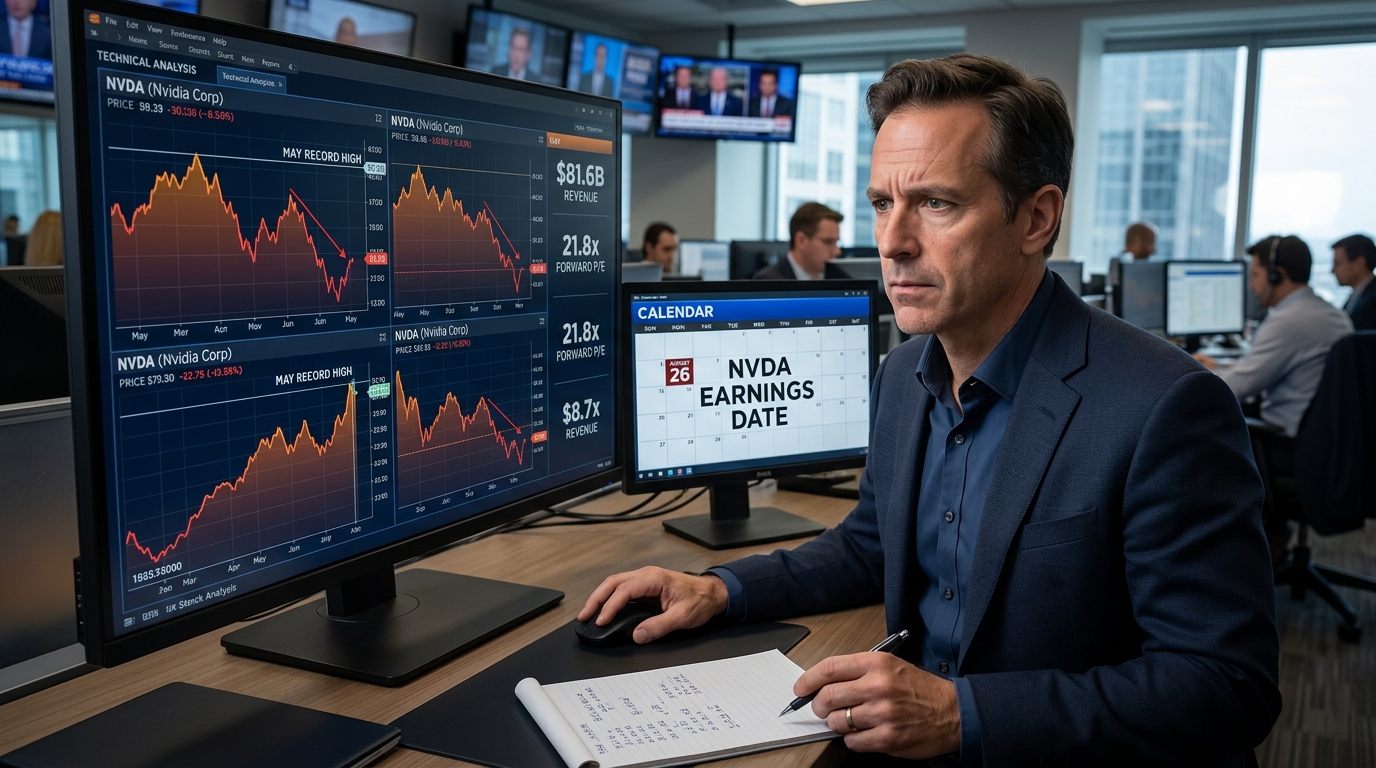
Here’s the thing about Nvidia right now. The business has never been stronger. The stock has never been more confusing.
NVDA closed July 8 at $202.42. That’s roughly 14% below its May 14 all-time high of $235.47. Over the same stretch, AMD has roughly doubled. Micron has nearly tripled. The VanEck Semiconductor ETF is up around 70% year-to-date. And Nvidia, the company that built the modern AI infrastructure stack, is sitting there up just 5% for the year, lagging the S&P 500’s ~10% gain.
Jensen Huang called it a “mystery” publicly. That word choice matters more than people realize.
What the Numbers Actually Say
In its fiscal Q1 2027 report on May 20, Nvidia posted $81.6 billion in revenue, up 85% year over year. Data Center revenue hit about $75.2 billion, up 92% annually, with data center networking revenue up 199%. The company authorized an additional $80 billion buyback. It raised its dividend from $0.01 per share to $0.25 per share. And after all that, shares fell 1.77% the next session.
That reaction is the whole story. The market isn’t doubting the quarter. It’s questioning what comes after.
For Q2 FY2027, management guided $91 billion in revenue, with no assumed China data center compute revenue. Read that again: Nvidia is projecting a new quarterly record while explicitly excluding its entire Chinese market from the model. The non-China business alone, sovereign AI, enterprise deployments, global cloud infrastructure, is growing fast enough to set records quarter after quarter. That’s the part of the thesis most people aren’t fully pricing in.
The Valuation Reset Nobody Expected
Nvidia now trades at about 21.8x forward earnings. Goldman Sachs flagged this as “compelling” this week, pointing out that it’s essentially the same multiple as the S&P 500 average, and far below Nvidia’s five-year average forward P/E of 72x. Sixty-one analysts cover the stock. The consensus price target sits near $301. That implies roughly 49% upside from current levels.
The reason the stock hasn’t reflected any of this is largely mechanical. Nvidia entered 2026 already priced at a significant premium after its extraordinary 2023, 2024, and 2025 runs. When the semiconductor sector re-rated upward on AI enthusiasm, NVDA had less room to move. AMD and Micron started the year at far less elevated multiples and had more space to appreciate as the cycle turned.
Slight tangent, but it matters here: the B200 GPU rental price on major cloud platforms fell from a peak of $6.11 per hour to $4.22, a 31% drop in three weeks. That rental index functions as a real-time proxy for AI workload demand, and its softness gave bears a narrative. Whether it reflects a genuine slowdown or temporary digestion of a massive capacity build-out is the debate that defines the trade right now.
The Noise vs. the Signal
Two headline risks have weighed on sentiment. First, reports on July 7 suggested Nvidia’s Kyber NVL144 rack system had been delayed to 2028. Nvidia denied it the same day, reaffirming the schedule. Shares recovered over 1% on the denial. Second, Reuters reported that DeepSeek is quietly building its own inference chip, reducing reliance on Nvidia and Huawei hardware.
That second one sounds scarier than it is. Nvidia’s data center revenue in China has already effectively gone to zero under existing export restrictions. The company’s Q2 guidance was built with zero China contribution. DeepSeek competing in the inference chip space would reduce demand Nvidia has already virtually lost.
More constructive: Washington has begun issuing licenses for Nvidia to sell H20 chips in China again. And reports suggest China may approve limited H200 purchases for select AI firms including Alibaba, ByteDance, and DeepSeek, though capped at under 200,000 total units. Any China re-entry, even partial, would represent upside the current guidance explicitly excludes.
The Hyperscaler Catalyst Window
The most important near-term catalyst for Nvidia isn’t its own earnings. It’s the cloud earnings parade in late July. Microsoft, Meta, Amazon, and Alphabet all report at the end of the month. Their AI capex guidance will function as a direct forward indicator for Nvidia chip orders. Collectively, these four hyperscalers are guiding toward over $710 billion in 2026 capital expenditure. Goldman projects industry AI capex could rise from $650 billion in 2026 to $1 trillion in 2027. If even one of those players signals accelerating GPU procurement, the market will read it straight through to NVDA.
After that, Nvidia’s own August 26 earnings become the defining moment of the quarter.
Sector Context
The broader semiconductor picture matters here. S&P 500 earnings are expected to grow about 23% year-over-year in Q2, marking a seventh consecutive quarter of double-digit growth. The macro backdrop, with the Fed holding rates at 3.50%-3.75% and CPI most recently reported at 2.4% year-over-year (as of the 12 months ending January 2026), creates a higher-for-longer rate environment that typically pressures high-multiple growth stocks. That’s part of why multiple compression has hit Nvidia harder than peers that had less stretched starting valuations.
But multiple compression and fundamental deterioration are different things. The business hasn’t softened. The order backlog remains enormous. AWS alone has plans to add over one million Blackwell and Rubin GPUs. The CUDA software ecosystem continues to create switching costs that competitors struggle to overcome. The Vera Rubin architecture, originally slated for 2027, is arriving ahead of schedule.
Technical Structure
NVDA lost the $200 level on June 23 and has yet to reclaim it. That level is now the key threshold separating a July recovery from a deeper slide. A daily close above $200 would flip momentum and open the $207-$213 zone. The six-week falling channel has a floor near $189, and a close below that level would extend the drawdown materially. The 61-analyst consensus target of approximately $301 sits well above both ranges, which means the fundamental case and the chart are telling different stories right now. That kind of divergence is exactly where active traders find their edge.
Scenario Framework
Bull Case: Late-July hyperscaler earnings show accelerating AI capex guidance. China H200 license approvals come through. The stock reclaims $200 decisively and builds toward $220+. August 26 earnings confirm $91B+ in Q2 revenue, reinforcing the cycle-continuation story. Multiple re-rates toward 25-28x forward as growth visibility improves.
Base Case: Hyperscaler earnings are in-line, not transformative. NVDA consolidates between $190 and $210 through August. August 26 earnings deliver a beat but guidance reflects ongoing China exclusion and rising competition. Stock trades in a range, grinding toward $220-$230 by year-end as the market slowly digests the valuation reset.
Bear Case: One or more hyperscalers signals capex moderation on the July earnings calls. GPU rental prices continue to slide, feeding a demand-slowing narrative. DeepSeek’s inference chip story gains traction. NVDA loses $189 support and opens a path toward $170-$175. The bear case from one analyst targets $217 as a floor, but a broader momentum breakdown could overshoot.
Active Trader Framework
The $200 level is the binary. Above it, the bias shifts long, with the $207-$213 zone as the first target. Below $189 on a daily close, the trade has failed. Position sizing should account for elevated implied volatility around late-July hyperscaler earnings, which will effectively serve as a pre-announcement catalyst for NVDA before the company reports on August 26.
Watch the B200 GPU rental price weekly. Watch Microsoft’s July 28 AI capex commentary. Watch for any formal update on H20 or H200 China licensing. Those three data points, not the chart alone, will define whether this is a dip or the beginning of something slower.
The discount looks real. The risk is that it was warranted. That’s the trade.
For informational and educational purposes only. Not investment advice. Trading involves risk, including loss of principal.