October 30, 2026
Bonus Content: Intel Fell 23% Overnight. Data Centers Are Not the Problem.
Dear Reader,
This runs counter to everything you’ll see in the media about the coming election…
But what’s happening economically in America right now is being taken advantage of by our politicians.
To them, record-high markets are the perfect cover for them to quietly take control of American companies – and set America up for a future EVEN WORSE than Socialism.
If that sounds too extreme, just consider what we’ve already seen:
- The federal government recently paid $8.9 billion for a stake in Intel – one of the biggest tech companies in the world…
- The Pentagon spent $400 million to become the largest shareholder of a rare-earth mining company…
- And the White House now holds a “golden share” in U.S. Steel – effectively guaranteeing the Oval Office authority over key business decisions!
Add it all up, and Washington has taken ownership stakes in some 30 companies since January 2025.
Which is why I’m worried a government takeover of the market is happening right out in the open.
Every bubble of my lifetime – savings-and-loan, dot-com, housing – was inflated by the Federal Reserve.
This is the first bubble directly sponsored by the federal government itself.
And what we’re starting to see now is just a foreshadowing of an even greater crisis…
Which is why I think the results of this election could be even worse than anyone is prepared for…
I explain why – and the #1 first step every American should take to prepare right now – in a short new video I put together with Stansberry Research.
Sincerely,
Dr. Ron Paul
Former U.S. Congressman and Presidential Candidate
Intel Fell 23% Overnight. Data Centers Are Not the Problem.
Intel reported a strong third quarter Wednesday night and sent its stock into freefall. That contradiction is worth understanding, because the two halves of Intel’s business are moving in completely opposite directions.
Why This Stock Now
Intel shares dropped roughly 23% in after-hours trading, trading around $72 to $73 from a close of $92.07. The quarterly numbers were not the problem. Non-GAAP earnings of $0.52 per share beat the $0.40 consensus, and revenue of $16.5 billion rose about 21% year over year. Investors sold anyway. The reason is the fourth-quarter outlook.
The Business
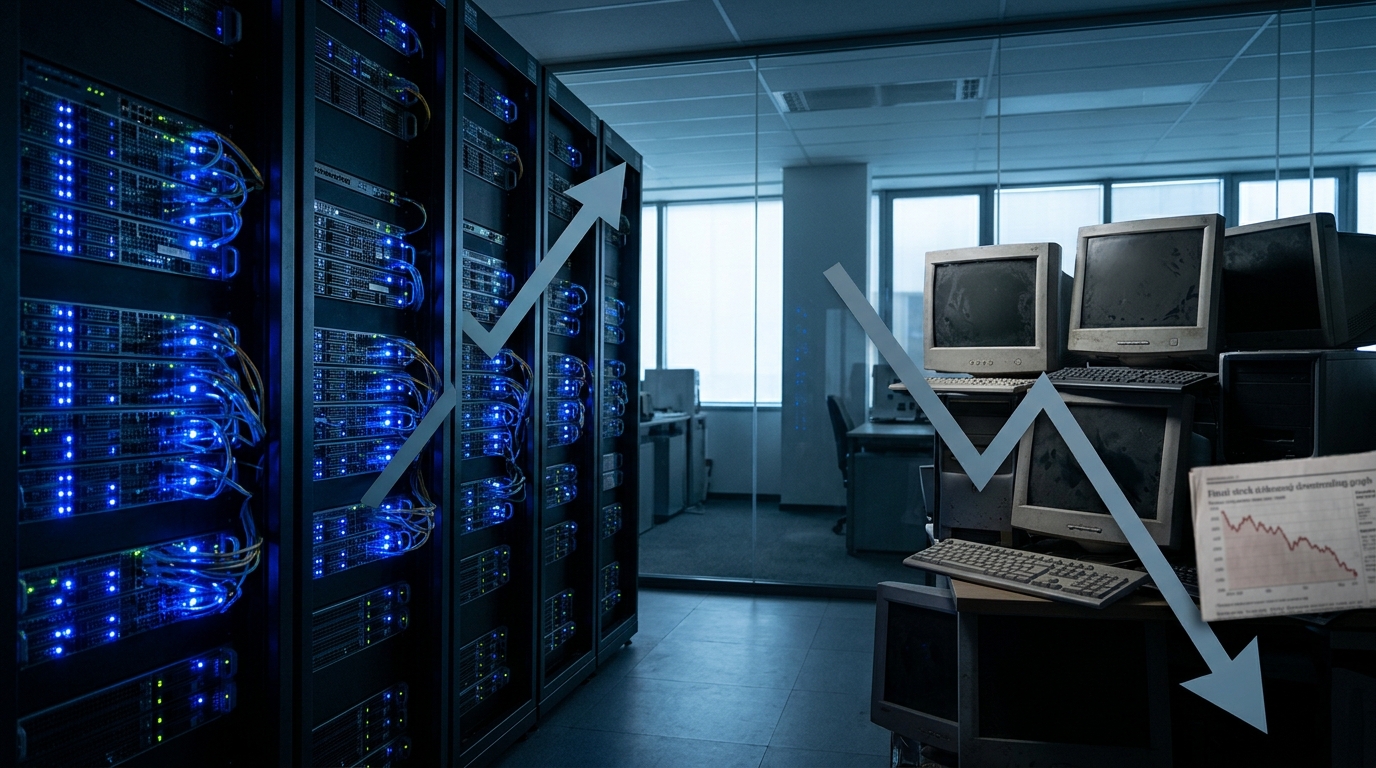
Intel’s Data Center and AI segment generated $7.3 billion in Q3, up 78% year over year. Demand was broad-based across hyperscale, enterprise, and Neo Cloud customers. Then there is Client Computing. The Client Computing and Physical AI Group (CCPG) recorded $8.1 billion, down 5% year over year. It is down sequentially and is the segment driving the guidance reset.
Why Wall Street Is Paying Attention
Intel guided Q4 revenue to $15 billion to $16 billion, below analyst expectations of about $17.08 billion, with the midpoint implying a shortfall of about 9%. Adjusted earnings are expected to reach $0.25 per share, compared with consensus of $0.44. Adjusted gross margin expanded to 44.1% in Q3 from 40% a year earlier, but the company expects the metric to decline to 38% in Q4.
Three factors explain the cut. First, the PC unit market is expected to decline roughly 12% in 2026, with the second half down more than 20%. Management said it does not expect a sustained recovery until memory availability improves and pricing normalizes, and it said it is not expecting that during 2027. Second, an incident and extended shutdown at Intel’s Israel factory (Fab 28) is expected to reduce Q4 revenue by roughly $300 million and pressure gross margin by about 200 basis points, based on the company’s early assessment. Third, elevated memory prices are constraining PC builds industry-wide.
The memory constraint Intel cited is not unique to its supply chain. Samsung and SK hynix face the same pricing dynamic, and whether they expand capacity fast enough will determine when that constraint lifts.
What Is Driving the Opportunity
Intel Foundry revenue reached $6.7 billion in Q3, up 16% sequentially. Capital expenditure for 2026 remains a major swing factor, and management has also said 2027 CapEx is expected to rise sharply. If the data center side continues to compound while the PC drag proves cyclical, the stock’s current level prices in permanent impairment rather than a trough. The company has described 2027 as an investment year and has cautioned that positive free cash flow may not happen in that period as it funds node ramps, including 14A, which means the data center trajectory carries most of the weight.
The foundry ramp Intel is funding depends on a manufacturing ecosystem where capacity constraints are already visible. TSMC’s monthly revenue data shows how tightly AI chip demand is tracking against available advanced-node supply.
What Could Go Wrong
Intel’s PC-market outlook calls for a decline of roughly 12% in 2026 and another roughly 10% in 2027. If AI PC adoption does not offset the box-count decline, Q1 2027 guidance could reset the stock again. Near-term challenges also include an industry-wide advanced substrate constraint that could limit Intel’s ability to capture server CPU demand even as PC sentiment eventually recovers.
The Bottom Line
A 23% decline reflects the severity of the guidance cut, not a business that is shrinking. Data center revenue surged year over year. The question is whether that growth rate is durable enough to carry the company through two or three more quarters of client weakness. Around $72 to $73, the market is betting it is not. That may be the right call, or it may be the kind of overreaction that creates the entry point Intel bulls have been waiting for.