
October 29, 2026
Bonus Content: Prediction Markets Are Booming. They Won’t Replace Stocks.
Quick reminder.
Your free copy of The 0DTE Game Plan is still sitting there, ready to download.
But the link won’t work forever.

Once it expires, the report goes back to $29.97 on our website.
So do yourself a favor and download it right now. Save it to your computer, and it’s yours to keep no matter what it costs later.
It takes about 10 seconds.
Inside, you’ll find the simple 3-step plan for trading same-day options like a business: Plan it. Profit from it. Protect it.
Make sense?
Click here to download The 0DTE Game Plan before your link expires.
Good Trading,
Bill Poulos
p.s. Free today, $29.97 once this link is gone. Grab your copy here.
Prediction Markets Are Booming. They Won’t Replace Stocks.
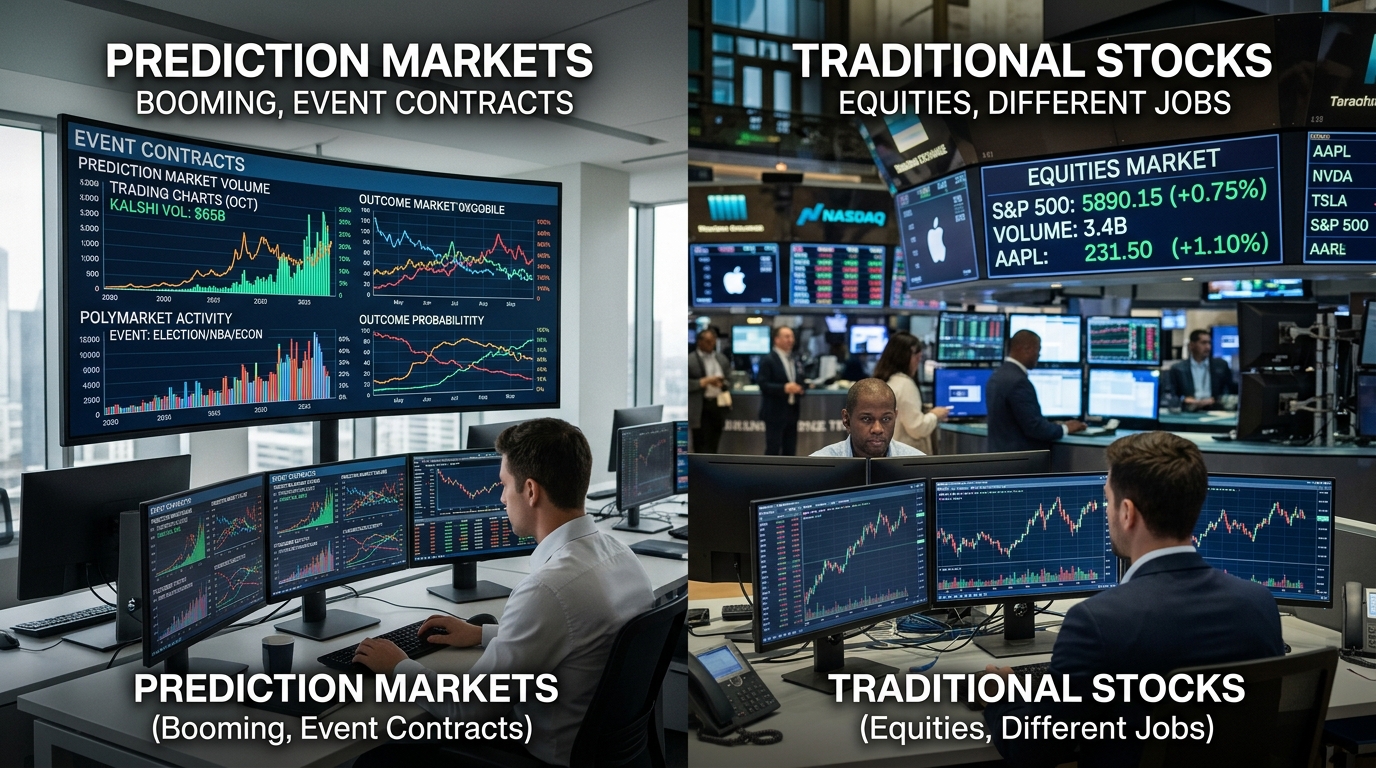
Kalshi just logged roughly $65 billion in trading volume for October alone. Polymarket’s share of the regulated U.S. market has fallen from 96% to roughly 27% in two years, not because it is shrinking in absolute terms but because Kalshi’s growth has been that relentless. Bernstein estimates prediction market volumes will reach $1 trillion annually by 2030. The NBA has signed partnership deals with both platforms. The question worth asking is not whether prediction markets are real. They obviously are. The question is whether they are becoming the future of trading, or a very fast-growing adjacent category that serves a different purpose entirely.
The distinction matters more than most coverage suggests.
Prediction market platforms are now actively recruiting equity traders. Kalshi and its competitors are rolling out contracts tied to stock indices, corporate earnings, and industry performance, pitching what one analyst called “equity binaries” – yes-or-no wagers on whether a company meets quarterly targets or its stock crosses a specific level by a given date. Robinhood now lets users trade financial event contracts on the same screen where they hold stock positions. The convergence looks deliberate.
But a prediction contract and a share of stock are structurally different instruments. A stock is a claim on ownership. A prediction contract is a claim on the truth of a future statement. When you buy Apple shares, you hold a fractional interest in a business with ongoing earnings power and retained assets. When you buy a contract on whether Apple beats its next earnings estimate, you hold a position that resolves to zero or one and disappears. Clients accustomed to equities often lack a framework for a position that forces total binary resolution instead of the gradual pricing changes familiar from stocks, as one advisor put it in April.
That binary structure is genuinely useful for expressing a specific macro view, whether the Fed cuts, whether CPI comes in above a target, in ways equities cannot replicate cleanly. These are views that neither equities nor futures express cleanly. The capital efficiency of bounded contracts is real. So is the transparency of a market price that must converge to zero or one.
The problems are also real. The CFTC issued an enforcement advisory on February 25, 2026 after two cases involving misuse of nonpublic information and fraud on KalshiEX, and the U.S. Senate voted on April 30, 2026 to ban its members from trading on prediction markets amid insider trading concerns. Volume scrutiny has grown: Kalshi’s push into perpetual futures has attracted heightened attention from regulators and market-structure critics, and unusual low-odds activity on Polymarket’s international sports contracts has also drawn scrutiny this fall. Neither platform concedes wash trading occurs. Baltimore became the first U.S. municipality to sue both platforms in August.
The regulatory pressure on both platforms is not static. The CFTC’s October rulemaking to fold event contracts into the swap definition could reshape which platforms survive federal oversight.
The more honest framing is this. Prediction markets are not replacing equities. They are colonizing the space between equities and sports betting, building a category that did not meaningfully exist five years ago. Growth rates rival the AI boom, according to Bank of America. That growth, though, is still largely driven by sports contracts. The equity trader crossover is an aspiration with real product momentum behind it, not yet a structural shift. Investors who treat the two as interchangeable are confusing speed with substitution.