
October 9, 2026
Bonus Content: Amazon Reports Oct. 29. AWS Is the Only Number That Matters.
Below is an important message from one of our highly valued sponsors. Please read it carefully as they have some special information to share with you.
Dear reader,
James Altucher here with an urgent message…
A few weeks ago, someone I follow closely for market intel did something a little crazy.
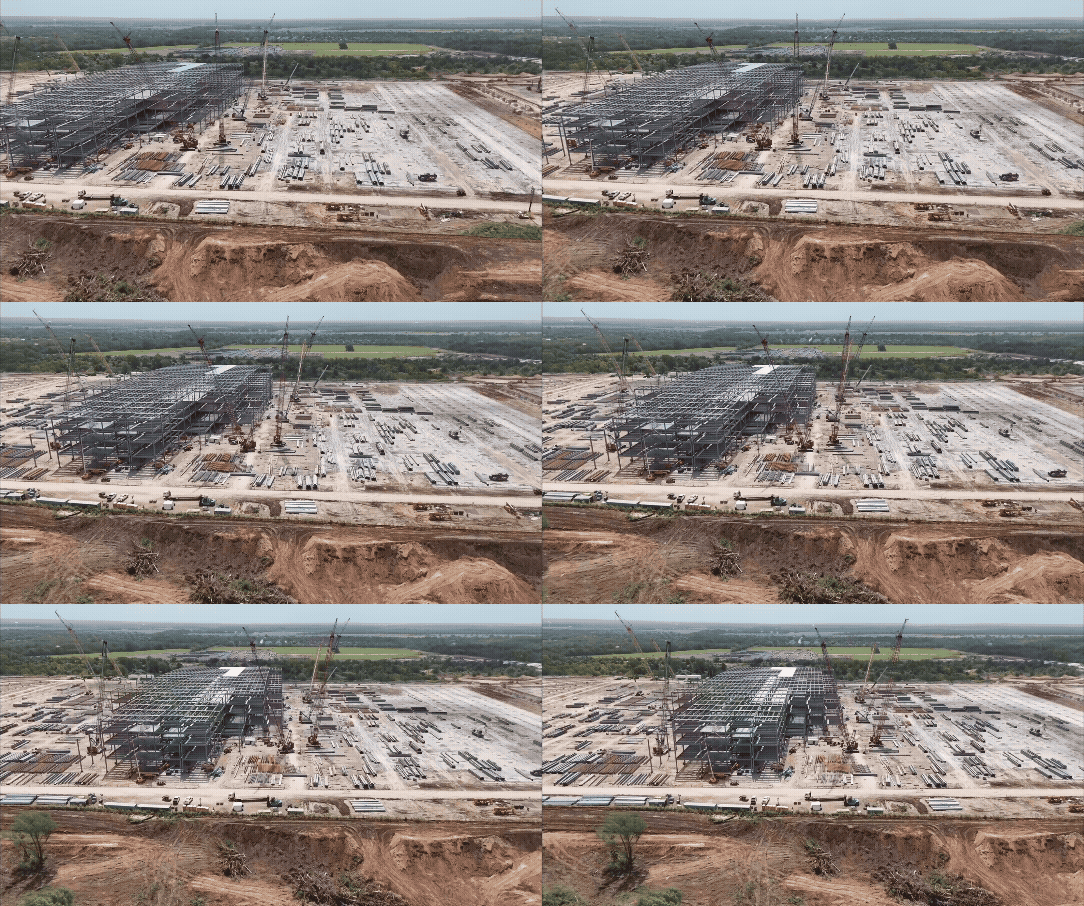
They drove out to one of Elon Musk’s secure production facilities, still under construction, and launched a drone over it.
I don’t even know if it was legal, but I know why they took the risk…
Elon is building something inside that factory that’s likely to send a shockwave through the economy.
The footage they released is nothing short of confirmation of a story I’ve been chasing for months…
You see, earlier this year Elon said he is clearing electric-car production out of Tesla’s main factory to build something else in its place. Something he calls an “infinite money glitch.”
Elon predicts it will be the biggest product in the history of the world. And I expect it to enter production in the coming days.
I have spent almost forty years at the center of the technology world, and I am telling you, this is the most important thing I have ever covered.
I put the whole story, along with the footage captured, into a short presentation.
Watch it now, before that factory turns on and the crowd comes rushing in.
>>> Watch the presentation here.
Regards,
James Altucher
Amazon Reports Oct. 29. AWS Is the Only Number That Matters.

Why This Stock Now
Amazon reports third-quarter results on October 29, and the calculation is simpler than it looks. The stock has returned about 13% over the past twelve months, underperforming the S&P 500 by roughly two percentage points. The reason is straightforward: $220 billion in capital spending this year, heavily focused on AI data centers and other technology infrastructure, has weighed on free cash flow and made some investors uncomfortable. The business underneath that spending is accelerating in a way the stock price has not yet reflected.
The Business
Amazon Web Services contributes the majority of Amazon’s operating income and is the most consequential cloud platform in the AI era. OpenAI has committed $38 billion to AWS for compute, and the agreement was later expanded by $100 billion over eight years. Anthropic, in which Amazon holds a substantial stake, has committed more than $100 billion over the next ten years. Those are not ordinary vendor relationships. They are demand anchors that extend well into the next decade.
Beyond cloud, Amazon’s advertising segment compounds at double-digit rates and would rank among the top U.S. media businesses on its own. North America retail operating margins are expanding. In Q2, revenue rose 20% but operating income climbed 43% to $27.5 billion, a gap that reflects genuine operating leverage taking hold.
Why Wall Street Is Paying Attention
AWS revenue grew 36.7% year over year in Q2, its fastest pace in 18 quarters. That figure has analysts asking a specific question ahead of October 29: can AWS growth reach 43% to 45% in Q3, well above the 38% built into current consensus? BNP Paribas analyst Nick Jones, who rates Amazon Outperform with a $355 price target, says that higher range is what investors are looking for, not the base case. Operating income for Q3 is guided at $22.5 to $26.5 billion, against a consensus near $25.9 billion.
Andy Jassy said on the Q2 call that AWS is booming. He also noted the company still cannot meet all the demand it has in 2026, and that he believes the same constraint will apply in 2027. The backlog stood at $496 billion as of that call.
What’s Driving the Opportunity
Amazon raised its 2026 capital spending guidance to $220 billion, up from about $200 billion at the start of the year, with the increase attributed to higher memory costs and rising AI demand. Q3 revenue guidance is $197 billion to $202 billion, up from $180 billion a year earlier. The stock trades at roughly 21x earnings, near the low end of its historical range for a company building AWS’s operating margins. AWS earned $16.6 billion of Amazon’s total $27.5 billion in Q2 operating income, from a segment that barely existed fifteen years ago.
What Could Go Wrong
Trailing free cash flow was negative $7.6 billion in Q2 after a surge in property and equipment spending. If AWS growth disappoints, or if management raises capex again above $220 billion, the market will not be patient. Prime Day timing shifts and foreign exchange headwinds are expected to reduce Q3 year-over-year growth below Q2’s pace on a reported basis, which could obscure underlying momentum. Competition from Azure and Google Cloud continues to intensify, particularly in AI inference pricing.
The Bottom Line
Amazon enters October 29 with the strongest cloud demand signal in its history, a backlog of $496 billion, and a stock that has lagged the S&P 500 for a year. The $220 billion capex load is not small. Neither is the contracted demand behind it. The question in three weeks is whether AWS growth at 43% or above makes the case that spending is returning value faster than investors feared. If it does, the underperformance of the past year is likely to reverse in a single afternoon.