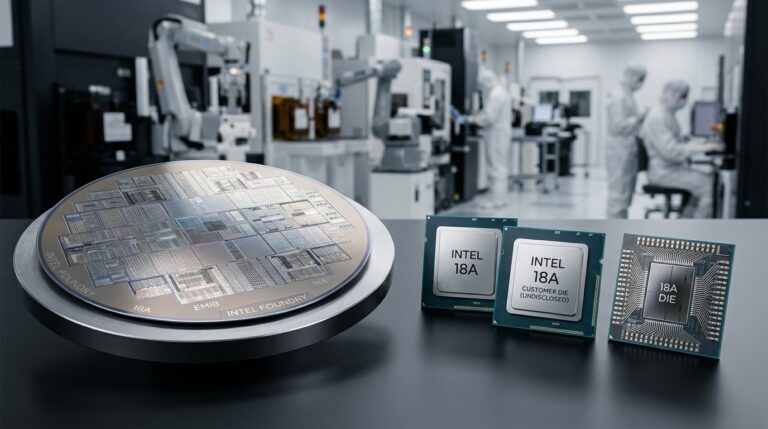
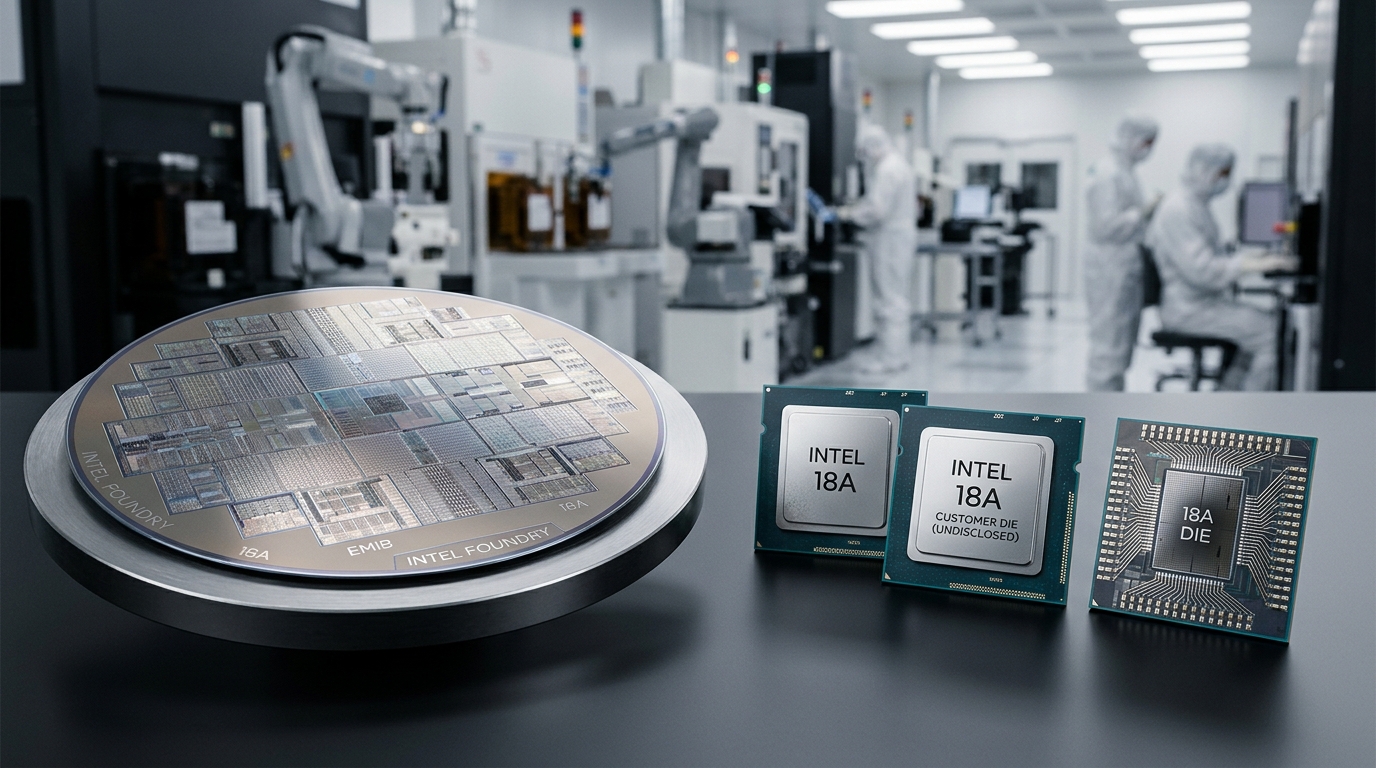
For two years, Intel’s foundry ambitions lived entirely in management slides and investor calls. Wednesday changed that. At the TomorrowX Summit in Austin, CEO Lip-Bu Tan said Intel has signed its first external customer for its 18A-series process. The customer’s identity remains undisclosed, but Intel’s Chief Technology Officer Pushkar Ranade later clarified that the customer signed up for the company’s 18A-P manufacturing process node, which Intel has said entered risk production in June 2026.
18A-P is an enhanced version of Intel’s 18A that Intel positions for foundry customers, with higher performance and enhanced thermal characteristics. That matters because Intel spent much of 2026 debating internally whether the base 18A node was even suited for outside work. The customer going to 18A-P rather than base 18A suggests the foundry-optimized variant is what actually moved the deal.
The yield number Tan dropped at the same summit is the part worth pausing on. Tan put Intel’s 18A yield at 70% at the TomorrowX Summit on November 18, 2026, as reported by attendees. When Tan took the helm on March 18, 2025, 18A yields were described as “horrible.” Going from that to 70% in roughly 20 months is the kind of execution signal that moves a process node from credible pitch to real product line. For potential customers, the 70% figure may be no less significant than signing the first customer itself.
Why Wall Street Is Paying Attention
Intel shares were up about 4% in premarket trading Thursday. The stock had closed Wednesday at $54.67, down more than 60% from its June high of $142.35, so the premarket bounce signals that this news is being read as a turning point rather than noise.
The Microsoft announcement arrived separately but on the same day. Intel announced that Microsoft became Intel’s first publicly named customer to use Intel Foundry’s Embedded Multi-die Interconnect Bridge (EMIB) advanced packaging technology for Azure first-party silicon. Intel also said the long-term agreement confirms multi-year Intel Xeon supply capacity for Azure, including instances of next-generation server CPUs codenamed Diamond Rapids. Intel Foundry General Manager Naga Chandrasekaran emphasized that EMIB could help scale future Azure infrastructure through the co-optimization of silicon, packaging, compute, memory and software.
Microsoft’s willingness to commit Azure silicon to a new packaging partner is not a surprise in isolation. Microsoft is the sole hyperscaler forecast to stay free cash flow positive through 2027, giving it the balance-sheet flexibility to lock in multi-year supply agreements that cash-burning peers cannot easily match.
The timing of both announcements is not accidental. Advanced-packaging allocation, not wafer starts, is a binding constraint on AI hardware in 2026, and TSMC’s CEO said on its July earnings call that packaging capacity is “so tight that now it’s limiting my customers’ growth.” Hyperscalers building custom silicon need somewhere to go. Intel just handed one of them a named alternative.
What’s Driving the Opportunity
The 18A win and the EMIB deal are structurally different but reinforce the same thesis. The 18A customer is proof that Intel’s most advanced process node can attract outside work on its own commercial merits. The Microsoft EMIB deal is proof that Intel’s packaging capability, long considered a key technical advantage, can convert into real revenue from a tier-1 cloud customer.
In one day, Intel’s foundry got a named packaging customer in Microsoft, an unnamed first outside 18A customer, and a 70% yield figure, with 14A products targeted for 2027 and outside 14A customers expected later. That roadmap cadence is what changes the investment case from “hope” to “sequence.”
Intel reported third-quarter revenue of $16.5 billion, up 21% year over year and above its $16.3 billion guidance midpoint. The foundry wins don’t show up in Q3 numbers, but they shape the revenue line management is building toward.
The Q3 beat itself carried a shadow that the foundry wins do not erase. Intel’s PC segment guided to a mid-20% decline in Q4, and a factory incident added a second pressure point the headline numbers never captured.
What Could Go Wrong
One outside 18A-P customer is not a pipeline. Whether Intel can improve its operating performance will still depend on subsequent execution of mass production and order expansion. The unnamed customer could be a small or one-off engagement rather than the high-volume anchor deal that makes the foundry economics work.
The stock’s own chart is a warning. Over the past month, INTC has fallen sharply. Intel expects December quarter revenue of $15.5 billion at the midpoint, up 13% year over year but short of FactSet consensus estimates of $17.3 billion. A foundry catalyst running against a guidance miss is a split verdict. And the shareholder lawsuit reported this month naming CEO Tan and CFO David Zinsner adds legal overhead to an already demanding turnaround execution.
The Bottom Line
Intel is not fixed. But Wednesday was the first day the foundry argument had receipts. A signed 18A-P customer, 70% yields on a node that looked broken 20 months ago, and Microsoft committing Azure silicon to EMIB packaging: each of those alone would have been a press release. All three landing on the same day, against a backdrop of constrained TSMC packaging capacity, is what makes INTC the strongest turnaround candidate worth serious attention right now. The case for buying into this recovery has never had more concrete evidence behind it. The case for caution is real too, which is exactly what makes the risk-reward worth sizing carefully rather than ignoring.