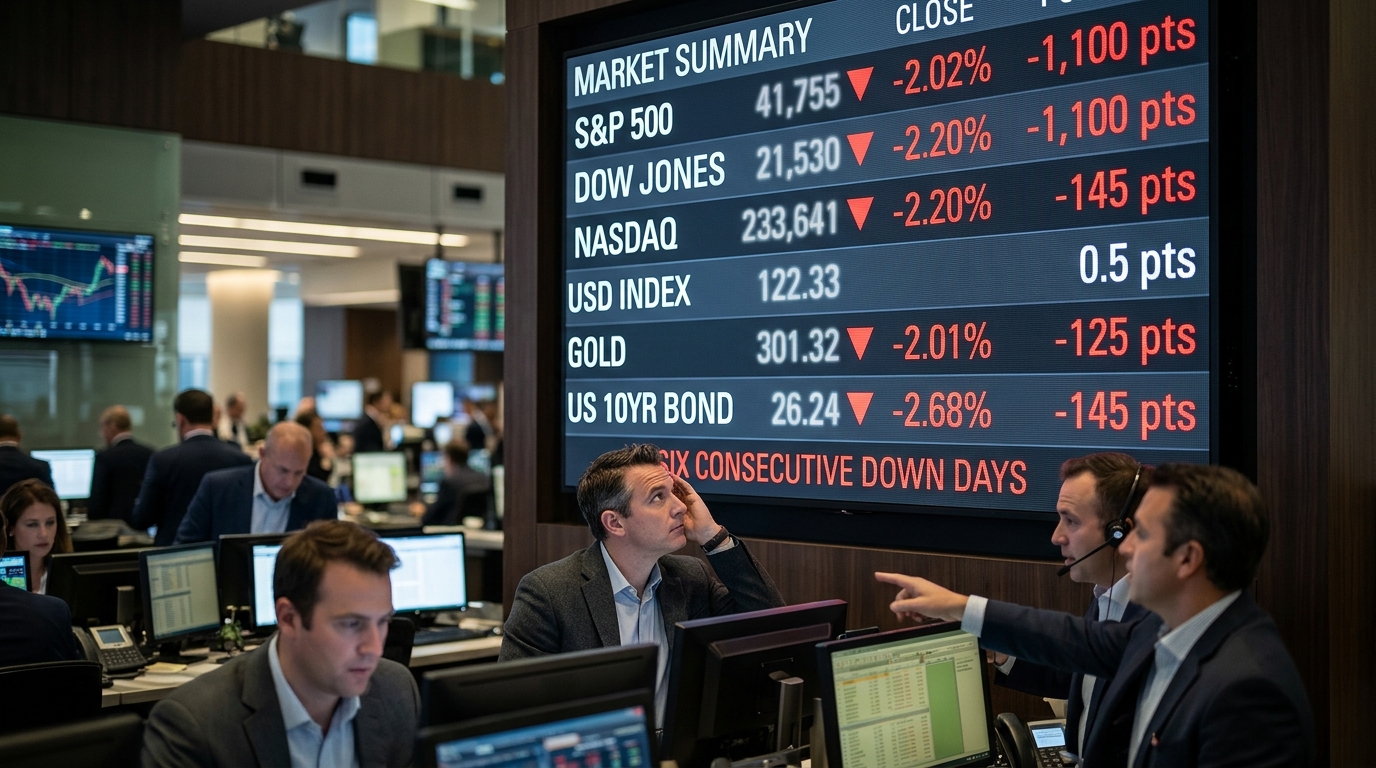
Thursday ended badly enough to feel historic. The S&P 500 closed at 7,175.83, down 2.02% for a sixth straight losing session. The Dow closed at 49,097.06, down 1,101.11 points. The Nasdaq closed at 23,879.20, down 2.25%, enough to tip it into correction territory.
Before drawing conclusions, read the whole scoreboard.
What Actually Moved
The losses were widespread: more than 90% of the stocks that make up the S&P 500 fell. That is breadth, not noise. The VIX jumped nearly 16% to 28.44, its highest reading since March. The AI complex led the damage. Nvidia fell 3.30% after erasing an early gain of 4.7%. Broadcom declined 2.58% and Micron fell 3.97%. AMD sank 7.72% after Hunterbrook disclosed a short position and alleged China exposure, which AMD said misrepresents its business.
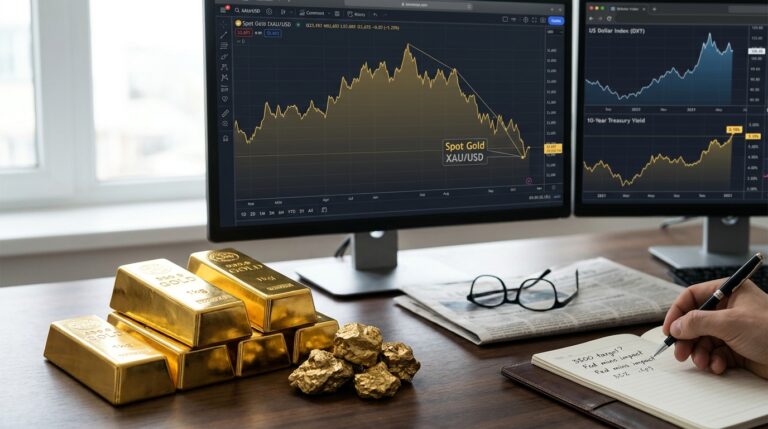
What made Thursday different from a normal tech selloff was what happened everywhere else. Treasuries rallied: the 10-year yield eased to 5.04%, the 2-year to 4.76%. The dollar held firm. Gold slid 1.8% to near $3,660, a 14-month low.
Why It Happened
The official explanation is that enthusiasm for the AI trade is cracking. The U.S. stock market tumbled again as beaten-down stocks tied to artificial intelligence kept falling on worries their breathtaking boom may be over.
The market has become more cautious on AI, with investors focusing on whether heavy spending on the buildout will translate into meaningful profits. Nvidia has dropped sharply this month amid leadership turmoil after CEO Jensen Huang resigned.
There was also economic data that deserved more attention than it received. Factory activity in the Philadelphia area expanded at a slower pace in November while employment showed strength and prices received rose at the fastest pace in more than four years. The Philadelphia Fed manufacturing index fell to 6.3, off more than 14 points from October. The employment index rose to 11.6, while prices paid jumped to 58.2, and prices received surged to 47, the highest since June 2022. Slower activity alongside sharper prices is a stagflationary signal, however mild. The Federal Reserve is already leaning toward another hike. Stubborn inflation has pushed markets to price in a December Fed rate hike and the risk of further tightening into 2027.
What the Market May Be Missing
The Treasury rally looks like signal. When equities fall and bonds rally, investors are reassessing risk, not just selling one crowded trade. But gold fell alongside stocks Thursday afternoon, which complicates the story. Gold falling with stocks can hint that some investors sold it to raise cash. Forced liquidation across assets is a different animal than a rotation out of tech.
Equity volatility has blown out, with the VIX up 15.8% to 28.44, while currency volatility has barely moved, a sign that the selling has been driven by tech rather than by broad cross-asset stress. That is worth holding onto. A currency market this calm does not look like a systemic unwind. It looks like a sector repricing that has grown large enough to drag the indexes with it.
Where It Shows Up
The epicenter is semiconductor and AI infrastructure stocks. Nvidia, Broadcom, and Micron are the most direct expressions of the trade. Second-order casualties include cloud names: Alphabet fell 3.46% and Amazon fell 3.87% despite being major Anthropic investors. Both are spending heavily on AI infrastructure and are now being marked down on the same doubt that is hitting the chip stocks.
Risks and Counterpoints
The bear case is straightforward. In the Federal Reserve’s October meeting minutes, participants discussed risks tied to AI investment, including the possibility that returns disappoint. Six straight losses, a Nasdaq already in correction, and the S&P 500 and Nasdaq each down about 5% for the week suggest this is not a one-day event.
The bull case rests on how contained the damage looks outside equities. Currency markets are calm. Treasury yields are falling, not spiking. Deutsche Bank strategist Binky Chadha has called the market “very oversold,” noting that growth and earnings remain strong. The S&P 500 is 8.2% from its October record. That is uncomfortable but not a bear market.
What to Watch Next
Friday’s open matters. U.S. index futures pointed lower ahead of the opening bell. A seventh consecutive loss in U.S. equities would be the longest streak since before the 2024 rate-cut cycle began. Watch whether Treasury yields continue lower as stocks fall. If they do, that is a genuine flight to safety. If yields start rising with equities, the stagflation read gains weight and the December Fed meeting becomes the dominant variable. The Dow sits roughly 183 points from correction territory. Whether it crosses that line is less important than what the bond market does when it gets there.