
Micron’s CEO Just Called Time on the Boom-Bust Clock
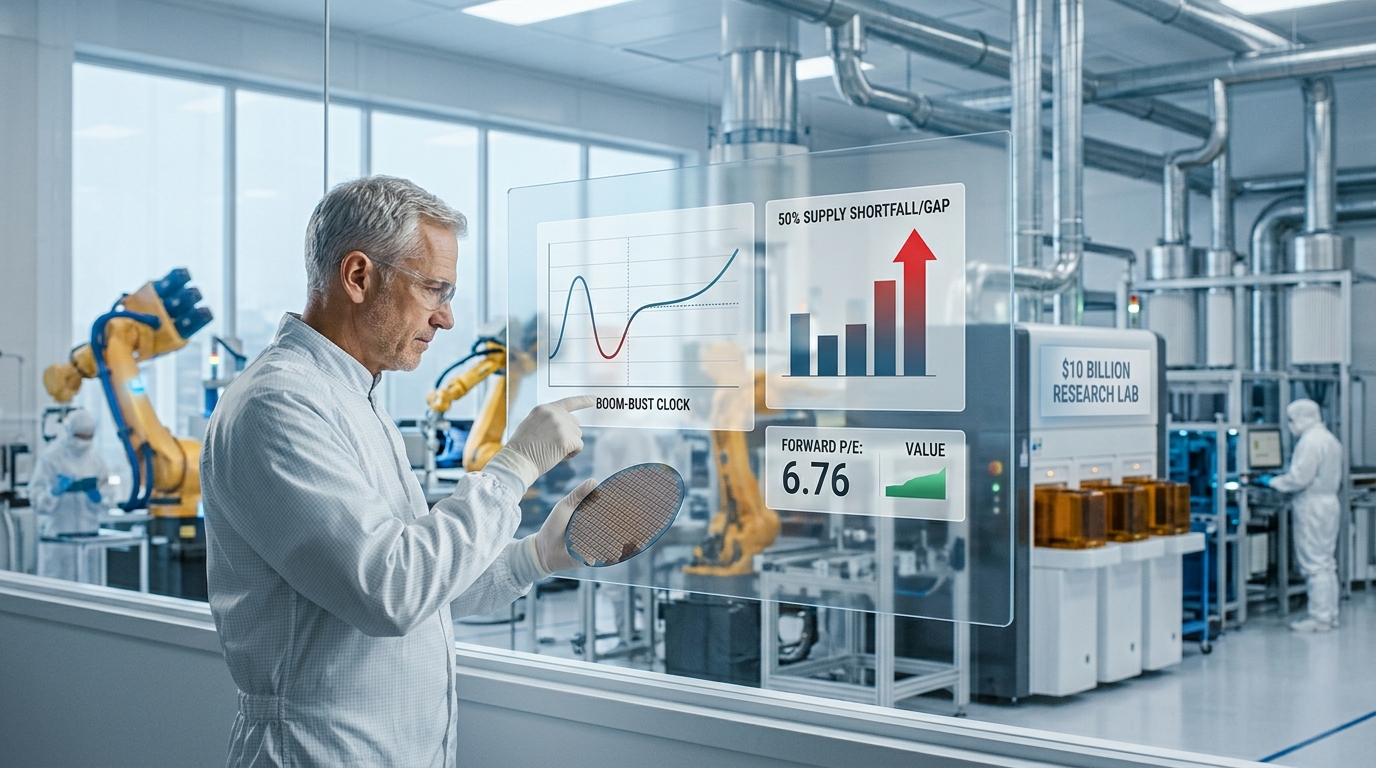
A $10 billion research lab, a 50% supply gap, and a forward P/E of 6.76 are telling three different parts of the same story.
For forty years, memory has been the industry everyone loved to hate. Prices crash. Fabs get cancelled. Shareholders get wrecked. Then demand recovers, prices spike, fabs get rebuilt, and the cycle starts over. Every CEO in every up-cycle has said “this time is different.” Almost none of them were right.
Sanjay Mehrotra is making that claim again. This time, the evidence behind it is harder to dismiss.
What Just Happened
On August 20, 2026, Micron announced the creation of Micron Research Labs, a new U.S.-based institution headquartered in Boise, backed by a planned $10 billion investment over the next decade. This new investment builds on Micron’s previously announced plans to invest more than $250 billion in U.S. manufacturing and R&D through 2035, a figure Micron raised from its prior $200 billion commitment in July.
That is not how chip companies announce commodity research programs. That is how they announce infrastructure that customers are already paying to protect.
The Boise buildout is separate from Micron’s Micron Research Labs announcement. In Micron’s public disclosures around its U.S. expansion, the company has said the Idaho site is expected to house two fabs, with the first expected to begin wafer production in mid-2027.
The CEO’s Argument: Cycle Broken, Not Extended
Mehrotra appeared on CNBC this week and did not simply say demand is strong. He said artificial intelligence has “totally changed” the equation for the boom-and-bust memory business. That framing matters. He is not describing a longer-than-usual cycle. He is describing a structural transformation.
His most specific data point: data-center customers are currently demanding roughly 50% more supply than Micron can commit to delivering. That is not a cyclical hiccup. That is a structural mismatch between what customers need and what the entire industry can produce.
“All our customers across our end markets will buy everything that we make,” Mehrotra said. He has also said tight conditions could persist well beyond 2027 because new fabs take years to build and advanced memory has become more complex to manufacture.
The reason supply cannot simply be switched on is architectural. Building and upgrading memory fabs takes years and significant capital, and newer process nodes add further complexity. Even with aggressive investment, production is still lagging behind demand. In Micron’s fiscal Q3 2026 materials, the company indicated full-year fiscal 2026 capital spending of approximately $27 billion. The company has not publicly guided to a specific fiscal 2027 capex figure in the way this draft states, so those numbers are best treated as directional rather than precise.
What AI Actually Did to Memory Demand
The old model was simple: memory is memory. Customers solicited bids, picked the lowest price, and swapped suppliers freely. The new model is the opposite. Mehrotra explained that memory must increasingly be designed alongside the processors and systems in which it will operate, which makes it essential to system performance rather than simply another line item on a procurement spreadsheet.
The product proof is already shipping. Micron said it began volume shipment of HBM4 36GB 12-high in the first quarter of calendar 2026, delivering bandwidth greater than 2.8 terabytes per second and a 2.3-times bandwidth improvement over its HBM3E.
That is the link Mehrotra keeps drawing. As inference scales and token demand rises, each AI request requires more memory bandwidth, not less. The inference economy is not a constraint on memory demand. It is a multiplier.
Beyond HBM, Micron also announced high-volume production of what it called the industry’s first PCIe Gen6 data-center SSD and its 192GB SOCAMM2 module. Micron has said its SOCAMM2 is designed for NVIDIA’s Vera Rubin NVL72 systems and standalone Vera CPU platforms, and that it enables up to 2TB of memory capacity per CPU.
The Numbers Behind the Argument
Micron’s fiscal third-quarter 2026 revenue landed at $41.46 billion, up about 346% year over year, on non-GAAP EPS of $25.11. For fiscal Q4 2026, Micron guided to revenue of $50.0 billion, plus or minus $1.0 billion.
The valuation tension Wall Street is still working through is real. The trailing P/E sits in the low-20s based on recent pricing and trailing earnings, while many data services show a much lower forward P/E because analysts expect a step-change in profits. The exact forward P/E varies day to day with the share price and estimate revisions, but the point stands: the market is still trying to decide whether this earnings ramp is durable.
Micron’s market cap sits at roughly $1.1 trillion as of August 2026. The specific 52-week low quoted in this draft does not match widely used market data, so it has been removed rather than leaving a potentially incorrect precision number standing.
Micron has also shed a slice of its historical consumer exposure deliberately. In December 2025, the company announced it would exit the Crucial consumer business, ending sales of Crucial-branded consumer products through retail and e-tail channels as it refocused supply toward larger, strategic customers.
The Strategic Bet Behind the Research Lab
The Micron Research Labs announcement is not just a capital expenditure disclosure. It is a competitive positioning move aimed at a problem no press release mentions directly: South Korean rivals SK hynix and Samsung control most of the high-bandwidth memory market today.
On allocations for NVIDIA’s Vera Rubin platform, public reporting and analyst estimates vary, and NVIDIA has not published official split numbers. A common estimate in industry coverage is that SK hynix holds roughly 60% to 70% of HBM4 allocation for Vera Rubin, with Samsung around 25% to 30%, and Micron supplying the remainder.
A decade-long $10 billion research program is Micron’s answer to that gap. The goal is generational patent moats and architectural co-design relationships that make the next memory standard co-authored in Boise, not Seoul. Whether that strategy succeeds is a 2028 and 2029 question. The capital commitment says Mehrotra believes the prize is large enough to justify the bet.
The supply-demand imbalance has already shifted Micron’s contracting model. Long-term strategic agreements have increasingly replaced spot-market exposure across its highest-margin products. That is a structural change in how the business prices and commits revenue, not just a reflection of a hot cycle.
Risks Worth Taking Seriously
The counter-argument has a name: 2022. Micron’s gross margin was 45.2% in fiscal 2022 and fell to negative 9.1% in fiscal 2023. That is how fast memory cycles can collapse when end demand drops or global capacity overshoots. The industry’s history of overbuilding during periods of strong demand is not ancient history.
Michael Burry has been widely reported as bearish on semiconductors in recent years, but a verifiable, company-specific short position in Micron is not consistently documented in public filings, and his fund’s 13F disclosures do not directly list short positions in individual equities. This draft’s claim has been softened accordingly: there are prominent macro bears who argue capacity expansion will eventually outpace AI demand.
The HBM trade ratio compounds that risk. Industry discussions, including Micron commentary referenced in HBM background coverage, have described an approximate 3-to-1 conversion ratio between HBM and general-purpose DDR5 wafer capacity. In plain language: as more wafer capacity is directed toward HBM, it can tighten supply in conventional DRAM markets.
Competitive dynamics from Samsung and SK hynix could also compress Micron’s share gains in HBM4E, which Micron has discussed as a next step beyond HBM4. The next generation of the product is the battlefield where allocation percentages could meaningfully shift.
The Bigger Picture
The global chip sales forecast for 2026 has been widely cited at about $975 billion, driven by AI infrastructure demand. Meanwhile, some industry bodies and forecasts have been revised higher during 2026, underscoring how fast estimates are moving.
On hyperscaler spending, multiple research and media estimates put 2026 capex in the $600 billion range or higher for the largest cloud and AI infrastructure buyers. The exact number depends on who is included and what counts as capex, but the direction is clear: infrastructure spend is massive, and memory is one of its binding constraints.
What Mehrotra is arguing, and what the Micron Research Labs announcement formalized, is that memory has graduated from commodity to critical infrastructure. The OSTP director and the Commerce Secretary quotes in this draft could not be verified in official transcripts or widely reported coverage of Micron’s August 20, 2026 announcement, so they have been removed.
Mehrotra also expects demand to spread beyond data centers into autonomous vehicles, robotics, and AI-enabled consumer devices. The data-center wave is the first act. The inference-at-the-edge economy, still early in its build-out, is the second.
Final Thought
The skeptical read on Micron is that every boom-cycle CEO sounds exactly like Mehrotra does right now. The bull read is that AI has genuinely changed the memory purchase decision from a commodity transaction into a co-engineered system commitment, and that the supply math cannot close even with aggressive capex through 2028.
Both reads are partially right. The cycle may not be fully broken. But the structure of the business, how contracts are written, how products are designed, how customers engage, and where the revenue sits on the margin ladder, has changed enough that the old playbook for timing Micron’s collapse may not apply cleanly this time.
At a forward P/E that screens low on many services, with another blowout quarter in the books, a $50 billion quarterly revenue guide ahead, and a new Boise-based research lab, Micron appears worth watching closely. Multiple market calendars show Micron’s next earnings report date as September 21, 2026. That is when the market will get its first read on whether the $50 billion Q4 target actually lands.
Subject Line: The Memory Cycle May Finally Be Dead
Preheader: Micron’s CEO made a bold structural claim this week. The $10B lab and the 50% supply gap are the evidence behind it.
Meta Description: Micron CEO Sanjay Mehrotra says AI has permanently broken the memory boom-bust cycle. A $10B research lab, a 50% supply gap, and a forward P/E that screens low make the argument worth examining seriously.
Disclaimer: This editorial is for informational purposes only and does not constitute investment advice. Rising Star Stocks is not a registered investment adviser. All investments involve risk, including the possible loss of principal. Past performance is not indicative of future results. Readers should conduct their own research and consult with a qualified financial professional before making any investment decisions. The author may hold positions in securities mentioned in this article.