
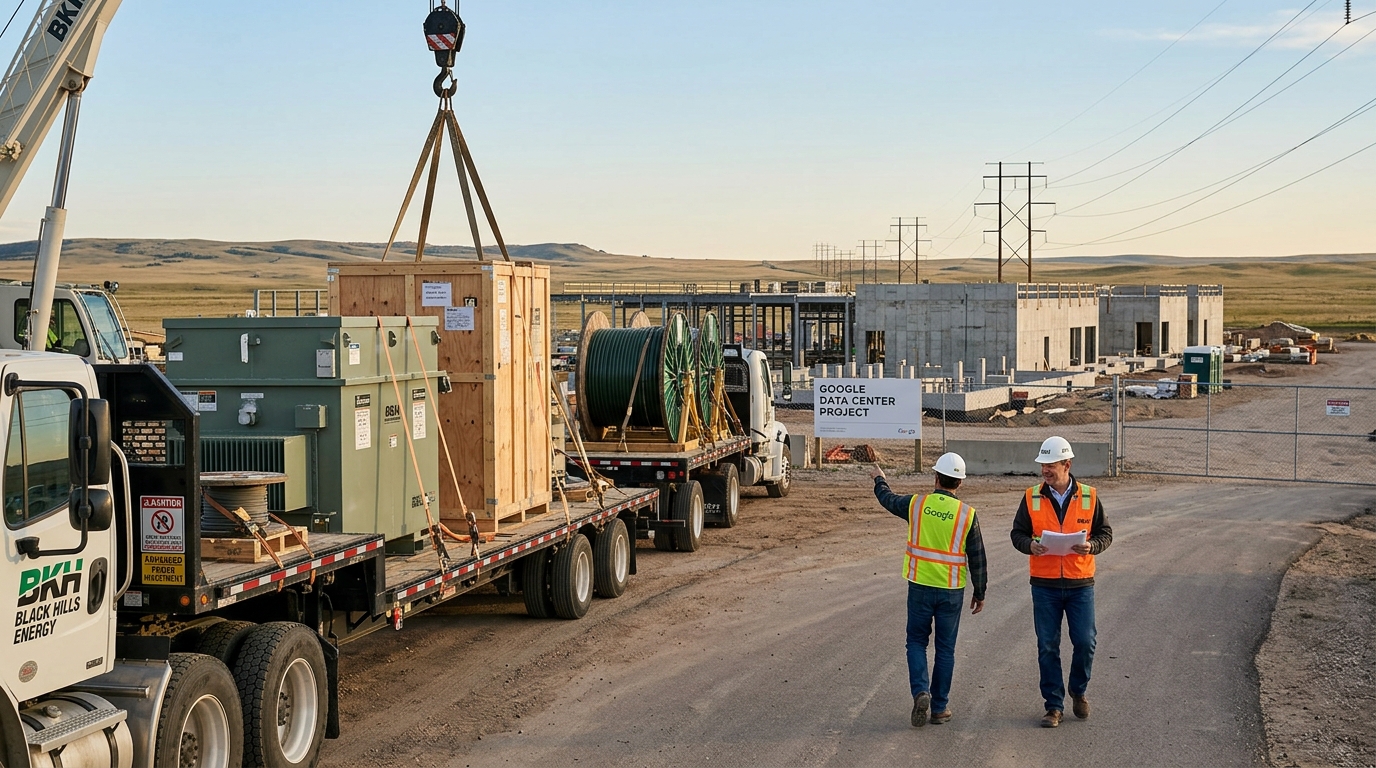
Something structurally different is happening in the utility sector, and Black Hills Corporation (NYSE: BKH) is sitting at the center of it. On October 6, Black Hills announced it had signed definitive agreements effective September 30, 2026, with terms running through 2048, to serve a planned Google data center to be constructed in Cheyenne, Wyoming. The plant does not yet exist. Google wrote the check anyway.
The Business
Black Hills is a regulated multi-utility serving electricity and natural gas customers across eight states, headquartered in Rapid City, South Dakota. It is not a household name on Wall Street. That anonymity is, at this moment, a pricing opportunity.
The project will draw on a total resource mix of 2.7 GW, including reserve margins. Black Hills will provide up to 590 MW of grid-connected energy service through company-owned generation and market energy, and will manage the output of approximately 2.1 GW of Wyoming-based, third-party contracted resources through a privately managed microgrid. To serve the data center, Black Hills will invest $1.8 billion between 2027 and 2029 to build 564 MW of company-owned natural gas generation at its existing Cheyenne Prairie Generating Station.
Why Wall Street Is Paying Attention
Black Hills shares jumped after the October 6 announcement and extended gains into October 7. The analyst community responded immediately. Freedom Broker upgraded Black Hills to Buy from Hold, raising its price target to $78 from $69. More significantly, Bank of America lifted its price target to $97 and reaffirmed a Buy rating, arguing the Wyoming data center opportunity is larger and longer-lasting than the company’s own guidance implies. BMO Capital also raised its price target to $86 from $83 while maintaining an Outperform rating.
The broader context amplifies the case. This is not an isolated deal. Constellation Energy signed a 20-year power purchase agreement with Google on October 6 to add 890 MW of nuclear capacity across PJM, with uprates at 11 existing units at six sites in Illinois, Pennsylvania, and New Jersey. Days earlier, We Energies announced an agreement with Oracle that would allow the tech giant to subscribe to between 10% and 20% of the Point Beach Nuclear Plant’s electricity generation. Hyperscalers are no longer waiting on regulators to build their power supply. They are funding it directly, contract by contract.
What’s Driving the Opportunity
The $399 million advance from Google is the detail that changes the risk calculus entirely. Google provided Black Hills with $399 million in refundable advances to help purchase equipment that requires long lead times, with Black Hills expecting to repay those advances by June 30, 2027. In other words, the customer is financing Black Hills’s procurement cycle before the utility spends a dollar of its own capital on construction.
The agreements and supporting regulatory mechanisms are structured so that Google bears all costs associated with serving the planned data center throughout the life of the project, with no cost shifting to other customers. That language matters for investors: it eliminates the political risk that typically dogs utility data center deals, where ratepayer advocates argue existing customers subsidize hyperscalers.
The project is expected to provide approximately $150 million of net income in 2030, and beyond that, Black Hills will continue to earn management fees and a return on its capital investment, fully depreciated by 2048. On a current market cap of roughly $5.8 billion, that 2030 net income contribution alone is material.
Freedom Broker analyst Matvey Tayts said the contract “changes BKH’s growth profile rather than simply adding a project,” noting it removes the main execution uncertainty around the company’s largest growth opportunity and shifts virtually all cost and stranded-asset risk to the customer.
What Could Go Wrong
The data center itself has not broken ground. If Google scales back its Cheyenne plans, Black Hills holds refundable advances but loses the long-term earnings stream the market is now pricing in. The $1.8 billion construction program is large relative to a company this size, and Black Hills is still working through how to finance the generation investment while maintaining investment-grade credit ratings. Rising interest rates increase the cost of that debt. Several key permits and approvals remain on the critical path, including the industrial siting permit and the South Cheyenne transmission certificate. Any regulatory delay pushes the 2027 earnings ramp.
The stock has already moved. BKH was trading around $75.84 on October 7 against a 52-week range of $59.91 to $78.69, meaning much of the immediate re-rating has happened. Investors buying now are paying for execution, not just announcement.
The Bottom Line
Black Hills is a regulated utility that just acquired a 22-year contract with one of the world’s largest technology companies, structured so that the customer absorbs the cost risk and pre-funds equipment procurement. Street-wide, BKH’s published consensus price target is in the low-to-mid $80s, which is roughly 10% above early-October trading levels. The more aggressive bull case from Bank of America at $97 reflects a view that the full Wyoming data center pipeline, which also includes Microsoft expansion, is not yet in the stock. For investors willing to accept construction and permitting risk in a utility wrapper, BKH offers a rare combination: contracted cash flow through 2048, a creditworthy customer paying before the power flows, and a sector re-rating still in progress.