October 12, 2026
Bonus Content: Emerson Put AI Chips Inside Factory Valves. The Stock Hasn’t Noticed Yet.
Hey,
With the Fed hiking rates for the first time since 2023, I thought I’d share this free gift with you.

Hurry, you’ll want to put this strategy into action this week.
In your corner,
Dave Aquino
Base Camp Trading
Emerson Put AI Chips Inside Factory Valves. The Stock Hasn’t Noticed Yet.
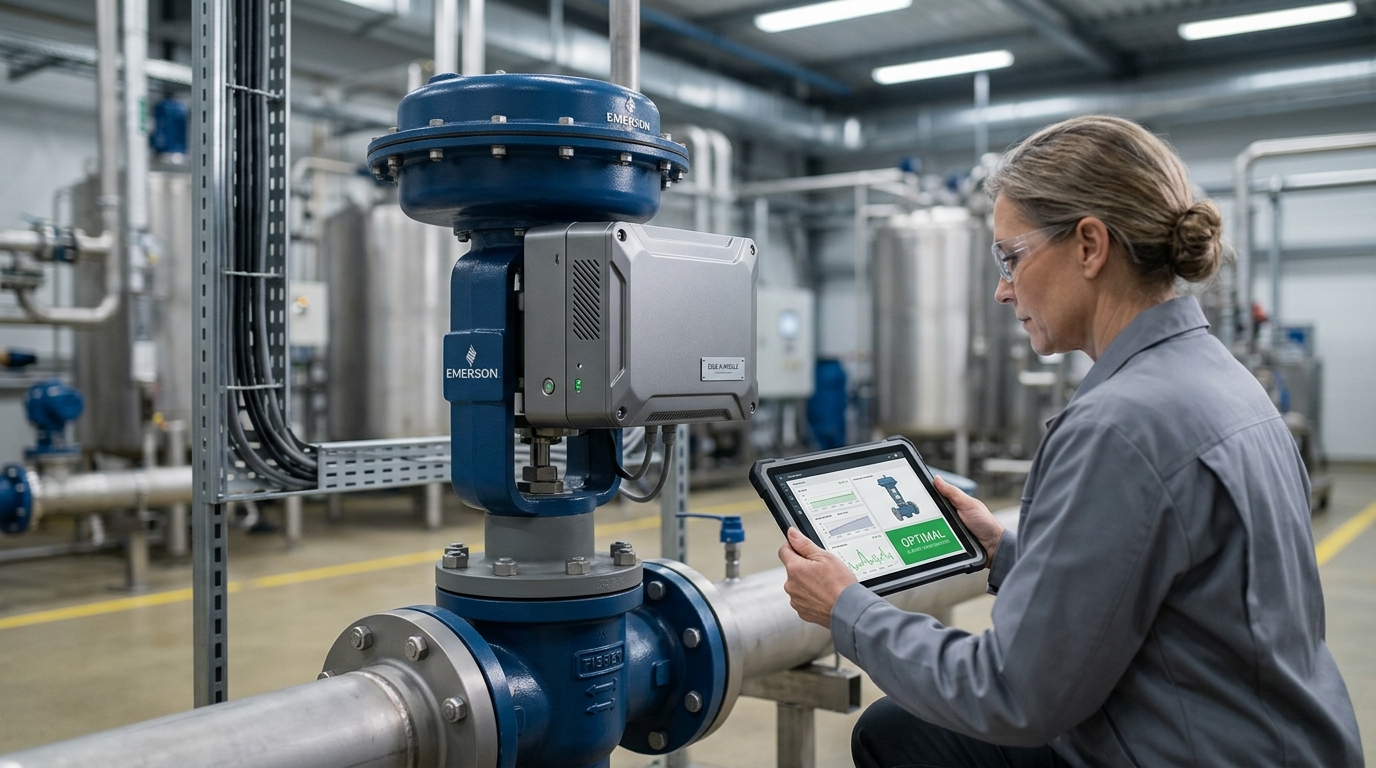
The conventional pitch for industrial AI has been cloud-first: ship sensor data to a data center, run the model, receive the alert, act. That architecture has a latency problem nobody talks about loudly enough. By the time a cloud platform flags a failing valve seal or a pressure anomaly, the defect has already propagated. Milliseconds matter on a process line running at full throughput.
Emerson Electric is moving in a different direction. The company announced a collaboration with SiMa.ai in late May 2026 to bring what both companies call “Physical AI” directly to the industrial edge, processing data on Emerson industrial PCs deployed on the factory floor and at remote sites, rather than routing it through the cloud. The practical result, according to Emerson, is real-time data analysis on those industrial PCs in harsh field environments.
The angle that is underappreciated here is not the hardware spec. It is the address. Embedding inference at the component level, directly where pressure, flow, and temperature readings originate, eliminates the round trip entirely. One detail to keep straight: SiMa.ai’s published MLSoC materials emphasize far higher throughput than “10 TOPS.” SiMa.ai’s own product brief and documentation describe INT8 performance on the order of 50 TOPS, with power consumption that varies by workload and is not universally “under 10 watts.” The takeaway is still the same: the point is efficient, ruggedized edge compute that can fit inside industrial form factors with tight thermal limits.
Among the demonstrated use cases cited in coverage of the partnership are leak detection and predictive maintenance. That is not a vision-system upgrade bolted onto existing infrastructure. It is the valve itself becoming the sensor intelligence layer.
The broader market this feeds into is growing fast. One widely circulated forecast pegs the global edge AI in industrial automation market at $7.59 billion in 2026, growing to $41.00 billion by 2033 (27.25% CAGR). Emerson’s existing installed base across process industries gives it a distribution advantage that pure-play chip vendors cannot replicate quickly.
On the stock, the setup is messier than the technology. Emerson trades around $159 as of early October 2026, with a consensus analyst rating of Buy and an average price target of $173.68 across 30 analysts. That is roughly 9% implied upside from here, which is not a particularly bold call. Morgan Stanley sits at underweight with a $135 target, a meaningful dissent from the crowd, and worth taking seriously as a check on optimism.
The core risk is execution timing. Industrial customers adopt new sensor architectures slowly. A plant engineer who has relied on SCADA-centric monitoring for 15 years does not rip out a working system because a chip vendor promises sub-10ms inference. Emerson has to sell the ROI on downtime reduction and yield improvement, facility by facility, which takes longer than a product announcement.
The counterargument is that Emerson does not need fast adoption across its entire install base to move the financial needle. The specific EPS figures in the draft (“$6.44” for fiscal 2026 and “$6.98” for fiscal 2027) do not match the most widely published consensus snapshots I could verify. Recent consensus-style aggregations generally put fiscal 2027 EPS expectations closer to the low-$7 range, and company guidance for fiscal 2026 has centered around the mid-$6 range on an adjusted basis. Edge AI monetization layered onto its core automation revenue could compress that timeline if industrial customers accelerate capital decisions under cost and safety pressure. That is the catalyst worth watching, not the chip itself.