
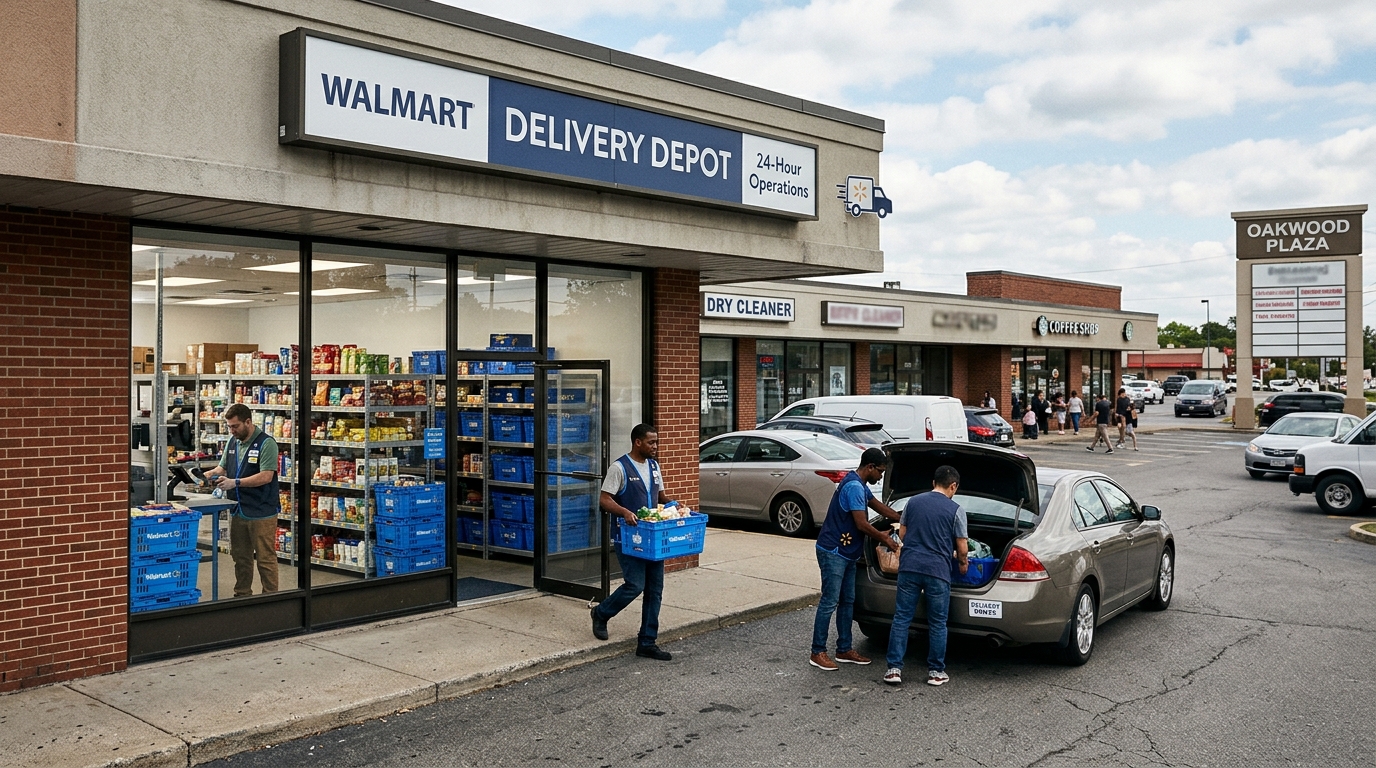
The strip mall anchor box, long treated as retail real estate’s most reliable workhorse, is undergoing a quiet conversion that most investors have not priced. Walmart is openly testing a model it calls delivery depots: closed-door fulfillment hubs occupying former pharmacy locations, stocked with high-velocity SKUs, and staffed not for shoppers but for gig drivers who arrive, pick, and leave. The public never enters. The shelves face pickers, not browsers.
The rollout is picking up pace. Walmart opened a depot in Fayetteville, Arkansas in a former Walgreens location, following openings in Texas and New Jersey. Reports have also described Walmart pursuing a delivery depot at an abandoned Rite Aid in the town of Poughkeepsie, New York. The depots are typically about 20,000 square feet and target former drugstore boxes close to residential neighborhoods. That is not an accident. Closed Walgreens and Rite Aid stores are effectively pre-positioned last-mile infrastructure, already zoned retail and typically close to the households Walmart wants to reach quickly.
The efficiency case is hard to argue with. Walmart has said it can reach 95% of U.S. households with delivery in three hours or less. Depots at former drugstore corners are one mechanism that can support that goal by shifting fulfillment out of live retail aisles and into spaces designed around picking and staging for drivers.
But this is where the strip mall investment thesis gets complicated. The zoning machinery is fighting back. In Pittsburgh, Walmart’s plan to use a former Rite Aid in Bloomfield as a delivery depot drew neighborhood pushback and became a zoning question precisely because it would not be open to the public. In the town of Poughkeepsie, reporting has described Walmart seeking to retrofit a former Rite Aid at the Red Oaks Mill Shopping Center into a roughly 20,000-square-foot facility, with local officials describing it as a use that does not neatly fit existing categories. One official summed it up this way: “It’s a new land use that we haven’t seen before.”
That friction matters for how investors should read open-air REIT valuations. Leasing spreads have been running double-digit positive at Kimco, Brixmor, and Regency. The assumption embedded in those spreads is that backfill tenants face the public. Dark stores disrupt the co-tenancy logic that holds a strip center together. Strip centers depend on the economic interdependence of their tenants, and operating covenants exist to maximize foot traffic. A delivery depot generates van and Spark driver traffic instead. Adjacent tenants notice.
Net-lease REITs holding former pharmacy real estate face the sharpest recalibration. A Walmart long-term lease on a shuttered pharmacy box is credit-positive for that building. Whether neighboring tenants see foot-traffic erosion, and whether existing percentage-rent clauses survive conversion to delivery-only use, depends on zoning decisions still being litigated in real time. The case outcomes in Pittsburgh and Poughkeepsie will help write the template. Current cap rates may not reflect that uncertainty yet.