Marvel was valued at $54 billion. Star Wars at $181 billion. And Pokemon at $115 billion.
What do they have in common? IP with a passionate fanbase.

And that’s great news for companies like Skybound Entertainment.
Skybound is one of the few companies that have successfully struck deals with major streamers and studios while keeping 250 of their own IP properties and the profits across gaming, merchandise, and licensing.
The opportunity to own a piece of it closes soon.
Here’s how they use that IP to create global franchises: They create the comics, where audience response helps shape their next breakout hits, then scale the strongest stories through TV and film, and monetize through releasing games, merchandise, and more. The Walking Dead and Invincible are just two big names in their portfolio.
Now you can own a piece of what’s next. Final days to invest before the opportunity ends.
Southern Company Has Google Paying for Its Nuclear Upgrades. That Changes the Investment Case.
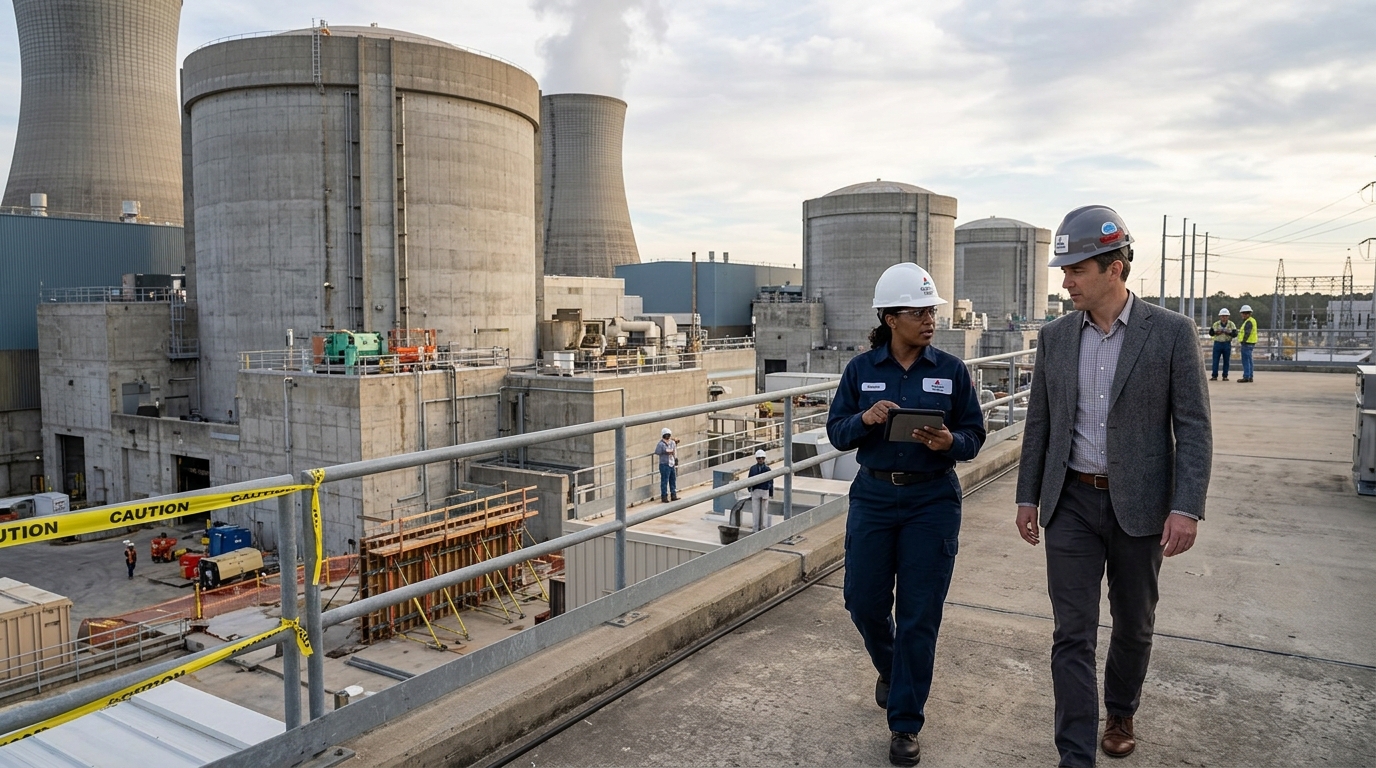
The story getting attention this week is Google funding nuclear capacity at two Georgia plants. The story worth examining is what that arrangement does for Southern Company’s stock.
Georgia Power and Google announced an agreement under which Google will support uprates on Georgia Power’s owned portion of the nuclear units at Plants Vogtle and Hatch, allowing the facilities to add approximately 96 MW of new capacity to the electric grid. The filings include a new Nuclear Uprate (NU-1) tariff structure as well as a request to approve a new extended power uprate for Plant Hatch 1 and 2. The PSC must still approve the deal, and the NRC must separately sign off on the Hatch license amendment. Those are real gates, not formalities.
But consider what the structure actually does. As part of the transaction, Google will subscribe to the new NU-1 tariff and receive Zero-Emission Credits representing the carbon-free attributes of nuclear energy associated with the power generated by the uprates. The deal comes amid growing scrutiny over who should pay for additional power infrastructure needed to accommodate soaring energy demand, and the agreement with Google will help shield residential and other industrial customers from the cost of the upgrades. Georgia Power says Google’s subscription is projected to enable about $900 million in benefits for customers over the life of the units.
This is the structural advantage that CEG and VST, the two names most investors reach for in the AI power trade, cannot easily replicate. Constellation and Vistra operate in competitive wholesale markets, where merchant power prices and hyperscaler PPA negotiations set the terms. Southern’s Georgia Power subsidiary co-owns the Vogtle and Hatch facilities, and the parent’s Southern Nuclear business operates them, inside a regulated framework. That framework, often dismissed as a ceiling on returns, is now functioning as a moat. A hyperscaler pays for the upgrade. Ratepayers are protected. The utility collects a steady, PSC-sanctioned return on the expanded asset base. The risk transfer is almost entirely in Southern’s favor.
The underlying business was already accelerating before this week’s filing. Data center usage at Georgia Power rose 55% year-over-year in Q2 2026, lifting system-wide data center load past 1.2 GW. Southern added 6 gigawatts of new contracted large-load agreements since the first quarter of 2026, including a 3.2-gigawatt, 25-year agreement with OpenAI. Beyond the 17 gigawatts already contracted, there are an additional 8 gigawatts of projects in late stages, including 3 gigawatts projected to be finalized in the near term. The prospective pipeline sits above 75 GW. Weather-normalized retail electricity sales are up 2.3% versus the first half of 2025, the strongest first-half growth in nearly twenty years.
Earnings have followed. Adjusted EPS reached $1.13 in Q2 2026, rising $0.21 versus Q2 2025 and beating the company’s estimate by $0.13. Management now expects full-year 2026 results to land near or at the top of the $4.50 to $4.60 guidance range.
The risks deserve honest attention. SO trades below its 12-month high, with the stock closing at $85.46 on September 21, 2026. Southern increased its five-year capital plan to $81 billion for 2026 through 2030, up from its prior plan of $76 billion, with about half going toward power generation. That capital intensity means execution must stay clean and regulators must remain cooperative. Any delay in large-load ramp, or PSC resistance to the new NU-1 tariff, clips the thesis. Morgan Stanley carries an underweight rating, a reminder that not everyone sees the regulated model as a feature rather than a constraint.
The Google deal adds one more dimension to the argument for SO over its unregulated peers: when a hyperscaler wants clean baseload power and wants it without triggering a political fight over ratepayer costs, the regulated utility with the existing nuclear fleet and a cooperative state commission is the counterparty of choice. Georgia Power has already received approval to supply OpenAI’s new project in Effingham County, as part of a large-load portfolio expected to deliver about $950 million in annual customer savings starting in 2029. Google is now the second major AI player writing checks that flow, directly or indirectly, through Southern’s balance sheet.
CEG and VST are legitimate plays on AI power. But they compete for merchant contracts in open markets. Southern is building a position where the biggest technology companies on earth are, in effect, co-funding its nuclear infrastructure while its shareholders collect a regulated return on the expanded capacity. That is a different, and arguably more durable, kind of advantage in the AI energy build-out.