
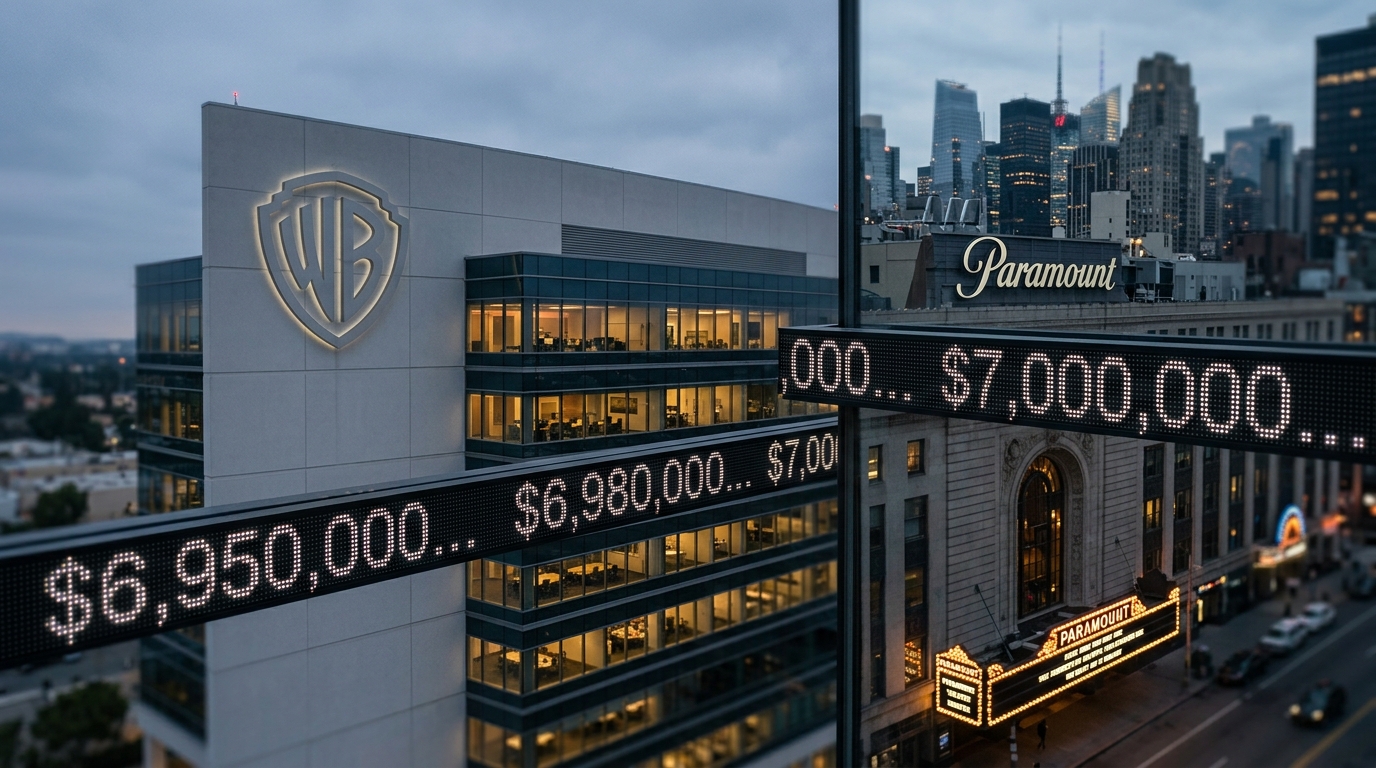
In six days, Warner Bros. Discovery shareholders start getting paid to wait. Specifically, they start collecting roughly $7 million a day from Paramount Skydance, whether the deal closes or not. That is not a rumor or a projection, it is contractual, it has a start date of October 1, and it will run until a federal judge rules on a trial that does not begin until March 2, 2027.
The question worth asking today, with WBD trading near $28 and the clock almost expired, is whether this stock represents a genuinely unusual risk-reward situation: a position where you get paid every single day you hold it, backed by a merger agreement that competition authorities in 68 countries have already cleared.
How the Fee Works
Paramount will begin accruing a ticking fee payable to Warner Bros. Discovery shareholders of roughly $7 million per day starting October 1 until the deal is complete. The fee is structured as $0.25 per WBD share per quarter, equivalent to approximately $650 million each quarter.
Critically, the Paramount ticking-fee payments to WBD are not due until the deal closes. That distinction matters. The fee accrues daily but settles at closing, meaning WBD shareholders receive a larger per-share payout the longer the delay runs. The meter is running in their favor.
What the Court Has Actually Decided
A US federal judge scheduled a March 2, 2027 start date for the antitrust trial tied to lawsuits brought by a coalition of 12 state attorneys general and the Writers Guild of America against the proposed Paramount-Warner Bros. Discovery merger, which has been widely reported as a roughly $111 billion transaction. After Judge Araceli Martínez-Olguín issued a temporary restraining order pausing the deal, the parties agreed to hold off closing pending the outcome of the cases or until June 2027, whichever comes first.
The state AG and WGA lawsuits are the only material barriers remaining to the closing of the Paramount-Warner Bros. merger. Paramount has said the deal has received all required regulatory clearances globally, including U.S. Department of Justice clearance, and has cited approvals from regulators in 68 countries. WBD shareholders also approved the transaction earlier this year. What is left is a 12-day trial in a California federal court scheduled to begin March 2, 2027.
The Settlement Conference Nobody Is Talking About
There is a development that has been underreported in the daily bond-request coverage: a court-supervised settlement conference has been set for October 14 and 15. A standard part of federal civil litigation, the conference will be confidential, and both sides will have to present their settlement positions to a magistrate judge. A settlement before March would close the deal and crystallize the accumulated ticking fee for WBD shareholders, potentially ahead of schedule. That outcome is not priced in by most investors watching the headline litigation.
What Could Go Wrong
The risks are real. If the deal is not closed by the June 2027 outside date, Warner Bros. Discovery has the option to terminate the merger and collect a $7 billion fee. Termination would be deeply disruptive. If the deal falls through, Morningstar analysts have argued that Netflix could reenter the fray and look to acquire Warner’s streaming and studios businesses, though at a materially lower price than the $27.75 per share it previously offered for those assets. WBD at $28 would face real downside in a termination scenario.
There is also execution risk on Paramount’s side. While Paramount is contractually on the hook for the delay via the ticking consideration, any attempt to amend the terms, including the ticking fee, would require mutual agreement with Warner Bros. Discovery and could invite shareholder lawsuits.
The Bottom Line
Over the twelve months to September 16, 2026, Warner Bros. Discovery returned +53.8% against +15.5% for the S&P 500. The stock is not undiscovered. But the ticking fee, the October 14 settlement conference, DOJ clearance, and global antitrust clearances together describe a situation where the path to a payout is more defined than typical merger arb.
WBD is not a stock you buy because the business is accelerating. You buy it because the contractual cash register starts ringing in six days, a settlement window opens in less than four weeks, and the only question is how long the meter runs before someone closes the deal.