
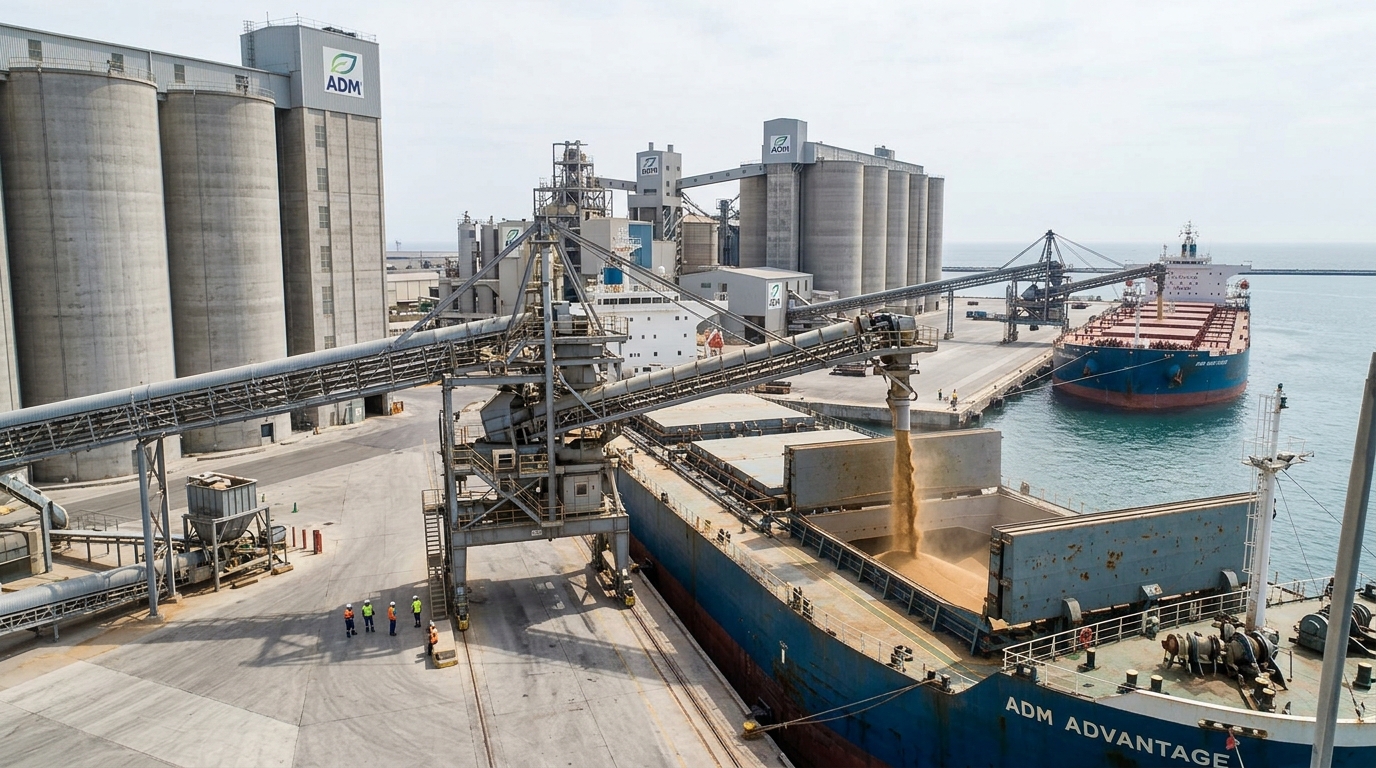
When the world’s cheapest wheat corridor closes and the world’s second-largest wheat producer simultaneously reopens its borders, the company that controls the pipes matters as much as the price. That company, right now, is Archer-Daniels-Midland.
India lifted export restrictions on wheat flour and related products on August 24, with the Directorate General of Foreign Trade issuing notifications confirming the change took effect immediately. India’s last wheat harvest climbed to an all-time high of about 120.657 million tons, giving New Delhi ample firepower to re-enter global markets. The timing is not coincidental: it lands precisely as the Black Sea exits the equation.
Attacks on shipping have shut down more than 97% of Russia and Ukraine’s grain export capacity in the Azov and Black Sea basin, cutting off a major source of low-cost supplies and helping to drive up global prices. SovEcon projects Russia will export between 3 million and 3.4 million metric tons of wheat in August, well below the five-year average of 5 million tons and potentially marking the lowest August total since the 2016-17 agricultural season. All major grain ports on the Black Sea and the Sea of Azov have been paralyzed. Last week, three grain terminals at Novorossiysk, through which around 25 million metric tons of grain exports were handled, were shut down.
For ADM, this is not a passive backdrop. It is a direct commercial test of the origination and merchandising model management spent two years rebuilding.
What the Segments Actually Show
ADM reported second-quarter 2026 adjusted earnings of $1.84 per share, up 98% year over year, on revenues of $22.68 billion. Total segment operating profit increased 75% year over year to $1.45 billion, with the Ag Services and Oilseeds segment benefiting from stronger crushing margins and improved asset utilization. Segment operating profit jumped 129% year over year to $867 million. That recovery matters here because it confirms the network is already running at high utilization entering the disruption.
Management noted that market volatility typically rewards ADM’s flexible global footprint, allowing the team to pivot origination and destination markets during disruptions. Ag Services results improved significantly by leveraging ADM’s global footprint to navigate complex trade dynamics and increased South American export volumes. That language now has a concrete test case: importers in the Middle East, Africa and Asia are facing the prospect of sourcing grain from higher-cost suppliers such as Australia and the United States.
Tighter Black Sea supply is already being reflected in global prices. Compared with July, U.S. wheat export quotes rose by $26 to $321 per ton. Wider U.S. basis is directly positive for ADM’s origination margin: the company buys from U.S. farmers and sells into export demand, and the spread between domestic and international prices is the operating engine.
The Input-Cost Complication
The bull case has a real counter. DAP fertilizer sits at $795 per ton, up 3.58% on the month, as China extended restrictions on phosphate fertilizer exports through August 2026, now covering an estimated 50-80% of its export volumes. Higher input costs for U.S. farmers mean planted acres in the next cycle could disappoint, trimming the origination volumes ADM needs to process and export. The fertilizer squeeze is a 2027 problem embedded in a 2026 stock.
Following the strong first-half performance, ADM raised its 2026 adjusted EPS outlook to $5.15-$5.60 from the previous range of $4.15-$4.70. In late July, ADM announced investments to expand North American oilseed crush capacity across four U.S. plants, aiming to unlock about 700,000 metric tons of additional annual capacity by late 2028 or early 2029. The capacity expansion is timed well; the risk is that biofuel policy and fertilizer-driven planting economics undercut the volumes needed to fill it.
Bull vs. Bear
The bull case is direct. Should Black Sea corridors reach their limits, grain importers may increasingly source cargoes from longer-haul exporters such as the United States, Canada, Brazil and Argentina. ADM sits at every one of those origins. India’s re-entry adds a new origin for buyers, which pressures wheat prices modestly, but it does not replicate the deep-water logistics infrastructure that routes grain through ADM’s Gulf terminals.
The bear case is that the disruption is too short-lived and too priced-in to generate another leg of earnings surprise, while DAP at $795 and the fertilizer cost cycle quietly erodes the farm-income base that drives origination volumes into 2027.
What to Watch
Three numbers will tell you whether the thesis is tracking: U.S. wheat and corn export inspection data week over week through September, any management update on Q3 Ag Services origination volumes, and whether China lifts phosphate restrictions past August or rolls them forward again. The first two are ADM’s opportunity. The third is its hidden liability.
The Black Sea is not closed temporarily. The disruption has come during the August-to-December period, when Russian grain exports are typically at their highest, and expectations that all the missed shipments can be made up later are overly optimistic. ADM does not need to be lucky. It needs to execute the origination pivot its management says it was built to make.