Dear Friend,
Google is paying Elon $920 million a month.
Anthropic is paying him $1.25 billion a month.
The richest companies on Earth are renting his computer because they can’t build what he has.
Together, about $26 billion a year.
Now the Pentagon, the biggest buyer on Earth, wants its own.
Every dollar of it rides on one tiny company Elon couldn’t build around.
I call it the X-Grid stock.
I expect it to be the biggest winner of the entire AI buildout.
Get the name of the company collecting underneath Elon >>
The Buck Stops Here,
Dylan Jovine
Founder, Behind the Markets
Berkshire Just Spent $9.6 Billion Buying Its Own Stock
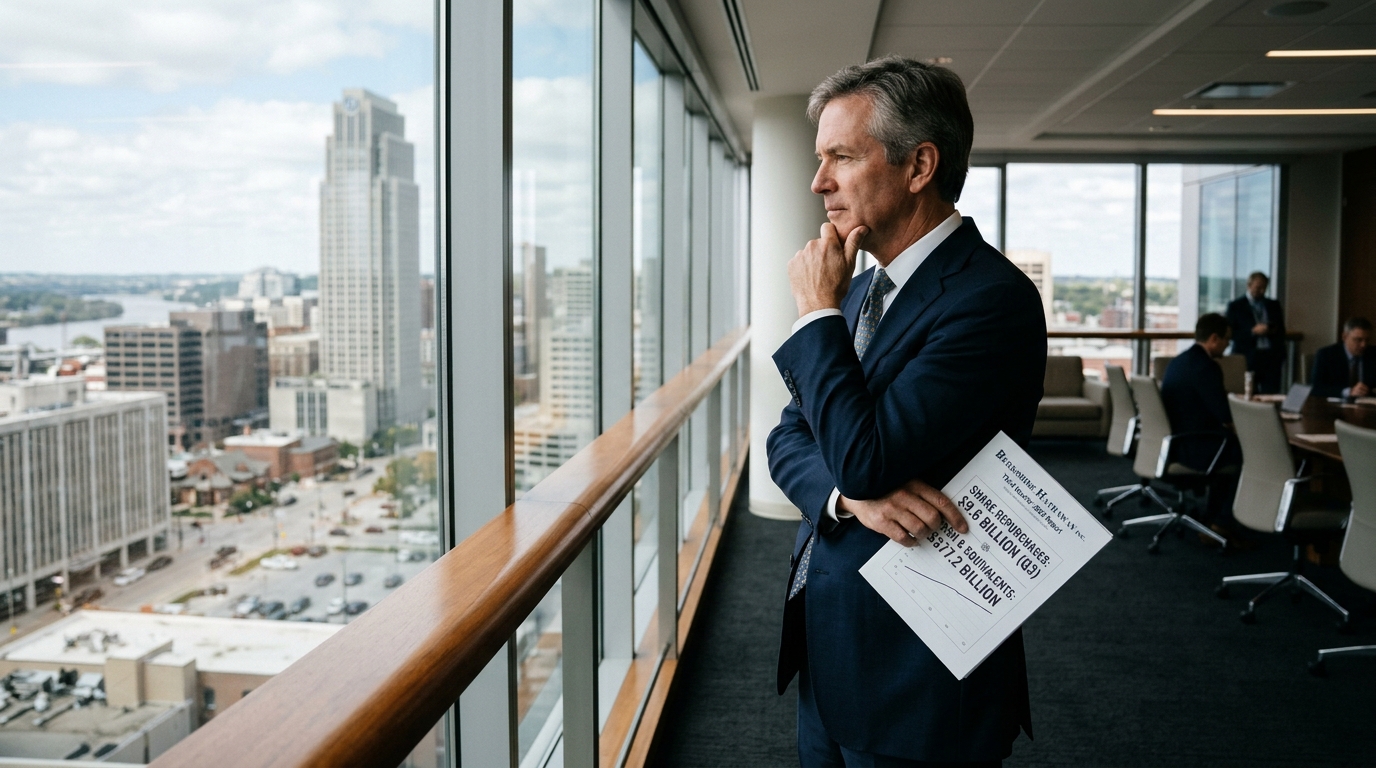
When a company sitting on $377 billion in cash and Treasury bills decides the best available investment is its own shares, that is a statement about everything else on the market. That is exactly what Berkshire Hathaway did in the third quarter.
Berkshire Hathaway said Saturday it accelerated its share repurchases during the third quarter, buying back $9.6 billion worth of its own stock even as operating and overall profits took a hit. That figure came in well ahead of estimates of $1.6 billion, pushing full-year buybacks to $14.4 billion and more than doubling the Q2 pace of $4.2 billion, itself a sharp acceleration from the roughly $600 million repurchased in the first half of 2026 as new CEO Greg Abel assumed leadership from Warren Buffett on January 1.
The $9.6 billion is the largest buyback in the company’s history, topping every previous quarter on record. To put that in context: Berkshire repurchased no shares in the fourth quarter of 2025. Abel restarted repurchases in the first quarter of 2026, after becoming chief executive. The ramp from a modest first-half pace to $4.2 billion in Q2 to $9.6 billion in Q3 is not gradual evolution. It is a deliberate shift in how Berkshire allocates capital.
Operating earnings for the period fell roughly 6% year over year to $12.7 billion, as insurance underwriting profit dropped 43% to about $1.35 billion. The underlying industrial businesses are expanding. It is the insurance unit pulling the headline number down.
In the first four weeks of the fourth quarter, Berkshire bought back about $2 billion more in stock. The acceleration did not stop when the quarter ended.
The market timing here matters. Berkshire shares roared past the S&P 500 this week as investors moved money away from slumping tech stocks and into the relative safety of a traditional conglomerate with relatively little exposure to artificial intelligence. Berkshire’s Class B stock is up about 13.6% year to date, beating the S&P 500’s roughly 7.3% gain. Since October 1, Berkshire stock has climbed about 14%.
The stock trades around 1.4 times book value, depending on the day. That is not cheap by absolute standards, but it is still far less extreme than the most richly valued corners of the AI complex. Abel clearly agrees: the buyback says so.
The contrast with the AI complex is sharper than the valuation multiple alone suggests. Nvidia’s board authorized a $235 billion repurchase program at a $5.4 trillion market cap, a very different signal about where management sees value.
The risk is real. Insurance underwriting profit fell 43% year over year. GEICO’s profitability is the question mark heading into Q4, and a larger-than-expected insurance loss could pressure operating earnings further. Alphabet is part of the portfolio, and some commentary has pointed to losses on that position as part of a disappointing run of stock picks this decade. The investment portfolio is not the story it once was.
What Abel is building, though, is cleaner than what the last several years suggested. Record buybacks, still-massive cash reserves, growing industrial earnings, and a stock that is functionally the market’s preferred shelter when tech sells off. If that rotation deepens, BRK.B is the most logical beneficiary in the large-cap universe today.