
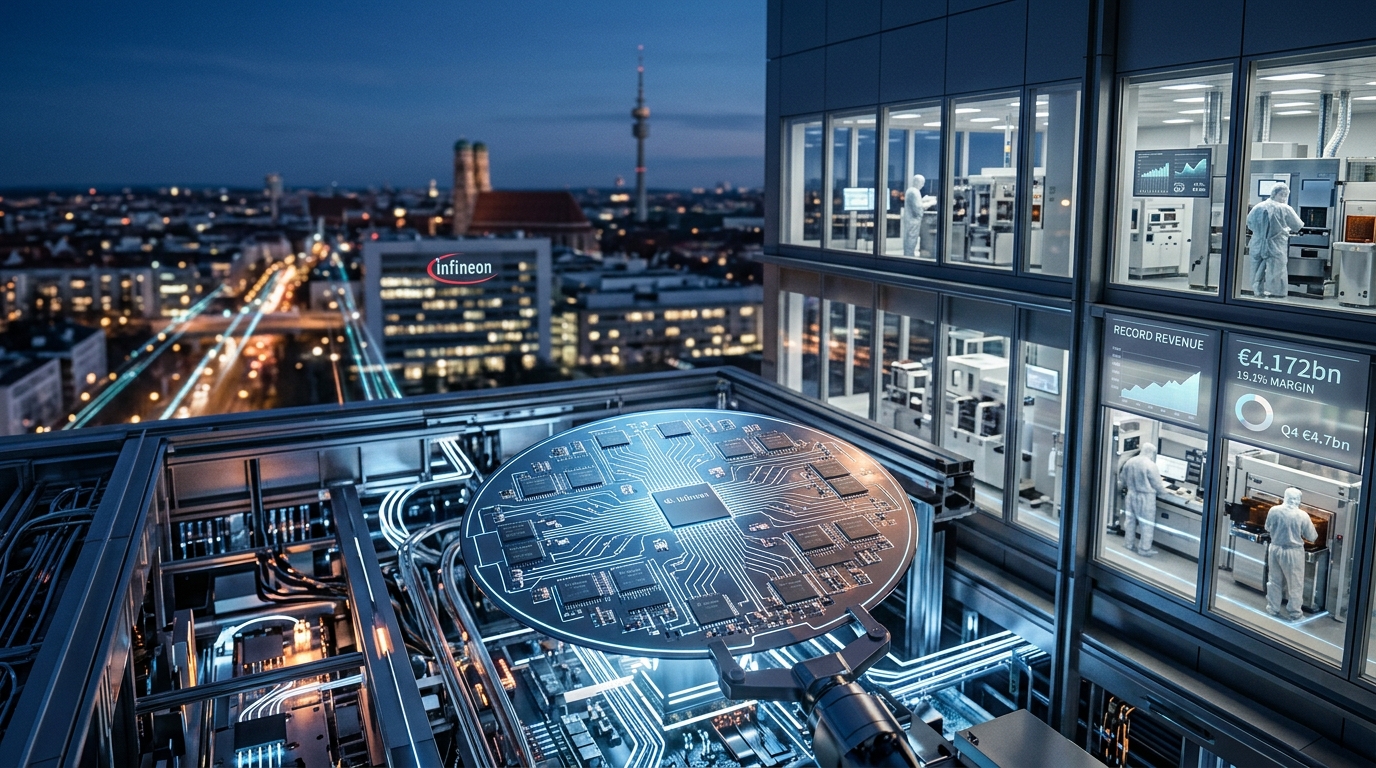
Infineon Technologies has rarely looked better on paper heading into a results day. The company closed its fiscal third quarter with revenue of €4.172 billion and a segment result of €797 million, a 19.1% margin that marked the highest quarterly revenue in Infineon’s history. Management guided Q4 to around €4.7 billion, implying roughly 13% sequential growth. And two weeks ago, the company landed a manufacturing milestone that rivals cannot match.
That is the optimistic version. The harder question is whether Tuesday’s full-year report and fiscal 2027 outlook can hold up in a week when the entire AI spending thesis is under challenge.
The Business
Infineon makes semiconductors primarily for automotive, industrial power, and consumer electronics, with the automotive segment accounting for roughly half of total company revenue. That split matters enormously right now. Automotive-segment revenue was €7.402 billion in FY2025, down 4% from €7.716 billion in FY2024. The European car market is not in a hurry to rescue that number.
The growth story runs through a different division entirely. The Power and Sensor Systems segment delivered revenue of €1.442 billion in Q3, up 14% sequentially and 34% year-over-year, driven in part by demand for power solutions for AI data centers. Infineon has said it expects to more than double its revenue from power supply solutions for AI data centers this fiscal year to over €1.6 billion.
Power delivery is the constraint that makes Infineon’s data center contracts durable. Eaton’s data center pipeline shows how deep the infrastructure buildout behind AI power demand actually runs.
Why Wall Street Is Paying Attention
The company says it has concluded, or is negotiating, multi-year capacity reservation agreements with leading AI customers representing a cumulative revenue volume in the high single-digit billions of euros, providing visibility as data centers shift to higher-power architectures. Those are real agreements, not projections.
Then there is the manufacturing bet. Infineon says it is establishing the world’s first high-volume production facility for next-generation gallium nitride power semiconductors on 300-millimeter wafers, investing approximately €1.1 billion in existing cleanroom facilities at its Villach site by 2034. Compared with 200mm wafers, the 300mm diameter enables the production of 2.3 times as many chips per wafer. Production is scheduled to begin by the end of 2027. No peer, including STMicroelectronics, NXP, or onsemi, has announced an equivalent 300mm GaN high-volume production plan.
Analyst ratings and price targets move constantly, so treat any single consensus target as a snapshot rather than a stable fact.
What Could Go Wrong
The AI spending environment shifted hard last week. The PHLX Semiconductor Index was about 38% below its June 2026 record close as of November 5. In the U.S., Reuters reported that AI data center-related stocks slid after Democrats won both the Senate and the House, raising prospects of tougher oversight of the AI buildout.
The automotive drag is the other weight. A large share of the company’s revenue comes from a segment still working off inventory and contending with weaker demand. If the 2027 outlook reflects any softness in AI capex commitments from hyperscalers, the stock has little automotive momentum to catch it.
The Bottom Line
Infineon’s fundamental position is genuinely strong. It holds a leading position in automotive semiconductors, it is a power chip supplier that AI data centers are contracting for years ahead, and it is spending €1.1 billion to lock in a manufacturing advantage in gallium nitride that will not come online until late 2027. Record Q3 revenue of €4.172 billion with a 19.1% segment margin and full-year revenue guidance of around €16.3 billion reflect a company in real acceleration.
The complication is that IFX.DE has been trading at roughly €45.76 recently, far below its 52-week high of €88.83, and the fiscal 2027 guidance it issues Tuesday now has to satisfy a market already questioning whether hyperscaler spending commitments will survive political and financial pressure. The GaN announcement and the multi-year customer agreements argue that Infineon’s AI revenues are more durable than the selloff implies. Tuesday will show how much of that the company is willing to put in writing for 2027.