November 3, 2026
Bonus Content: Keurig Dr Pepper Reports Q3 Midway Through Its Split
Elon Musk’s Six-Word Threat to Every U.S. Bank

His words: “You won’t need a bank account.” Now he’s mailing out metal cards to make it happen.
Keurig Dr Pepper Reports Q3 Midway Through Its Split
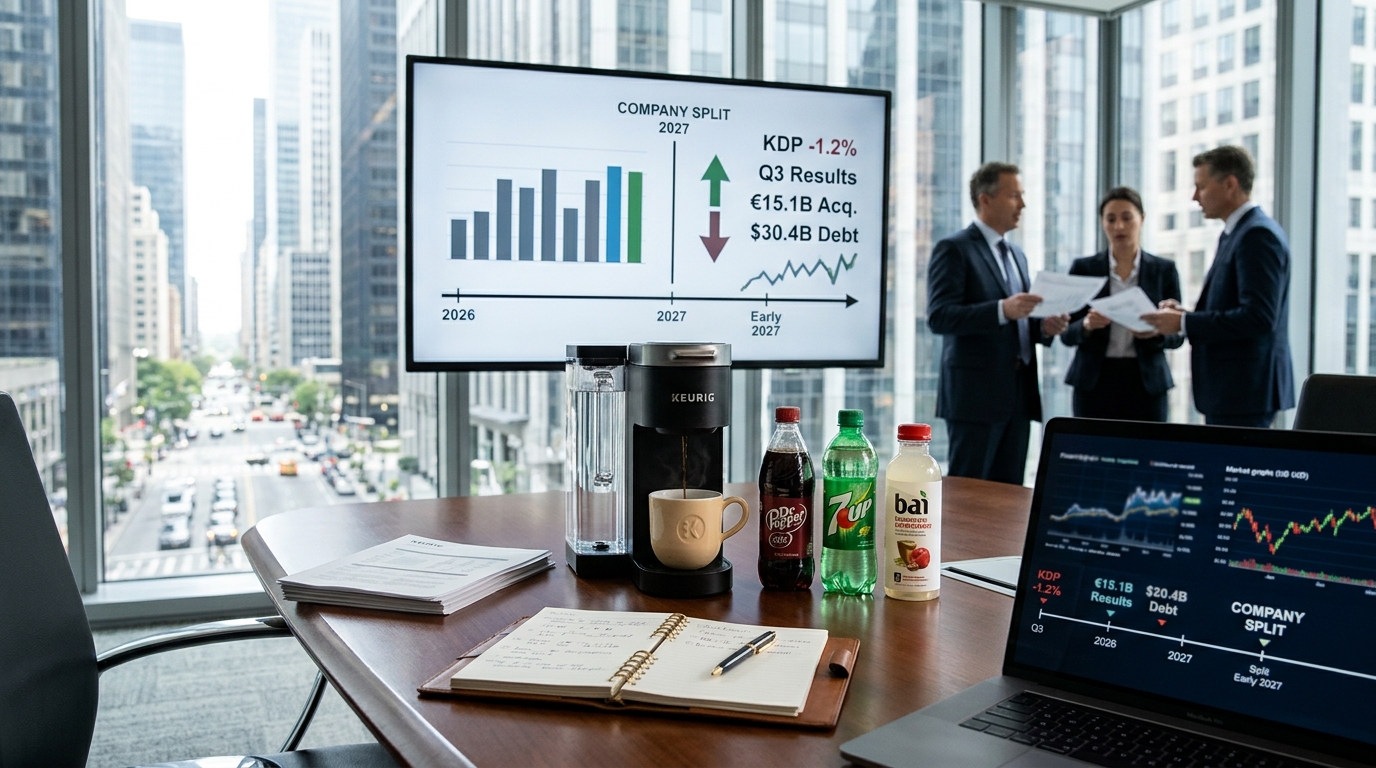
This morning, before the market opened, Keurig Dr Pepper (KDP) dropped its Q3 2026 results. It is the last full quarter investors will see before the company splits in two. That makes today’s report less about one quarter’s numbers and more about whether owning KDP right now is the cheapest way to get a stake in a global coffee giant, or whether the debt load makes that a bad trade.
Why This Stock Now
The core idea is straightforward. After the JDE Peet’s acquisition closed, KDP said it plans to separate into two independent, U.S.-listed publicly traded companies: a Beverage Co. housing its traditional Dr Pepper and refreshment brands, and a Global Coffee Co. Upon separation, KDP has said Global Coffee Co. would have approximately $16 billion in annual revenue and reach across more than 100 markets. Piper Sandler estimates Global Coffee Co. may be receiving little or no market credit at the current combined valuation, potentially driving about 18% upside. That is the bull case in one sentence.
The Business
KDP’s brands include Dr Pepper, Canada Dry, Snapple, Ghost, Electrolit, and Green Mountain Coffee Roasters, and the April 1, 2026 acquisition of JDE Peet’s greatly expanded its global coffee business. The purchase added coffee brands such as Jacobs, L’OR, and Peet’s, while steady demand for Dr Pepper, Ghost energy drinks, and Electrolit hydration products continues to support the beverage side.
U.S. Refreshment Beverages delivered 10% net sales growth and an 11.9% increase in adjusted operating income in the second quarter. That side of the business is clean. The coffee side is not.
Why Wall Street Is Paying Attention
For Q3 2026, analysts expected KDP to post earnings of about $0.62 per share on revenue of about $7.33 billion. In the same quarter a year earlier, the company reported $0.54 per share on revenue of $4.31 billion, a comparison that reflects not organic growth but the sheer bulk added by the JDE Peet’s deal. KDP has beaten consensus EPS estimates in each of the three prior quarters. The beat-or-miss here matters less than what management says about leverage and the separation timeline.
Management continues to target the split for early 2027, subject to market and other conditions. KDP also said it named Russ Torres Chief Executive Officer of the future Global Coffee Co. on October 1, with Torres set to join KDP on November 3, 2026. Leadership is filling in. The clock is running.
The beverage franchise KDP is carving out will compete directly in a consumer staples sector that has attracted significant institutional rotation. Coca-Cola’s positioning as capital moved away from high-multiple names shows the multiple a clean beverage franchise can command.
Elon Musk Just Did Something He’s Never Done Before
This February, Elon spent millions to send a message to 125 million Americans. Most people ignored it. But Wall Street veteran Whitney Tilson couldn’t stop thinking about it, and says what Elon was really saying explains everything about what’s unfolding in America’s economy right now.
What’s Driving the Opportunity
The separation itself is the catalyst. Piper Sandler’s argument is that investors may be applying too much of the coffee business’s risks to the company as a whole. If the two entities trade independently and markets assign the beverage franchise a proper consumer staples multiple, the sum could exceed today’s blended price. KDP itself has said it expects strong cash generation to support about 0.5x of deleveraging per year.
Coffee input costs, though still elevated, have moderated sharply from their worst levels. Arabica prices did peak in February 2025, but the specific late-September 2026 price and percentage decline cited here could not be verified from primary market data in time for publication. The commodity headwind for Global Coffee Co. is still real, but it is no longer accelerating.
What Could Go Wrong
The debt is not a footnote. At June 30, 2026, KDP reported $30.385 billion of pro forma debt principal and a 4.4x pro forma management leverage ratio. Management continues to target a pro-forma management leverage ratio of 4.1x at year-end, that is still four times earnings before interest, taxes, depreciation, and amortization, heading into a separation that requires both new entities to maintain investment-grade credit ratings. KDP has disclosed it will not permit the separation to be consummated if the corporate rating of either separated business, on a pro forma basis at the time of separation, would be less than investment grade from either Moody’s or S&P, absent required consents tied to the preferred investment agreement. Ratings risk is not hypothetical at this leverage level.
Intensifying pod-based coffee machine competition, commodity inflation, and upcoming spin complexity underscore KDP’s pressure in U.S. coffee. The CEO search for Global Coffee Co. was only recently resolved. The valuation claim in this draft, including the specific trailing P/E multiple and peer averages, could not be verified from primary filings or company materials in time for publication, so it has been removed rather than leave a potentially stale comparison standing. Much of the separation upside is already priced in by anyone paying attention.
AI’s NEXT Magnificent Seven
The Original Magnificent Seven Produced 16,894% Average Returns Over 20 Years.
But the Man Who Called Nvidia at $1.10 Says “AI’s Next Magnificent Seven Could Do It Even Faster.”
The Bottom Line
KDP is not a clean, straightforward consumer staples buy. It is a highly leveraged transformation trade with a specific and binary outcome: the split either unlocks real value by freeing two well-positioned businesses to trade on their own terms, or it stalls under debt pressure and delivers years of nothing while rates stay high. Today’s Q3 report is the market’s best current read on whether that outcome is on track. The beverage business clearly earns its keep. The question Q3 has to answer is whether Global Coffee Co., bought for about €15.1 billion, is doing the same.