
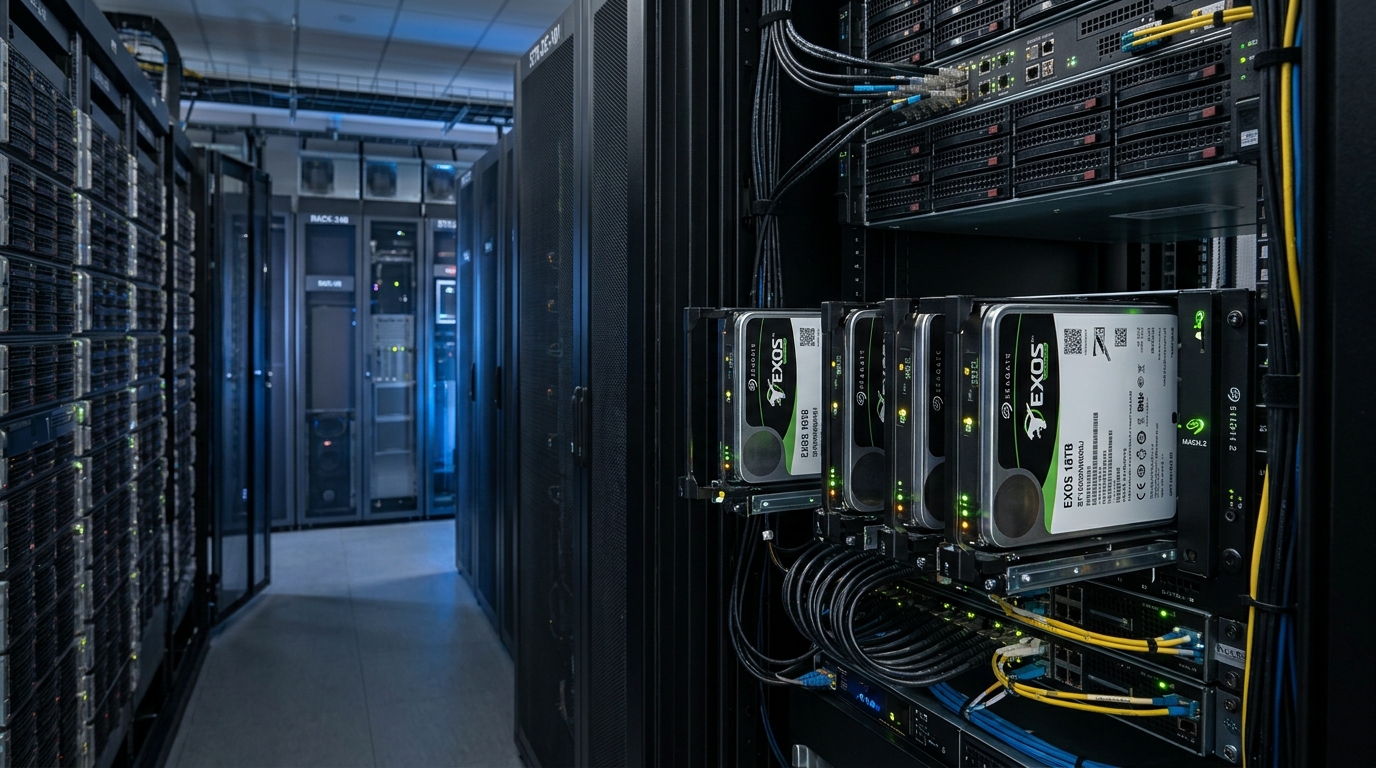
Seagate dropped its fiscal first-quarter 2027 numbers after Tuesday’s close and they are, by any reasonable standard, extraordinary. Revenue climbed 61% year-over-year and 17% sequentially to $4.2 billion, exceeding the company’s own guidance. Non-GAAP operating margin hit a record 50.7%, expanding 610 basis points sequentially and 2,170 basis points year-over-year. That is not a hardware company’s margin profile. That is a software company’s margin profile wearing a hard-drive badge.
The driver is well understood at this point. Data center revenue reached $3.4 billion, growing 63% year-over-year and representing 81% of total quarterly revenue. The core of that growth is Seagate’s HAMR-based Mozaic platform, which lifted non-GAAP gross margin to 57.8% as value-based pricing and a richer product mix took hold, a ramp that gained added credibility after Microsoft Azure qualified a joint Seagate and Broadcom solution that combines HAMR-based Mozaic drives with Broadcom connectivity infrastructure. Supply, critically, is not a commodity. Management reported that the vast majority of nearline exabyte supply is now allocated under long-term supply agreements through calendar 2028, with some cloud customer agreements extending through calendar 2030. Customers are not shopping around. They are locking in.
The Business
The company stated that demand is being driven by the expansion of AI applications from model training toward inference and agentic workloads, which increases the value of persistent data storage. That is a durable shift, not a one-quarter surge. Each new AI workload category generates more data that needs to live somewhere cheaply, at scale, for a long time. Seagate’s Mozaic drives are structured precisely for that job. The incremental increases in per-disk capacity delivered by Mozaic 4+ enable high-capacity, cost-efficient storage that scales without increasing infrastructure footprint or energy consumption, advancing capacity per rack and per watt, improving data center efficiency, and lowering total cost of ownership.
Why Wall Street Is Paying Attention
Seagate achieved impressive financial milestones in Q1 2027, generating $1.7 billion in cash flow from operations and about $1.5 billion in free cash flow, record highs for the company. That cash went to work immediately. Seagate retired approximately $1.2 billion in principal debt in the fiscal first quarter, lowering gross debt to $2.4 billion. An additional $750 million in high-yield senior notes were retired after quarter-end in early October, reducing total principal debt to approximately $1.6 billion.
Here is where the story shifts. With the balance sheet largely cleaned up, management is redirecting cash toward shareholders. With its debt-reduction objectives largely completed and investment-grade status regained, Seagate said it is shifting more attention toward shareholder returns. CEO Dave Mosley said Seagate’s capital-return model targets returning 75% of free cash flow to shareholders over time, with share repurchases serving as the primary vehicle alongside dividends. The company expects to significantly increase share repurchases starting in calendar 2027. For fiscal Q2, management guided revenue to $4.80 billion and non-GAAP EPS to $9.20, signaling continued sequential momentum as hyperscale demand for mass-capacity storage shows no signs of slowing.
The hyperscaler spending that is locking in Seagate’s supply agreements is itself being validated by cloud revenue growth. Microsoft Azure’s 43% growth quarter confirmed that AI infrastructure capex is converting into booked cloud revenue at scale.
What Could Go Wrong
The question is not whether Seagate is executing well. It clearly is. The question is what the stock is already pricing in. Seagate’s stock was trading around $287.54 at the start of January 2026 and has since increased by roughly 130% to about $668, based on the October 27, 2026 close. The all-time closing high was about $1,093 on June 22, 2026. Shares are now trading at nearly half that peak, which creates a more attractive entry than June but does not erase the run. The stock has delivered; the issue is that so has the earnings acceleration, and much of it is visible to everyone now.
Inventory days rose from 83 to 97 in the quarter. Management attributed that to staging Mozaic 4 products for upcoming customer qualifications, a reasonable explanation but one worth watching. If qualification timelines slip, that inventory becomes a different conversation. Competitive pressure from Western Digital and its SanDisk unit remains real, even if Seagate is currently ahead on HAMR deployment.
The Bottom Line
Seagate’s results make the investment case easy to understand. Record margins, record free cash flow, a balance sheet being rebuilt into a return vehicle, and demand locked in through 2028 by long-term supply agreements. TheFly reported Morgan Stanley carried an Overweight rating with a $1,200 price target as recently as October 20, 2026. The gap between that target and where the stock sits today is wide enough to matter.
What deserves honest acknowledgment is that this is a stock that has already moved enormously. Buyers here are not discovering Seagate; they are betting that the next phase of earnings growth, driven by a buyback engine now replacing the debt-reduction effort, is not yet fully reflected. Given the Q2 guidance and the $4.4 billion still sitting in the repurchase authorization, that bet is not unreasonable. It simply requires more patience and more precision than it did twelve months ago.