

Dear Reader,
I don’t trust Sam Altman at all …
And neither should you.
Because my research tells me he is hiding something …
Something so potent, so revealing …
It could spark the biggest monetary crisis of our lifetime.
Worse than the Dot-Com Crash …
The housing market collapse …
Even the Great Depression …
That’s why I suspect he’s using every tool at his disposal to keep this from getting out.
But on Dec. 18, around 4 p.m. …
He will be forced to reveal a document that’s currently confidential.
When he does, it will immediately trigger a $40 trillion wealth shift …
Altman himself has even said …
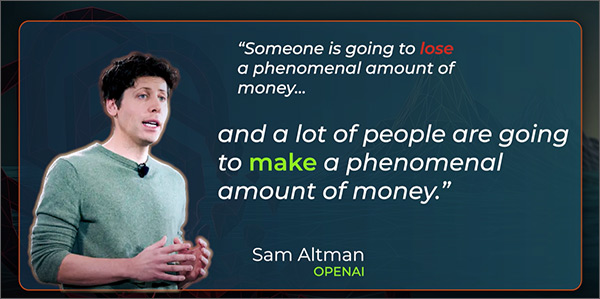
“Someone is going to lose a phenomenal amount of money … And a lot of people are going to make a phenomenal amount of money.”
To make sure you’re on the right side of this divide, click here.
Sincerely,

Nilus Mattive
Nilus Mattive
P.S. Look, if you wait for OpenAI to go public before you act … you’ll be too late.
Altman is expected to drop this bombshell on Dec. 18 …
Weeks before a potential IPO.
So please, don’t hesitate.
Watch this video to find out how you can protect yourself.
Starbucks Has Four Quarters of Growth. Now It Must Prove More.

Four consecutive quarters of positive comparable sales is a real achievement for a company that spent the better part of two years losing customers. But four quarters is also exactly the kind of track record that demands a harder question: what comes next? That question gets an answer Thursday afternoon when Starbucks closes its fiscal year with its Q4 report after the bell.
Why This Stock Now
SBUX is scheduled to release its Q4 earnings on October 29, 2026, after the market closes, with analysts anticipating diluted EPS of $0.73, up 40.4% from $0.52 in the year-ago quarter. That headline number matters less than the fiscal 2027 guidance management sets alongside it. The earnings call is expected to focus on the fiscal 2027 outlook and sustainability of U.S. transaction growth, with same-store sales guidance of 3% or higher and EPS broadly around the consensus of $3.16.
The Business
Starbucks runs more than 41,000 locations across 90 markets. The recovery under CEO Brian Niccol’s “Back to Starbucks” plan has been built almost entirely on traffic rather than price. Global comparable store sales rose 7.9% in Q3, driven by a 4.2% increase in comparable transactions and a 3.6% increase in average ticket. That transaction-led composition matters: promotions can buy a comp quarter, but repeat visits suggest something more durable is working.
U.S. Starbucks Rewards members with 90-day active status stood at 35.6 million at the end of Q2, a loyalty base that gives management both a pricing lever and a data advantage competitors struggle to replicate.
Why Wall Street Is Paying Attention
Non-GAAP operating margin expanded 430 basis points year-over-year to 14.4% in Q3. Two consecutive quarters of margin expansion after a prolonged squeeze is the kind of proof that moves institutional positioning. UBS forecasts fiscal Q4 North American same-store sales growth of 7.5%, ahead of the consensus estimate of 6.7%, and EPS of $0.77 to $0.82, compared with the $0.72 consensus.
Following stronger-than-expected Q3 results, Starbucks raised its fiscal 2026 global comparable-store sales growth outlook to nearly 6% and increased its non-GAAP EPS guidance to a range of $2.55 to $2.65, up from $2.25 to $2.45 previously. Further reinforcing shareholder returns, Starbucks announced a 1.6% increase in its quarterly dividend on October 7, raising the payout from $0.62 to $0.63 per share.
What’s Driving the Opportunity
The store portfolio is being actively pruned and rebuilt. Following a review of its North America stores, Starbucks said it would close approximately 250 coffeehouses, or about 1% of its more than 18,000 coffeehouses in the region, citing locations that do not meet its customer experience and financial performance standards.
The company has now completed more than 1,000 coffeehouse uplifts across the U.S. and Canada and is accelerating its pace toward completing at least 1,500 by the end of fiscal 2026. Those physical investments in the store experience are the bet behind the margin target, and Thursday’s report will show whether they are paying back on schedule.
What Could Go Wrong
The valuation tolerates nothing. The market has already priced the turnaround generously, with Starbucks trading at 34.3x NTM earnings and 21.2x NTM EV/EBITDA. Analysts expect EPS to grow about 21% a year over the next two years, which helps explain why the gap persists. Any fiscal 2027 guidance that underwhelms on comps or margins will reset that multiple quickly.
Premium multiples punish guidance misses with unusual speed. Lululemon’s stock fell 16% in a single session after management opened the guidance slide, even though the headline EPS number had crushed consensus.
The September store closure announcement also carries a cost. A September 24 filing said about 250 North America locations would close, with about $300 million in restructuring charges, about $200 million of it cash. That cash outflow arrives just as the company needs to fund the next wave of store uplifts. Coffee input costs remain elevated, and tariff dynamics that helped Q3 margins may not repeat at the same magnitude in fiscal 2027.
The Bottom Line
Starbucks has done the harder half of a turnaround: it has gotten customers back in the door. Attention now turns to fiscal 2027 guidance and whether the company can maintain growth as comparisons become more difficult, with investors generally expecting U.S. same-store sales growth of at least 3%. A comp acceleration and a credible margin path to something closer to the pre-2024 range of 13% to 15% would justify the current multiple and then some. A guidance range that splits the difference between ambition and caution is what a 34x stock cannot afford. Thursday’s call is where the turnaround graduates from promise to proof.