Dear Reader,
Amazon built a robot that can “feel.”
Not emotions like happiness or sadness.
It can work with items as different as socks and fragile electronics… while sensing contact and adjusting the force it applies.
As you probably know, Amazon has spent years automating its warehouses.
But strangely, this breakthrough has nothing to do with faster software, smarter chatbots, or more powerful AI chips.
Instead, it involves a new robot called Vulcan that can sense and handle objects using touch and force feedback.
Amazon says Vulcan can pick and stow approximately 75% of the item types inside its fulfillment centers.
Why does that matter?
Because it shows where AI may be headed next: out of computer screens and into the physical world.
See the story, including why physical AI could become the next major act of the AI boom.
|
Regards,
Matt McCall
Editor, McCall’s Innovation Report
P.S. Amazon says Vulcan can already pick and stow approximately 75% of the item types in its fulfillment centers. Click here to see why that matters for investors.
GE Vernova Is Down 30% From Its High. Tuesday Changes Everything.
The stock closed Friday, October 23, 2026, at about $825. Three months ago it traded above $1,174. That roughly 30% drop is about fear: fear that AI data-center spending will slow, that infrastructure financing will tighten, and that GE Vernova’s record backlog will prove more decorative than real. The October 28 earnings report, due before the opening bell, is where those fears either get confirmed or collapse.
The Business
GE Vernova makes gas turbines, grid transformers, high-voltage equipment, and wind systems. The power and electrification segments are the ones that matter right now, and both are running at a pace the company itself described as very strong and durable demand. Orders jumped 88% organically in the second quarter to $24.2 billion. Against $11.1 billion in revenue, that is a book-to-bill ratio that most industrial companies would consider a once-in-a-decade gift.
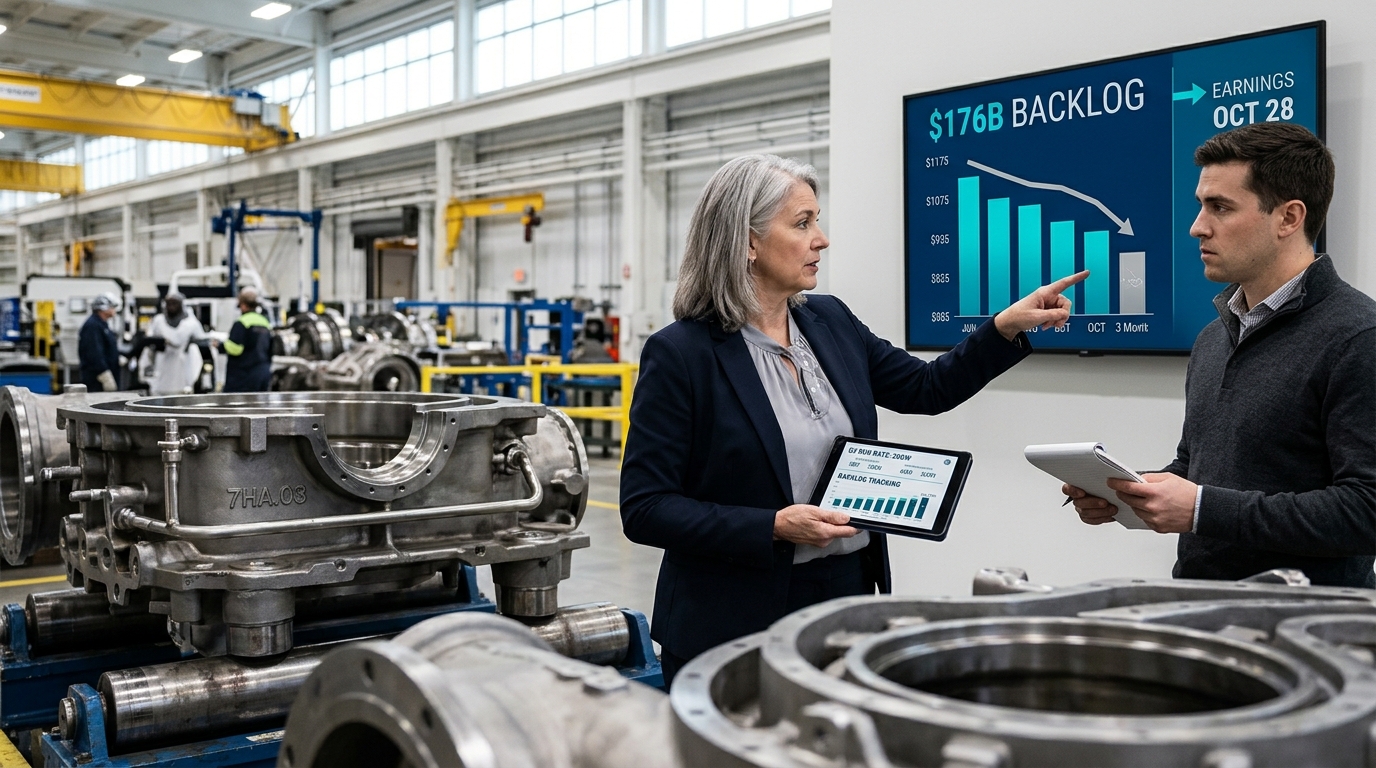
The backlog closed June at $176 billion, nearly four times what management expects to ship this year. Gas turbine equipment backlog plus slot reservation agreements reached 116 gigawatts by the end of Q2, up from 83 gigawatts at year-end 2025. Of that 116 gigawatts, 63 gigawatts were slot reservations rather than firm equipment backlog. CEO Scott Strazik said in September that the company should hit its $200 billion backlog milestone very early in 2027.
Why Wall Street Is Paying Attention
Full-year guidance calls for revenue of $45.5 billion to $46.5 billion and free cash flow of $11.5 billion to $12.5 billion. That FCF range is sharply higher than the $6.5 billion to $7.5 billion range the company guided to in April. Q2 free cash flow alone reached $5.1 billion, more than GE Vernova generated across all of 2025.
Analysts’ average price target sits near $1,224, roughly 48% above Friday’s close. BMO Capital reiterated a Buy rating on October 21. JPMorgan trimmed its target from $1,330 to $1,150 but kept an Overweight, which still implies sizable upside from current levels.
The bear case comes from GLJ Research, which initiated at Sell with a $470 target, calling GE Vernova a cyclical gas-turbine manufacturer priced like a secular compounder. That view has so far been wrong on the orders, but it frames the risk correctly: if the data-center buildout decelerates, a meaningful portion of the backlog loses its urgency.
The same AI data-center power demand driving GE Vernova’s order surge is reshaping rivals in the electrical equipment space. Eaton’s data center pipeline now represents 15 years of construction at 2025 build rates, yet the stock still trades at a discount to that opportunity.
What’s Driving the Opportunity
Tuesday’s report centers on three numbers: gas turbine output, margin progression, and cash conversion. If the turbine ramp showed up in the numbers and the cash conversion follows, consensus EPS near $4 looks achievable.
Beyond the quarter, the structural argument is durable. Electrification segment revenue grew 68% in Q2, driven by switchgear, transformers, and high-voltage direct-current solutions. Grid modernization is a decade-long cycle. The AI data center story amplifies it; it does not create it.
What Could Go Wrong
GE Vernova has missed EBIT estimates in each of the last five quarters. Last quarter’s EPS of $2.47 came in $0.70 below consensus. The Wind segment continues losing money, and Strazik has said data centers’ share of Electrification orders will likely be about 20% in Q3 and Q4, down from the first half’s pace. Slot reservations are not firm orders. How fast those convert to contracted revenue determines how quickly the backlog translates into earnings.
The conversion question — how fast a large backlog translates into contracted revenue and earnings — is not unique to GE Vernova. Vertiv’s book-to-bill of 2.9x and the operating leverage embedded in its $15 billion backlog show how that math can compound faster than consensus models.
The Bottom Line
GE Vernova is not cheap on trailing earnings. But paying a mid-20s multiple for a company with $176 billion in backlog, gas turbine output ramping toward a 20-gigawatt annual run rate, and free cash flow guidance that has been raised materially in 2026 is a different conversation than paying a mid-20s multiple for a cyclical manufacturer coasting on last cycle’s orders. Tuesday morning resolves the execution question. At roughly $825, the market is pricing in meaningful disappointment. If the turbine ramp showed up in the numbers, that discount closes fast.