October 15, 2026
Bonus Content: Carrier’s HVAC Machines Already Pull Water From Air
Below is an important message from one of our highly valued sponsors. Please read it carefully as they have some special information to share with you.
Hi, James Altucher here.
I’m reaching out today to relay epic three words, recently spoken by Elon Musk.
Infinite.
Money.
Glitch.
It sounds insane…
But that’s what Elon is calling a groundbreaking new class of technology about to take the world by storm.
I have put together a short presentation on what it is and why I believe this could be the biggest wealth event of our lifetime.
[ → Watch the presentation by October 21 ]
James Altucher
PS: I’m giving away a free report to anyone who watches this presentation today. It details Elon’s Musk’s unprecedented trillion-dollar compensation package and identifies the companies he NEEDS to hit his incentives. Just click here to watch the free video, and I’ll show you how to claim it. No credit card needed.
Carrier’s HVAC Machines Already Pull Water From Air
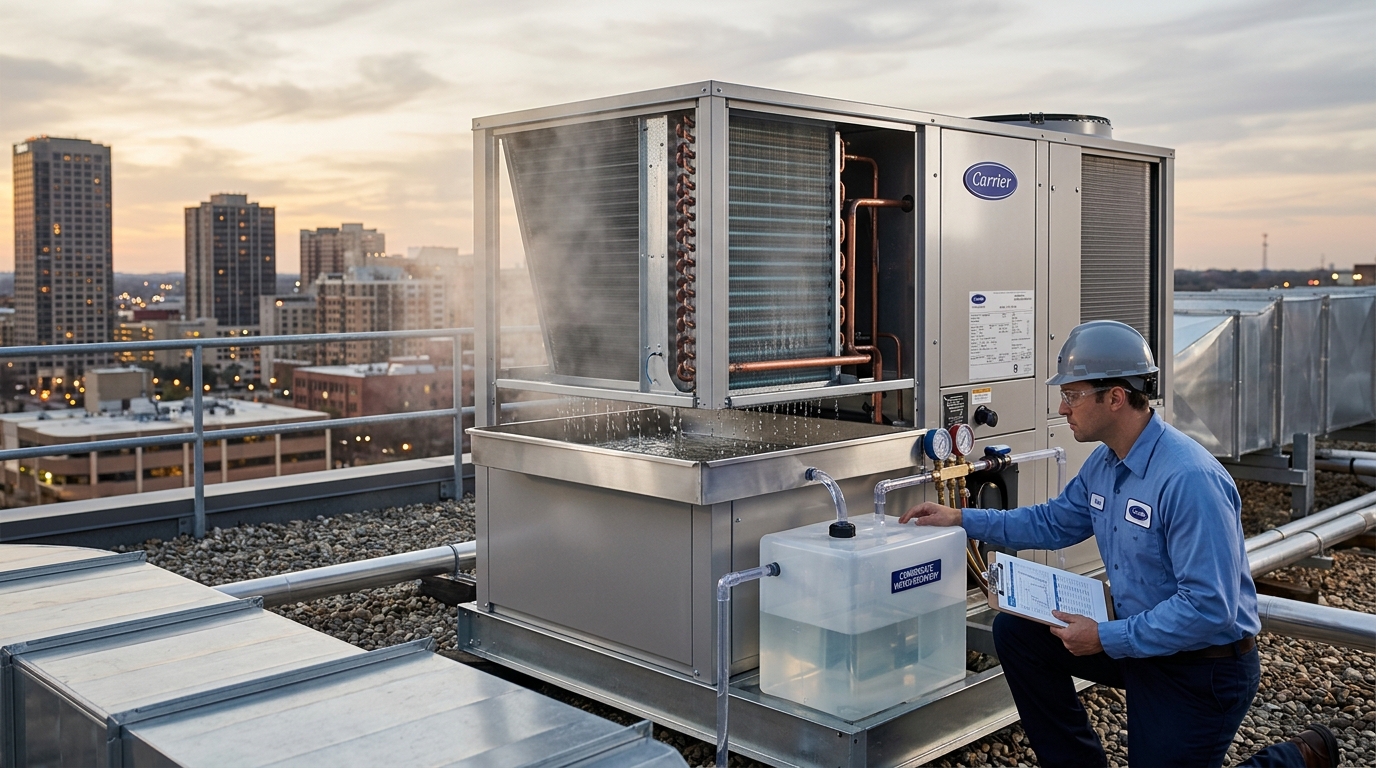
The question no one is asking about Carrier Global right now is also the most interesting one: what happens when the machine that cools your building also becomes the machine that waters your operations?
Atmospheric water generation, the process of condensing moisture directly from ambient air, is not a speculative technology. It is the same thermodynamic principle at the heart of every chiller and heat exchanger Carrier has been manufacturing for decades. The commercial atmospheric water generator market was estimated at about $3.1 billion to $3.3 billion in 2026 depending on the research firm, with some forecasts calling for roughly high-single-digit annual growth into the early 2030s. Rising demand for decentralized, on-site water generation is pushing adoption across industrial and commercial sectors. That demand is loudest in arid industrial zones, exactly where water-cooled infrastructure is already straining local supplies.
Carrier has not labeled itself an atmospheric water harvesting company. It does not need to. The company says it doubled its global data center revenue to $1 billion in 2025 and entered 2026 with backlog positioned for 50% growth in that vertical. The heat exchange infrastructure already deployed is the same platform that condenses, collects, and manages water vapor at scale. The gap between what the technology already does and what operators in Phoenix or Riyadh actually need is narrowing fast.
Water issues are most acute in the arid West, and Arizona has moved to stop approving some new development around metro Phoenix that relies on groundwater, after state modeling found shortages in parts of the region. The industrial segment is often cited as the largest slice of the atmospheric water generator market, but the exact share varies by source. Carrier’s commercial HVAC customers in those regions are the same companies running into tighter water constraints.
The stock itself is a separate conversation. CARR’s 52-week range runs from $50.24 to $76.76, and shares are currently trading near the low end of that band. Goldman Sachs downgraded CARR on October 14, 2026, cutting the target from $74 to $61 and moving the rating from Buy to Neutral. Mizuho, however, maintained its Outperform rating on October 15, 2026 while trimming its target from $75 to $70, implying roughly 25% to 30% upside from recent trading levels. Eleven analysts carry Buy ratings against ten Holds, with an average target of $70.43.
The bear case is real. Residential HVAC remains weak in the Americas, and the stock is down more than 20% from its June 2026 high and recently traded around $55. Q3 results land October 29, 2026, and near-term sentiment is cautious.
The bull case is structural. Carrier reported data center orders were up over 500% in Q1 2026. Every AI campus built in a water-stressed region is a potential customer for a cooling system that doubles as a water source. Carrier does not need to launch a new product line to capture this. It needs operators to ask the right question about equipment they are already buying. That shift is starting to happen, and the stock has not priced it in yet.
The catalyst for Carrier’s data center thesis depends on hyperscaler capex converting into real infrastructure orders. Azure’s 43% growth quarter confirmed that AI spending is now producing revenue at scale, which sustains the campus construction pipeline Carrier is selling into.