Hi,
Take a look at this…

It’s smaller than a fingertip…
It’s made of glass…
And it’s about to unlock the next wave of AI growth.
Jensen Huang, Nvidia’s CEO, says this “light-speed” device is shattering the limitations of AI… and without it, AI can’t scale.
Google Ventures says it’s the future of AI compute…
And Sequoia Capital – the firm that backed Anthropic and OpenAI – calls it a “holy grail.”
Already, Elon Musk, Mark Zuckerberg, Cathie Wood, and Bill Gates are moving money to prepare for what’s coming…
Yet most Americans have never heard of it.
Wall Street insider Jason Bodner – the same man who called Nvidia at $4.50 – says this device is about to launch a whole new wave of AI winners…
And to prove it, he’s giving away his #1 stock involved with it – for free.
Click here to learn more. (No purchase necessary.)
We have so much to look forward to,
Jeff Brown
Founder & CEO, Brownstone Research
P.S. Stocks tied to this “light-speed” device already surged 133%, 217%, and even 320% – in a few short months. But it’s just getting started. Click here before the mainstream catches on.
Xylem Just Bought a Mobile Water Fleet. Why It Works Now.
Somewhere between a drought declaration and a bond referendum, water infrastructure lost its patience for large capital projects. The change is not theoretical. It is showing up in earnings calls, acquisition announcements, and the way utilities are writing contracts in 2026.
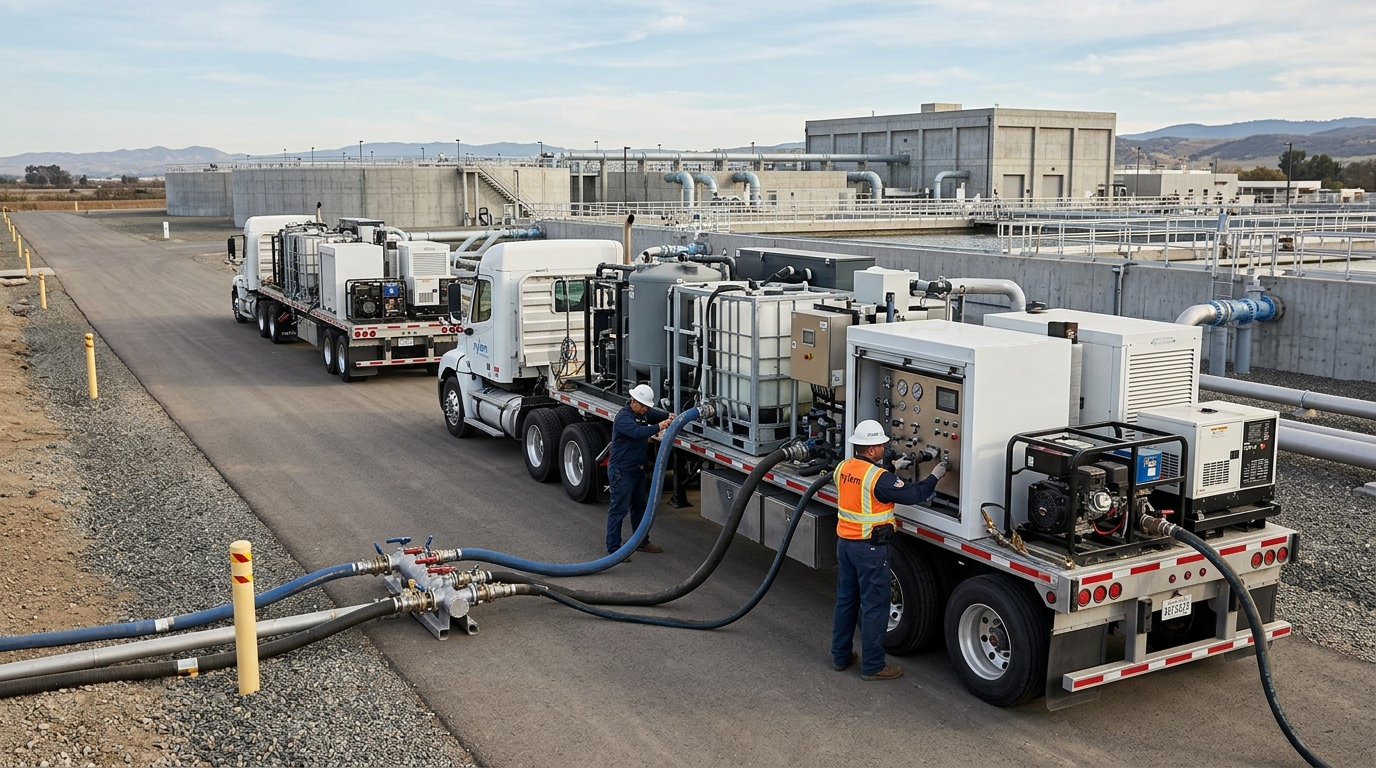
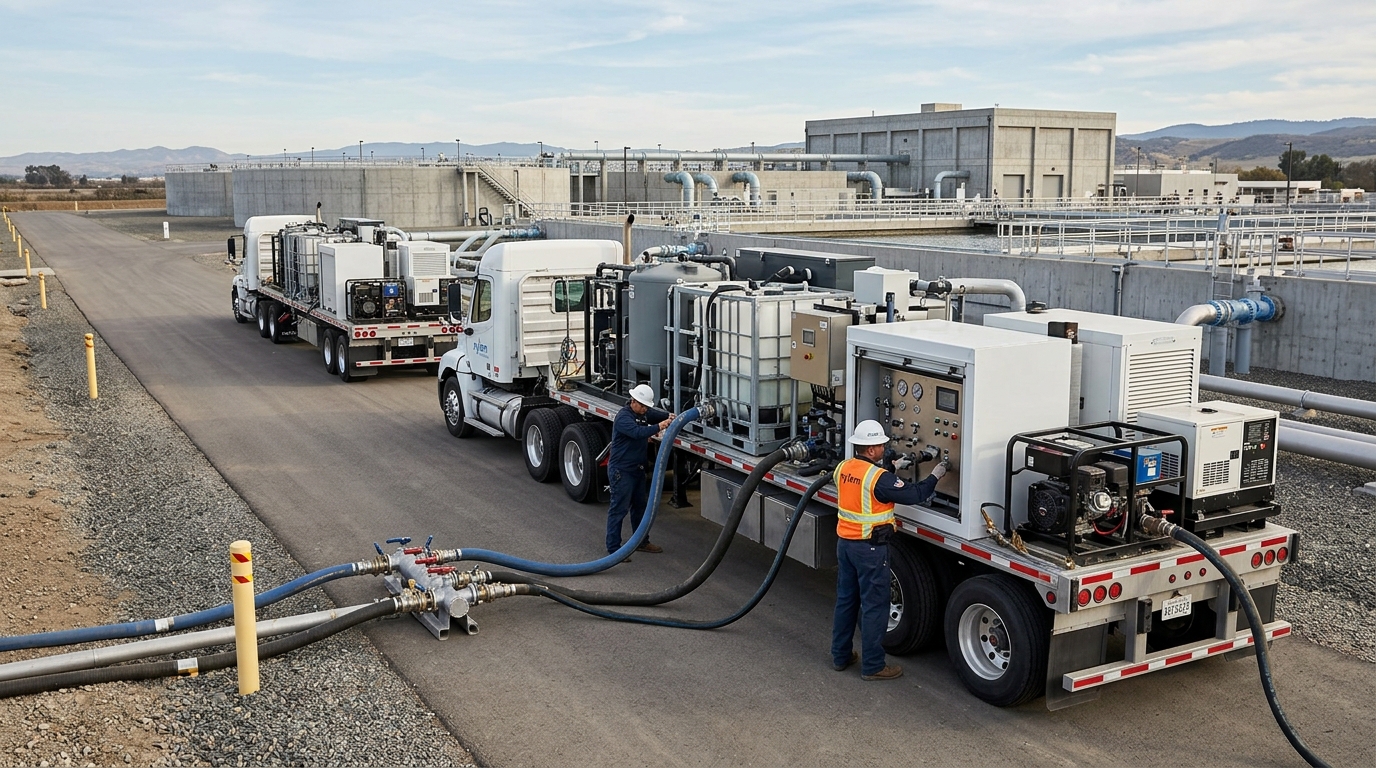
The model gaining ground is straightforward: instead of a municipality borrowing $40 million to build a reverse osmosis plant it may not fully need for a decade, a provider installs modular, containerized RO systems and charges a monthly fee for clean water delivered. Water-as-a-Service. The municipality converts a lumpy capital decision into a predictable operating line. The provider owns the asset, earns recurring revenue, and redeployes the hardware if the contract ends.
Operators are turning to mobile solutions for a simple reason: financial flexibility. That is not a vendor pitch. It is an economic reality accelerated by three converging forces: aging pipe networks, tightening PFAS regulations, and municipalities that are structurally short on capital.
Bluefield Research has projected U.S. municipal capital expenditure for water and wastewater treatment infrastructure of about $515.4 billion through 2035. The staggering number obscures the problem: most smaller utilities cannot front that kind of spend, even when the long-term need is obvious. That gap is where the service model fills in.
Xylem (NYSE: XYL) is the most compelling public way to own this transition right now. The company delivered about $9.0 billion in revenue in 2025, and its second-quarter 2026 results sharpened the case. In prepared remarks and on the Q2 call, management pointed to major contract wins, including the largest in company history, and said it has been reshaping the portfolio through more than $400 million of divestitures alongside targeted acquisitions to build out digital and mobile water treatment capabilities.
WaterFleet is not a side bet. In Xylem’s Q2 2026 SEC filings, the company disclosed that it entered into a definitive agreement on July 24, 2026 to acquire 100% of WaterFleet Intermediate Holdings, Inc., a mobile water and wastewater utility services provider, for approximately $200 million (subject to customary adjustments). That is a direct bet on the OPEX model challenging the old CAPEX playbook.
On profitability, Xylem’s Q2 2026 adjusted diluted EPS was $1.46, up from $1.26 a year earlier. Management also said ending backlog was $5.3 billion, with book-to-bill for the quarter well above one, and it raised full-year 2026 adjusted EPS guidance to $5.55 to $5.70. Full-year 2026 revenue guidance was narrowed to roughly $9.2 billion.
The less-obvious catalyst is AI infrastructure. On the Q2 2026 call, management framed data centers as an early indicator of a broader opportunity across the AI ecosystem, from data centers to semiconductors and power. Xylem has said it expects data-center-related revenue to increase by about 200% in 2026.
The risks are real. Mobile treatment is moving beyond emergency response, but adoption still takes time, and Xylem’s Q2 organic growth was about 1%. A prolonged soft cycle in European and Chinese municipal spending could drag the headline number for several quarters before a larger Water-as-a-Service revenue base compounds meaningfully.
Still, the direction is clear. Municipalities cannot afford the old model. Providers who own modular hardware and earn recurring fees are positioned to grow through the infrastructure gap rather than waiting for bond markets to open. Xylem, with a $5.3 billion backlog and a signed agreement to buy WaterFleet, is one of the cleanest public expressions of that shift available today.