
Hurricane Isaias is expected to make landfall late Friday, October 9, or early Saturday, October 10, along the northern Gulf Coast, and the trading question is not whether prices move. They already have. The storm has knocked 1.28 million barrels per day of U.S. Gulf oil production offline, up from just 185,120 bpd two days ago as operators cleared personnel from the storm’s path. That kind of acceleration is notable, but offshore shut-ins are the easier half of this story.
The harder half sits onshore. Approximately 14% of U.S. refining capacity lies within or near the hurricane’s projected path, while refineries are running at 95% utilization and gasoline and distillate inventories sit at multi-decade lows. There is no buffer. “This could not have come at a worse time as gasoline and diesel inventories are quite low,” wrote Andy Lipow of Lipow Oil Associates, adding that nearly all U.S. offshore production is in Isaias’ path, meaning “the impact, even short-lived, can be significant.”
The Refinery Map
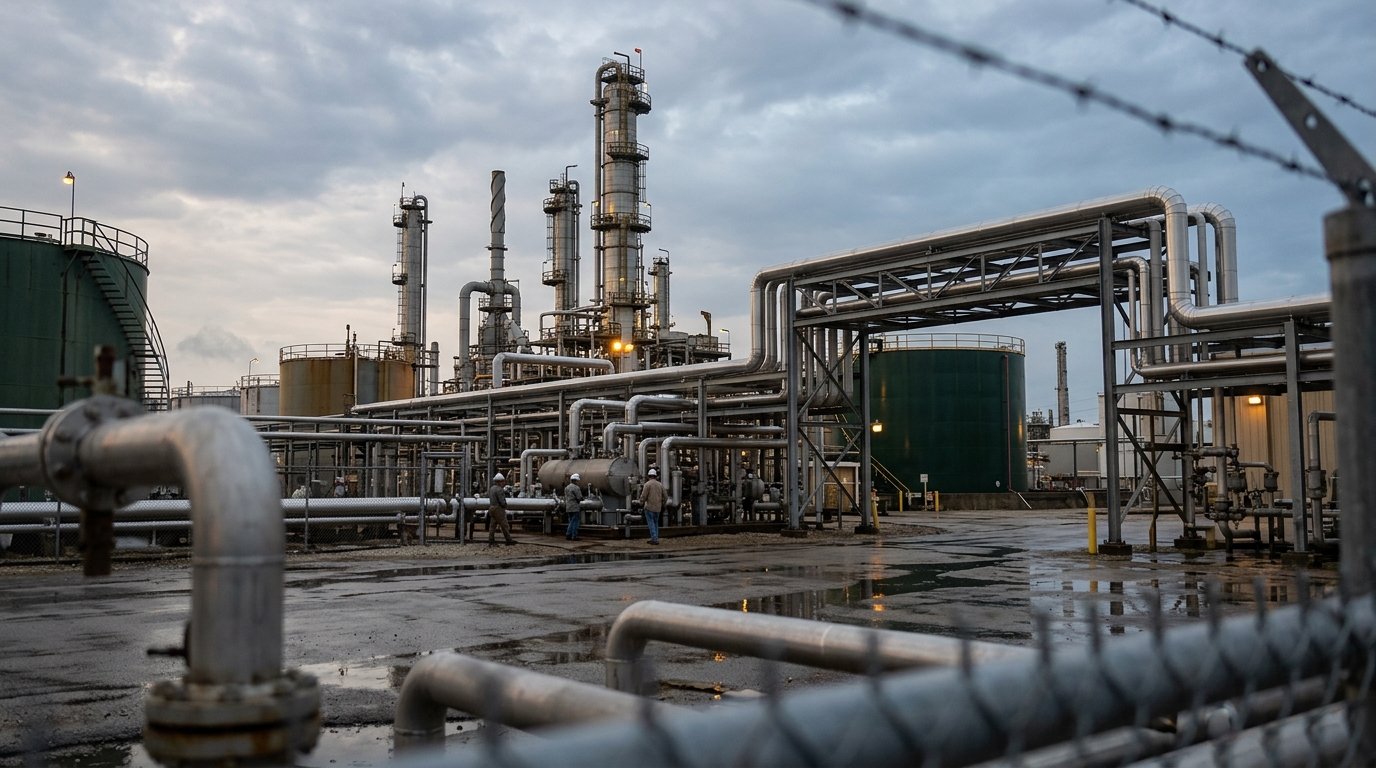
The eastward track shift toward Alabama and the Florida Panhandle gives Louisiana’s Mississippi River plants some breathing room, but it does not take the biggest exposures off the board. Plants relevant to the storm’s path include Marathon’s Garyville facility at 617,000 b/d, Chevron’s Pascagoula at about 369,000 b/d, Shell’s Norco at 231,153 b/d, and Valero’s St. Charles and Meraux plants. Chevron’s Pascagoula refinery and Vertex’s 88,000 b/d plant at Saraland, near Mobile, are the closest to the current forecast track.
Any prolonged disruption at Pascagoula would add immediate pressure to tight domestic supplies. Garyville, as Marathon’s (MPC) largest asset anywhere in its system, carries similar consequence for crack spreads. Valero (VLO) and Phillips 66 (PSX) have less direct refinery exposure to this exact landfall zone, but both benefit from any spike in distillate crack spreads if total Gulf Coast throughput falls.
Why Diesel Is the Number to Watch
Diesel prices set a record in September and were around $6.32 a gallon as of October 6, based on AAA’s national average. EIA reports East Coast distillate inventories were 32% below their five-year seasonal average in September and expects retail diesel to stay above $6 a gallon in October. Any flooding that keeps a Gulf Coast plant offline extends that deficit.
Refineries in the path of Isaias are likely to see flooding that could take them offline for up to 10 days, according to GasBuddy’s Patrick De Haan, which is expected to produce a short-term squeeze for U.S. gasoline prices. A 2023 EIA analysis found that a high-impact scenario disrupting roughly 1.5 million b/d of offshore production and similar refining capacity could temporarily raise average U.S. gasoline prices by about 25 to 30 cents per gallon.
The Insurance Side
On losses, early industry commentary has generally framed a low-to-mid single-digit billions insured-loss range as plausible, using analogs such as Hurricane Sally for context. Separately, Cotality said 777,000 homes are at wind risk in the storm’s corridor. That range matters for positioning in Chubb (CB), Travelers (TRV), Everest Group (EG), and RenaissanceRe (RNR). Gallagher Re noted that ample reinsurance-market capital makes the storm unlikely to materially affect discussions ahead of January reinsurance renewals. Chubb reported a 95.7% property and casualty combined ratio in the first quarter of 2025. A low-single-digit-billion event is digestible. A track shift west toward Garyville changes that math.
Trader’s Action Plan
The bifurcation is clean. If Isaias clears the coast without major refinery damage, offshore shut-ins restart within days and the price impulse fades. MPC and VLO likely outperform in that scenario as crack spreads normalize from a higher base. If Pascagoula or Garyville reports flooding, the diesel trade extends, refiner margins compress near-term on throughput loss, and insurance names face a larger claims revision than current estimates assume. Watch the Colonial Pipeline operating notices and any refinery damage reports Saturday morning. That is where this trade resolves.