October 3, 2026
Bonus Content: Nitrogen at $915 a Ton. Smart Applicators Cut the Bill.
Below is an important message from one of our highly valued sponsors. Please read it carefully as they have some special information to share with you.
Dear Reader,
Two of the most powerful men in technology, Elon Musk and Sam Altman, cannot stand each other. They have sued each other. They have been at war for years.
But within days of each other, both of them said the exact same peculiar thing: we are living at a tipping point in human history. They call it “the Singularity.”
I expect it will set off an unstoppable technological explosion. And that it will create unimaginable wealth for a small group of people.
For fifty years the idea was science fiction. Now the two men racing to build it say it is already here.
I have connected it all to something Elon could be about to switch on. He calls it his “infinite money glitch.”
I lay out what these two men see coming in a short presentation. Watch it immediately.
[ ▶ Watch the presentation here]
Regards,
James Altucher
Nitrogen at $915 a Ton. Smart Applicators Cut the Bill.
Commercial corn growers planning their fall nitrogen applications are staring at a number that refuses to cooperate. University of Illinois farm economists put anhydrous ammonia at $915.50 per ton in early August in Illinois, 16% above a year earlier and 23% above 2024. That is not a one-month aberration. Farmdoc Daily and other industry trackers show prices started 2026 already elevated, averaged about $828 per ton from September 2025 through February 2026, then spiked above $1,100 per ton from early April into mid-June as the Iran conflict disrupted energy and fertilizer trade flows. Volatility is still expected to stay elevated as the conflict continues.
The broader picture is worse. DTN data cited widely across farm media showed urea jumping 35% in a single month earlier this spring to an average of $826 per ton. Rabobank has also flagged poor fertilizer affordability, with its affordability index in negative territory and projecting constraints that extend beyond 2026.
This is where the business case for precision tractor attachments shifts from agronomic to financial. Fertilizer can represent 30% or more of a farm’s total input costs, and many precision nutrient programs report fertilizer savings in the 15% to 20% range while maintaining or improving yields. On a 2,000-acre corn operation applying 180 pounds of nitrogen per acre at current anhydrous prices, a 15% reduction translates to real money, not a rounding error.
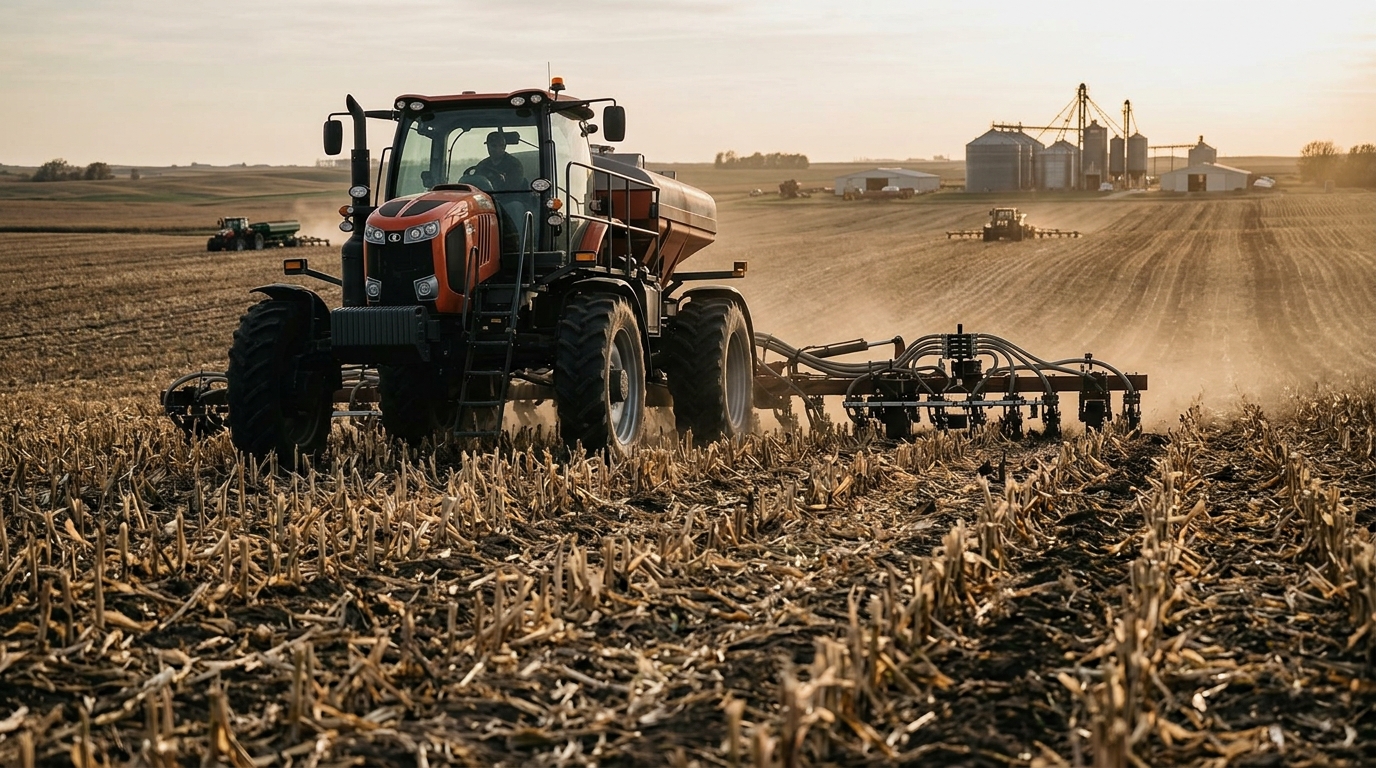
The hardware to capture those savings has matured considerably. The industry push is toward closed-loop automation: systems that blend field data layers such as imagery and soil information with rate control, so the applicator can vary doses by zone with high-accuracy GPS guidance. John Deere has added variable-rate capability to See & Spray Select for model year 2026 machines, targeting variable-rate applications such as later-season fungicides and desiccants. Case IH’s SenseApply system, which supports Live variable-rate application across liquid and granular use cases including nitrogen, takes a different commercial angle: the company positions Live VRA as an unlimited license with no annual subscription and no per-acre fees, with the technology designed to be adaptable across supported machines.
For farms already running established tractor fleets, the retrofit argument is compelling. Keeping an existing fleet can reduce new capital costs, and variable-rate upgrades can improve placement and rate accuracy without replacing every machine. Research and extension literature also shows variable-rate fertilizer systems can materially reduce total nutrient applied in the right conditions, but results vary by field variability, crop, and management approach.
The risk is real too. Precision equipment requires accurate prescription data to deliver its savings. Profitability outcomes can swing widely when prescriptions are poor versus when nutrient rates closely match field needs. Farmers who invest in mapping, soil sampling, and sensor calibration get the upside. Those who bolt on the hardware without the data infrastructure may not break even.
The broader investment opportunity sits with the attachment and software makers rather than the fertilizer producers themselves. Tight supply and persistent price pressure are a durable demand driver for anything that reduces how many pounds of nitrogen a farm needs to buy. In the January 2026 Ag Economists’ Monthly Monitor, Farm Journal reporting said input prices remained the biggest hurdle to profitability for producers in 2026. That problem does not go away when the geopolitical situation stabilizes. It simply becomes the baseline.