
Dear Reader,
The biggest mistake investors made during America’s first Great Deflation was buying the railroads.
More than 100 of those railroads eventually went bankrupt.
The best investments were the companies that used collapsing freight costs to crush their competition.
And I believe investors are making the exact same mistake with AI today.
They’re piling into the obvious “railroads”: NVIDIA, Microsoft, Meta, and Google.
Meanwhile, one little-known aerospace manufacturer has connected 19 factories around the world into a single AI-ready data system.
And it is already producing remarkable results.
Its record profit margins climbed 25% year over year.
Revenue rose 11% last year.
But I don’t believe the story is finished.
This company isn’t trying to build the next artificial-intelligence empire. It’s using AI to make every factory faster, leaner, and more profitable.
It has now hit all five triggers in my proprietary stock-selection system, including accelerating sales, rising earnings, breakout momentum, insider buying, and meaningful disruption.
Don’t make the mistake of chasing the railroad while this potential “Price Killer” races ahead.
Good investing,
Alexander Green
Chief Investment Strategist, The Oxford Club
P.S. 19 connected factories, record margins, and all five of my triggers tell me the larger story may still be ahead.
See my larger prediction here.
ExxonMobil’s Pioneer Synergies Doubled. Q3 Earnings Are Oct. 30.
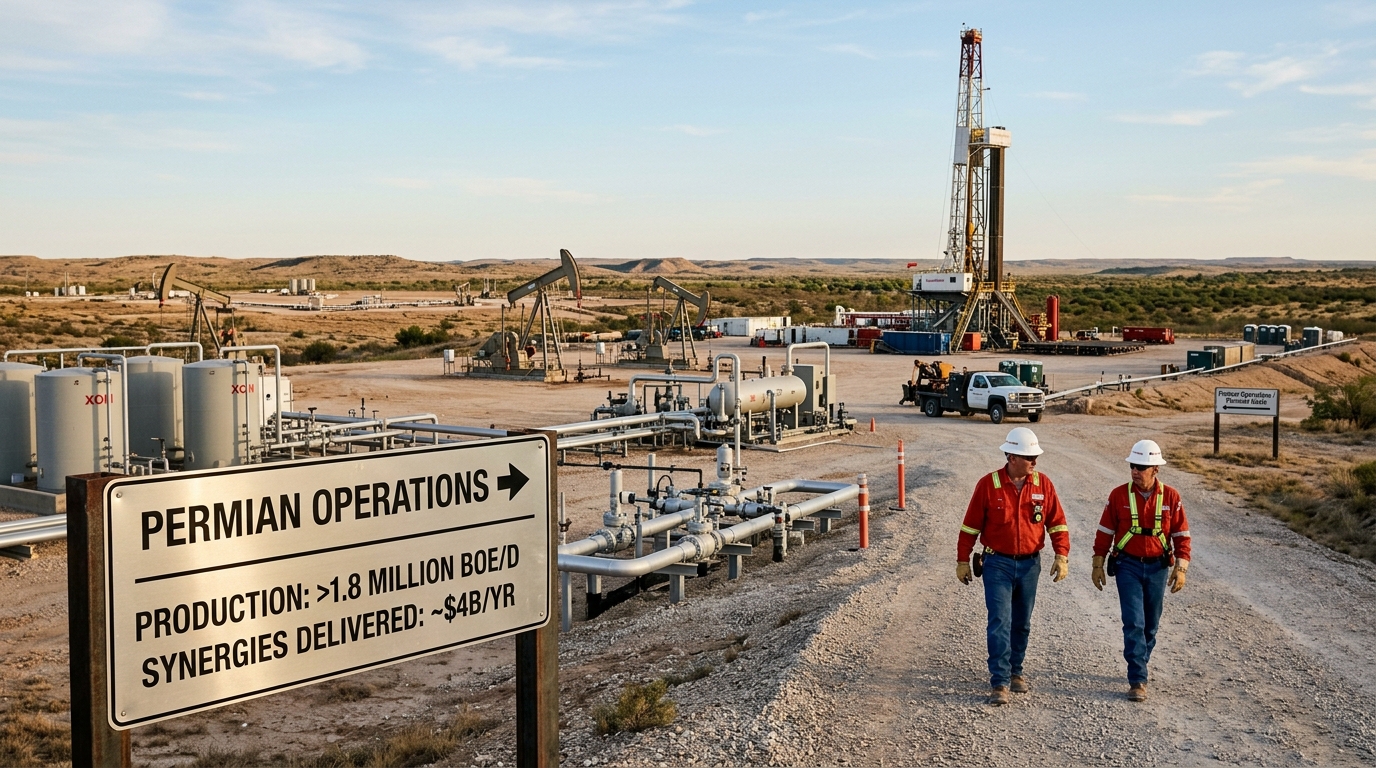
ExxonMobil presented at the Barclays 40th Annual Energy-Power Conference this month and disclosed a number that deserved more attention than it received. The Pioneer Natural Resources acquisition, which closed on May 3, 2024, is now generating approximately $4 billion in annual synergies, double the initial estimate. The company said it is using 40 technologies to improve recovery rates and capital efficiency across the Permian Basin, with a long-term goal of doubling recovery from current levels.
Doubling a synergy target two years into an integration is either a sign of strong operational execution or evidence that management sandbagged the original projection. Either way, it changes the long-term earnings math on what the Permian represents for shareholders over the next decade.
Production numbers back the claim. Permian output hit a record above 1.8 million oil-equivalent barrels per day in Q2 2026. ExxonMobil’s 2030 plan calls for growing that figure to approximately 2.5 million oil-equivalent barrels per day. If achieved, the Permian alone would represent a much larger share of company output. Meanwhile, ExxonMobil has said its Guyana investment costs were recovered roughly two years ahead of schedule, with that milestone expected to double free cash flow between 2025 and 2030.
The Q2 results, released July 31, showed the broader machine running hard. Adjusted earnings came in at $14.7 billion. Free cash flow reached $17.2 billion. The company returned $9.4 billion to shareholders in the quarter through $4.3 billion in dividends and $5.1 billion in buybacks. A $1.03 per share quarterly dividend for Q3 was paid September 10. Combined, the annualized dividend and buyback pace produces a total shareholder yield of roughly 5.8%.
The macro environment is cooperating. Brent crude was around $90 per barrel in mid-September, after averaging in the low-to-mid $80s earlier in the summer. ExxonMobil has disclosed that each $1 move in Brent translates to roughly $700 million in annual upstream earnings, which means the current pricing environment is a meaningful tailwind heading into the October 30 Q3 report.
The risks are real. Adjusted EPS of $3.52 in Q2 came in below some analyst forecasts, and shares fell about 2% on the day. Any softening in crude prices into Q3 reporting could trigger a similar reaction. Guyana entitlement volumes are expected to decline beginning in Q3, a modest drag on the production story. The Venezuela investment discussions remain unresolved, adding a geopolitical variable with outcomes ranging from immaterial to significant.
The structural case does not depend on oil staying at $90. Pioneer synergies at $4 billion annually, a net debt-to-capital ratio of 10.7%, $16.3 billion in structural cost savings achieved to date, and an earnings growth target of $25 billion through 2030: these are not cyclical arguments. They are execution arguments. With Q3 earnings six weeks away and Brent holding around $90, the window to own that execution story ahead of the catalyst is open now.