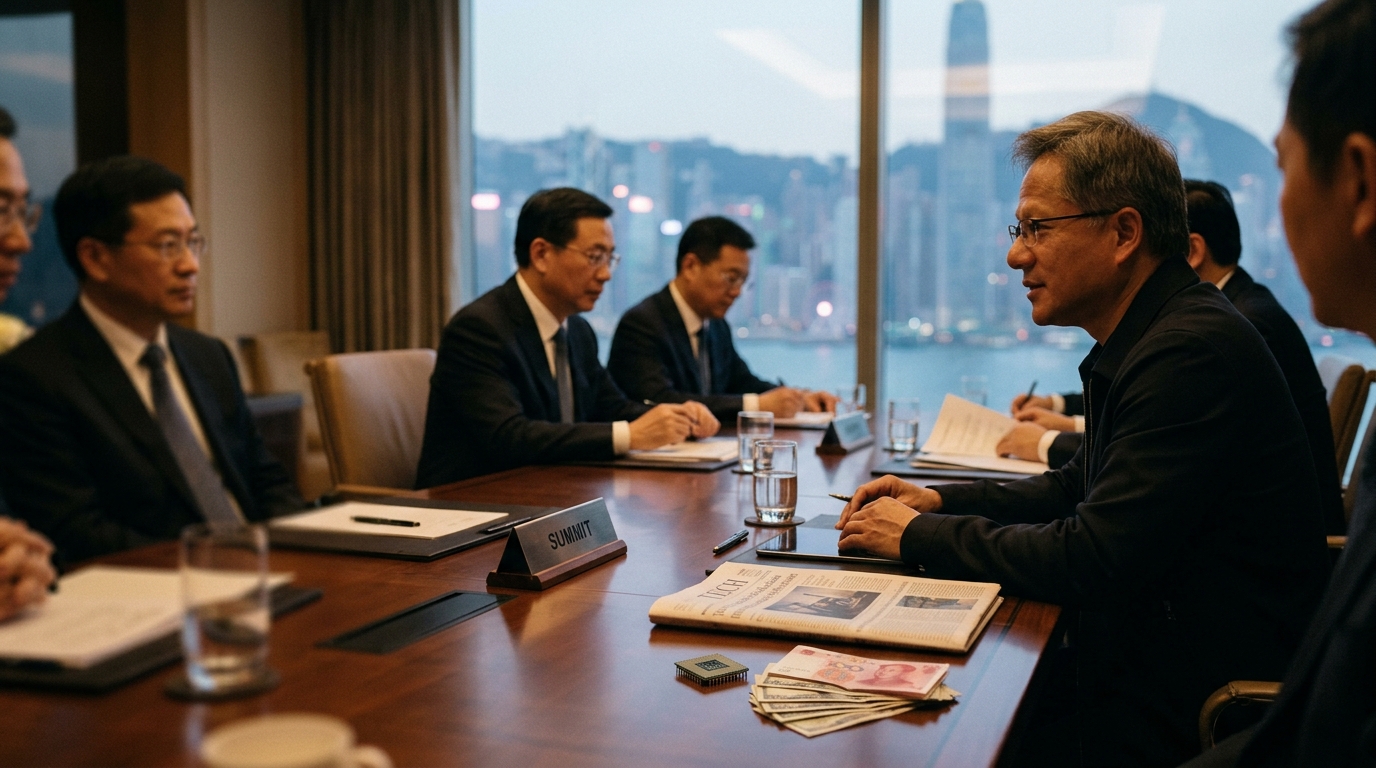
Five days out from the most consequential scheduled event of the trading week, the market already knows what a smooth summit is worth. Chinese stocks rebounded Friday with the blue-chip CSI 300 logging its best day in a month, closing 1.1% higher, while the Shanghai Composite rose 0.9%. That move came entirely on anticipation.
The White House has confirmed the September 24 date from its end, and Trump has spoken confidently about the meeting, but Beijing has not made an equivalent public announcement of Xi’s travel plans. The reason is specific: Kyodo News reported that China has warned it will cancel the summit if Washington approves any new arms sale to Taiwan before the visit, with the warning attributed to Chinese officials. A senior U.S. official disputed the account in comments carried by the Daily Caller News Foundation. The conflicting signals are themselves the risk.
The White House has not left the week ambiguous on intent. Trump will greet Xi Jinping and his wife, Peng Liyuan, at Joint Base Andrews on Wednesday, September 23. On Thursday, September 24, the two leaders are scheduled to hold a bilateral meeting at the White House, followed by a state dinner in the East Room. OpenAI CEO Sam Altman and Nvidia CEO Jensen Huang are planning to attend the dinner, along with Tim Cook, who recently stepped down as Apple’s CEO. Huang’s presence at a diplomatic dinner is not ceremonial at this scale. AI is expected to be a main topic of discussion. Before U.S. export curbs tightened, Nvidia had about 95% market share in China’s advanced AI accelerator market, and Huang has said the China AI chip market could be about $50 billion.
Where Capital Is Moving
Technology stocks led Friday’s mainland session, with chip and AI-related names leading gains in both mainland China and Hong Kong. That rotation tells you what institutional money is pricing: a chip-access thaw, not a broad trade deal. U.S. Treasury Secretary Scott Bessent is scheduled to meet Chinese Vice Premier He Lifeng this weekend in New York for final preparatory talks, with AI competition and China’s access to advanced U.S. chips among the expected topics.
For U.S.-listed vehicles, the picture is more differentiated than Friday’s green flow suggests. FXI, which tracks the 50 largest Hong Kong-listed Chinese names, carries less internet concentration and has broadly outperformed KWEB year-to-date. KWEB, focused on Chinese internet names including Alibaba and Tencent, has more direct exposure to any chip-access headline but more downside in a breakdown. Alibaba has particular relevance: Reuters reported in May that the U.S. Commerce Department cleared around 10 Chinese companies, including Alibaba, Tencent, ByteDance, and JD.com, to purchase Nvidia’s H200 chips.
The Trading Plan Into Thursday
The market has already priced some probability of success. The trade is not buy everything and wait. It is to hold measured exposure in FXI and BABA where the fundamental catalyst is clearest, while keeping KWEB positions sized for a binary outcome rather than a base case. Nvidia has its own event-driven logic: policy unpredictability is now a permanent feature of Nvidia’s China strategy, and the H200 framework creates a pathway to China sales, but the conditions attached can pressure margin. A summit that produces expanded chip licenses is a legitimate positive catalyst for NVDA. A cancelled summit is a significant negative.
The exit condition is not ambiguous. A cancelled or downgraded summit would likely revive the trade friction story that had eased since the May Beijing meeting, with implications for sectors tied to that fragile detente. That means cutting China ETF exposure immediately if pre-summit headlines indicate Xi is not traveling. The May summit offered a useful historical parallel: after that Beijing meeting, Chinese stocks halted their rally and the CSI 300 slid 0.3% on the week, as the absence of substantive breakthroughs prompted profit-taking rather than a fundamental sentiment shift.
Reports suggest the U.S. is likely to postpone any new tariff announcements tied to its excess-capacity trade investigation until after next week’s summit, which provides a short-term floor. But a floor is not a thesis. The thesis is Huang at the table, chip licenses on the agenda, and Beijing traveling to Washington. If Beijing confirms by Tuesday, add. If the Taiwan arms issue forces a postponement, step aside entirely until the diplomatic calendar resets.