August 8, 2026
DV’s $13.60 Deal. The Arb Is Small.
Nielsen is buying DoubleVerify. The bigger trade is what happens to “independent” verification.
First a note from Brownstone Research
Editor’s Note: Former tech executive Jeff Brown picked Nvidia in 2016. It’s up 25,155% since. He recommended Bitcoin at $240. It’s up 31,219% since. And he’s been ahead of the curve on Elon Musk’s businesses for over a decade. In fact, he was one of the first to predict SpaceX’s IPO. But today, he says this goes beyond SpaceX. Elon is building something even bigger. And you can get in right now, on the ground floor. Read more below…
Dear Reader,
I’ve been following Elon’s career for decades…
When the mainstream media said Tesla would fail…
I doubled down.
And the stock has risen 1,510% since.
I’ve inspected Elon’s facilities around the country…
And I was one of the first to predict SpaceX’s IPO.
Now, I believe Elon is about to make his latest invention available to the public.
When he does, sales could go through the roof.
And the stock price of one of his critical partners could soar.
I expect Elon to make this announcement any day now. By the end of the month at worst.
But you never know with Elon…
He could post it on X tomorrow.
So there’s very little time to act.
Click here to find out the name of Elon’s critical partner… The company he can’t live without.
Before it’s front page news.
Regards,
Jeff Brown
Founder & CEO, Brownstone Research
DV’s $13.60 Deal. The Arb Is Small.
Nielsen is buying DoubleVerify. The bigger trade is what happens to “independent” verification.
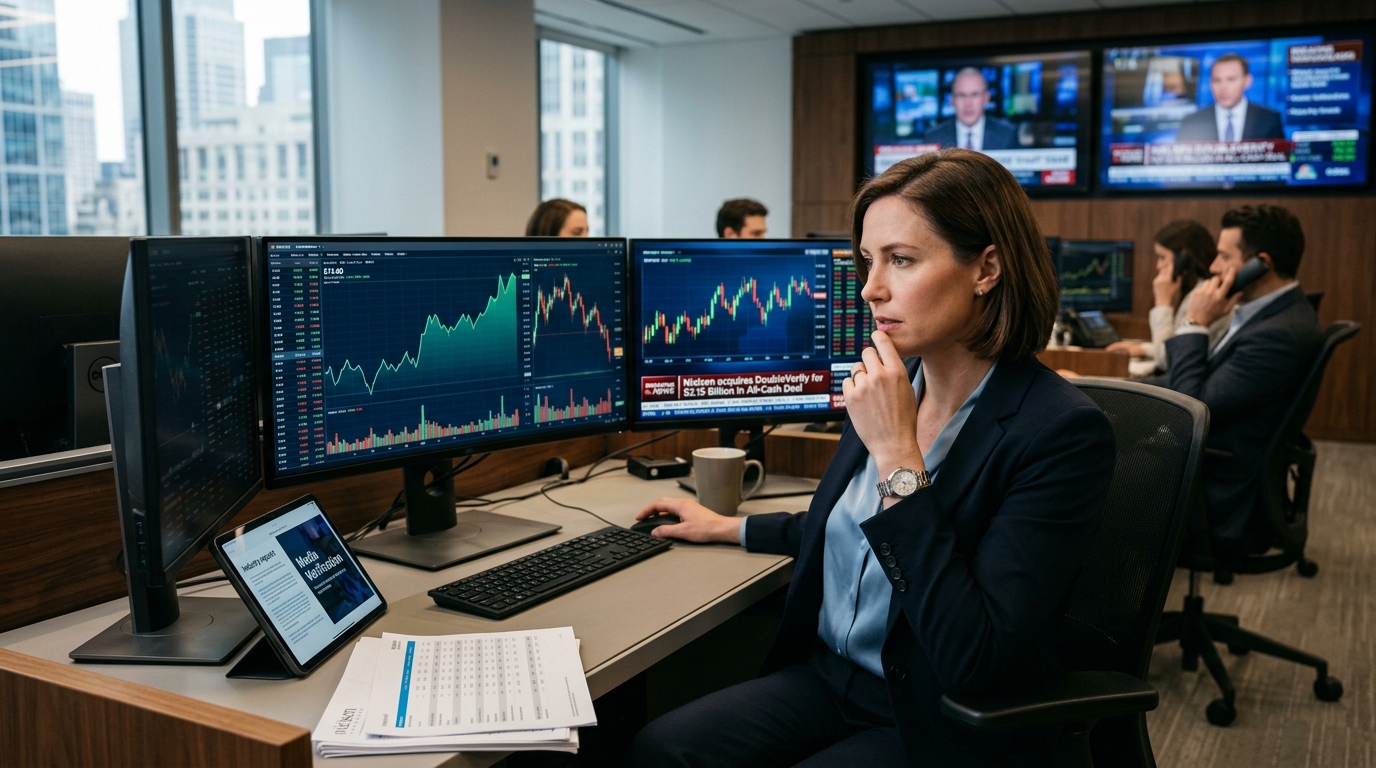
DoubleVerify closed at $11.71 on August 6, 2026. The next day, Nielsen put a number on the table: $13.60 per share in cash, valuing DV at roughly $2.15 billion. The stock immediately snapped toward the offer price, because the market understood what this is: a defined exit with limited variance.
So yes, there is a merger-arbitrage trade here. But the spread is not the headline. The headline is that the public market is losing another “independent referee” in ad tech, and the buyer is the company most associated with being the referee in TV measurement.
Why This Stock Now
This is a rare situation where the price target is written into the press release. If the deal closes, DV is functionally capped at $13.60, and the remaining return is mostly time value, not business upside.
The boards have approved the transaction and the companies are targeting a Q1 2027 close, subject to shareholder and regulatory approvals. Nielsen said it plans to finance the acquisition with cash on hand and committed debt from Barclays, BofA Securities, and Citi. That matters because it reduces the “did the buyer actually line up funding?” risk that blows up a lot of otherwise clean deals.
In other words: the trade is straightforward, and that is exactly why the strategic angle is the more important one to focus on.
The Business
DoubleVerify sells one thing advertisers keep paying for even when budgets tighten: proof.
DV verifies that ads ran where they were supposed to run, in front of real people, in suitable environments. Its tools span viewability, brand safety, fraud detection, and measurement layers that buyers use to decide whether inventory deserves premium pricing.
As a business, DV has not been “broken.” The problem was that it started getting valued like it was. The stock had been under pressure as growth slowed and platforms pushed more measurement in-house. That is the backdrop for why a cash bid at $13.60 clears the market so quickly.
The 60-Second Change That Stays With You
One small setting could change how you enter and exit every options trade. It’s easy to overlook, but many beginners learn its importance the hard way. Discover the permanent rule inside Your First Trade Playbook – free for a limited time.
Here is the tell: when a category’s leading players keep leaving public markets, it is usually not because the products stopped mattering. It is because the public-market multiple no longer pays you for the work required to defend the position.
Why Wall Street Is Paying Attention
The DV deal is not a one-off. It is the second big confirmation that “verification as a standalone public software story” has lost sponsorship.
Integral Ad Science, DV’s closest large competitor, entered a definitive agreement to be acquired by Novacap for $10.30 per share in cash, valuing IAS at about $1.9 billion. With Nielsen absorbing DV, the two best-known independent verification brands have effectively moved off the public-board scoreboard in a short window.
Why would Nielsen want this asset now? Because Nielsen is trying to own the full loop: plan, buy, verify, and measure. It already has the brand recognition and distribution in audience measurement. Adding DV gives Nielsen a “quality and suitability” signal that can travel with the audience currency.
Nielsen’s broader push has been to modernize TV measurement with hybrid data. The Media Rating Council accredited Nielsen’s Big Data + Panel national TV measurement in January 2025. That framework combines a panel of roughly 42,000 households with big data from about 45 million households and 75 million devices. If Nielsen can staple DV’s verification layer to that measurement footprint, it becomes a much stronger negotiating counterweight with agencies heading into 2027 planning cycles.
What’s Driving the Opportunity
Start with the practical: DV has effectively been “put in play” at $13.60. The market will treat that level as the magnet until something changes in the deal path.
Now the strategic: the most valuable thing DV sold was not a dashboard. It was independence.
Advertisers want a neutral third party because neither side in an ad transaction has a clean incentive to grade their own homework. DV’s position was built on being the outside verifier that both buyers and sellers could live with.
Nielsen is also a grader, but it is a grader with market power, history, and baggage. That does not mean the combined offering fails. It means the new product has to overcome a trust hurdle that DV did not have to fight as hard.
If the combined platform is accepted as “neutral enough,” the upside is obvious: fewer vendors, one set of standards, and a tighter link between delivery, quality, and outcomes. If it is not accepted, this deal accelerates a shift where large buyers diversify measurement and verification relationships rather than consolidating them.
What Could Go Wrong
Deal drift is the first risk. A Q1 2027 target means time is doing the heavy lifting. Spreads can widen on regulatory questions, financing market volatility, or simply “nothing happening” for months.
Process noise is the second risk. Post-announcement shareholder-rights reviews are common in transactions like this. They are often more headline than substance, but they can still create delays.
Trust is the real risk, and it sits beyond closing. If major agency groups or large advertisers resist Nielsen-owned verification, the integration rationale weakens. Nielsen can still close the deal and still have a valuable asset, but the “one contract, one standard” dream becomes harder to sell.
Trump: Don’t Mess With This American Stock!
One little-known U.S. stock is 20x cheaper than AMD – yet more profitable than Airbnb, Chipotle, and Hilton.
Backed by Trump and now partnering with a top AI firm, it’s poised to explode.
The Bottom Line
If you own DV today, the decision is not about a blue-sky upside case. It is about whether you prefer a defined cash exit at $13.60 versus redeploying capital into situations with wider payoff tails.
The better read-through is what this says about the market’s next phase. Nielsen is not paying $2.15 billion for a quarter of numbers. It is paying to control a choke point in measurement: the layer that decides whether an impression was worth paying for.
My view: the arb is fine for the right portfolio, but the real opportunity is to watch the second-order winners and losers. If agencies lean into Nielsen’s “one data layer” pitch, the measurement stack consolidates. If they do not, the demand for alternatives grows, and competitors get a fresh opening precisely because Nielsen bought the independent referee.