Intel had the best first half of any major semiconductor stock in 2026. Up roughly 640% from its 52-week low, the stock touched $142.34 on June 30 and looked like the most remarkable corporate turnaround in chipmaking history.
Then the floor opened up.
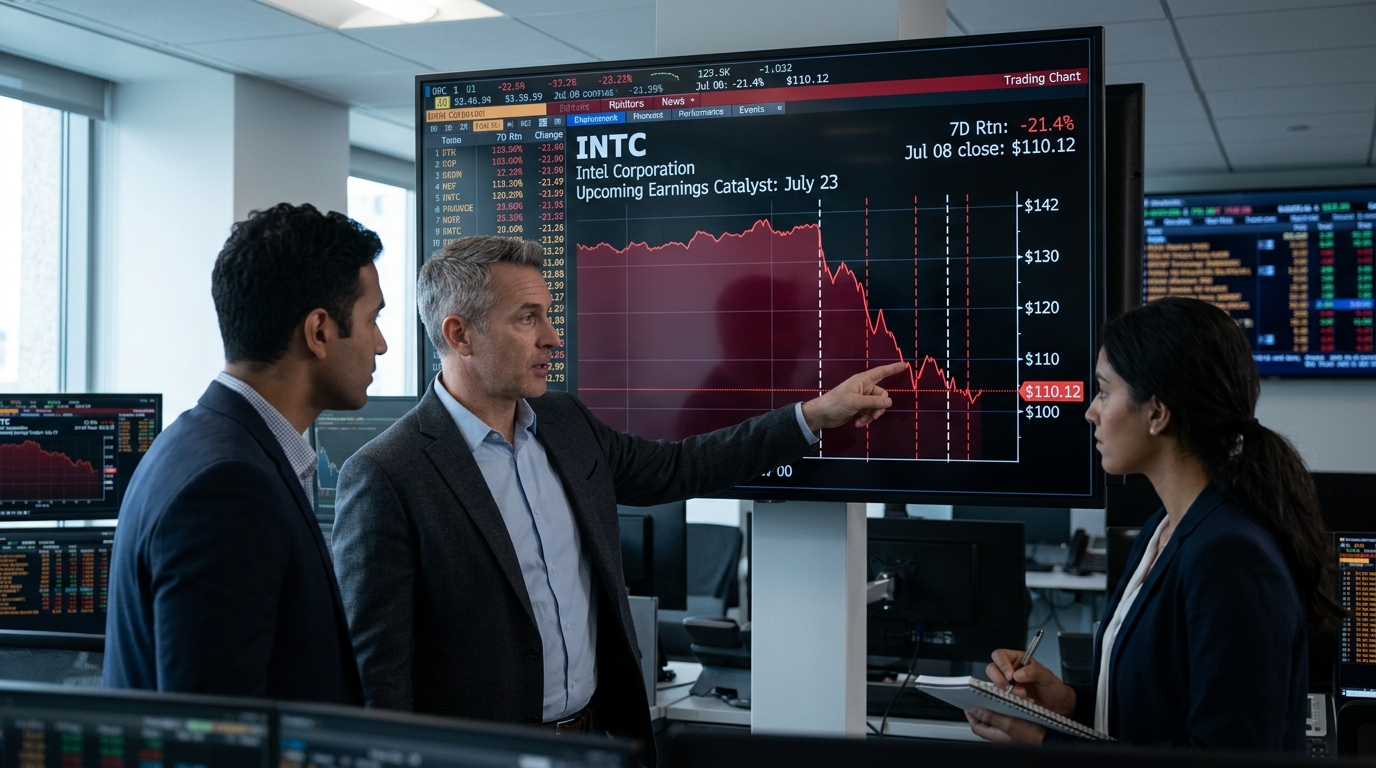
By July 8, INTC had dropped to around $110, a loss of roughly 21% across seven trading days. And that happened while the Dow Jones hit a fresh all-time high. This was not a macro selloff. It was surgical.
Analyst Targets
- HSBC: Buy, $200 target (raised from $100) — long-term foundry thesis intact
- JPMorgan: Called the chip selloff a “buying opportunity,” AI chip shortages seen lasting into late 2026
- Bank of America: Flagged bubble risk, average analyst target near $97 — below current price
- Cantor Fitzgerald: Neutral, raised to $150 from $90
Three Catalysts, One Week
The selling started July 1 when Bank of America warned that AI semiconductor valuations had become too stretched. That alone knocked Intel down over 8%. Then came the sector-wide hit. Then came the company-specific news that really did the damage.
Reports circulated that Intel’s 18A and 18A-P manufacturing processes are unlikely to reach profitable yields until late 2026 or possibly 2027. That single piece of information hit the stock for nearly 10% on July 7 alone, because the entire foundry bull case is built around a specific timeline assumption: that 18A inflects in 2026.
The third leg was competitive. For the first time, AMD passed Intel in quarterly data center revenue. That is not a rounding error. That is a structural marker.
The Foundry Math Right Now
Here is what the numbers actually say. Intel Foundry generated just $174 million in external customer revenue in Q1 2026, while posting a $2.4 billion operating loss in that same segment.
The problem is timing. All of that future revenue requires 18A to work at scale. If the yield timeline slips, the committed revenue slips with it.
Intel’s Q1 2026 headline numbers were actually strong. Revenue landed at $13.6 billion, $1.4 billion above the midpoint of guidance. The Data Center and AI segment grew 22% year-on-year. Intel has beaten revenue estimates in six consecutive quarters. The business itself is recovering. The July selloff is almost entirely a repricing of what the foundry is worth at a future date that just got pushed back.
What Q2 Needs to Show on July 23
Intel guided Q2 revenue to a range of $13.8 to $14.8 billion, with a midpoint of $14.3 billion. Non-GAAP EPS guidance is $0.20, non-GAAP gross margin of 39%. Analysts are watching three specific things in that report:
- External foundry revenue trajectory — flat or declining confirms the bear case; any sequential step-up changes the story
- Non-GAAP gross margin — management guided Q2 to 39%, down from Q1’s 41%, flagging 18A ramp costs as the headwind. Holding above 38% suggests the recovery is on track
- What CEO Lip-Bu Tan says directly about profitable 18A yield timelines — this is the binary. A confirmed H2 2026 milestone with specific data makes the selloff look like an overreaction. A push to 2027 validates the bears.
Forward Scenarios
Bull: July 23 shows external foundry revenue accelerating, management reaffirms H2 2026 profitable yield milestone with specifics, gross margin holds. Stock reclaims $125 and runs toward the $141 prior high, with a legitimate path to $200 if foundry execution becomes believable on a 12-month horizon.
Base: Q2 beats the modest EPS bar, revenue comes in near the $14.3B midpoint, but 18A timeline commentary is vague. Stock stabilizes in the $110-$125 range as investors adopt a wait-and-see posture into H2 data.
Bear: Margin misses the 38% floor, external foundry revenue stalls, and management acknowledges 2027 as the realistic yield timeline. The $108.60 support level breaks on volume, and the next reference point is $100, then the low $90s.
Technical Overlay
Intel is holding just above its 200-day EMA near $108.60. That is the line. The RSI sits near 37-38, approaching but not yet at oversold territory. The CCI is deeply negative. A close below $108.60 on heavy volume opens a path toward $100 with limited technical support between those two levels. Reclaim $125.70 on a daily close, and the base case target is $141.
What Actually Matters Here
Intel ran roughly 640% in under a year. That kind of move prices in a very specific future. When any part of that future slips by even one quarter, the correction is violent because the multiple was built on certainty that no longer exists. The July selloff is the market reassigning probability to the foundry timeline, not concluding that the business has failed.
The question for July 23 is not whether Intel had a good Q2. It probably did. The question is whether management can restore enough confidence in the 18A timeline to justify a stock that, even after a sharp drop, still trades at valuations that some analysts describe as extremely stretched.
That is a high bar to clear in one earnings call.
For informational purposes only.