Yesterday, Akamai announced a seven-year, $11.6 billion cloud commitment with Anthropic and immediately raised its 2026 capital expenditures by roughly $1.7 billion to pre-purchase memory and secure supply chain components. That single move captures what is happening across the entire AI infrastructure landscape: companies are spending before they earn, locking in hardware before demand converts to revenue, and financing the gap however they can.
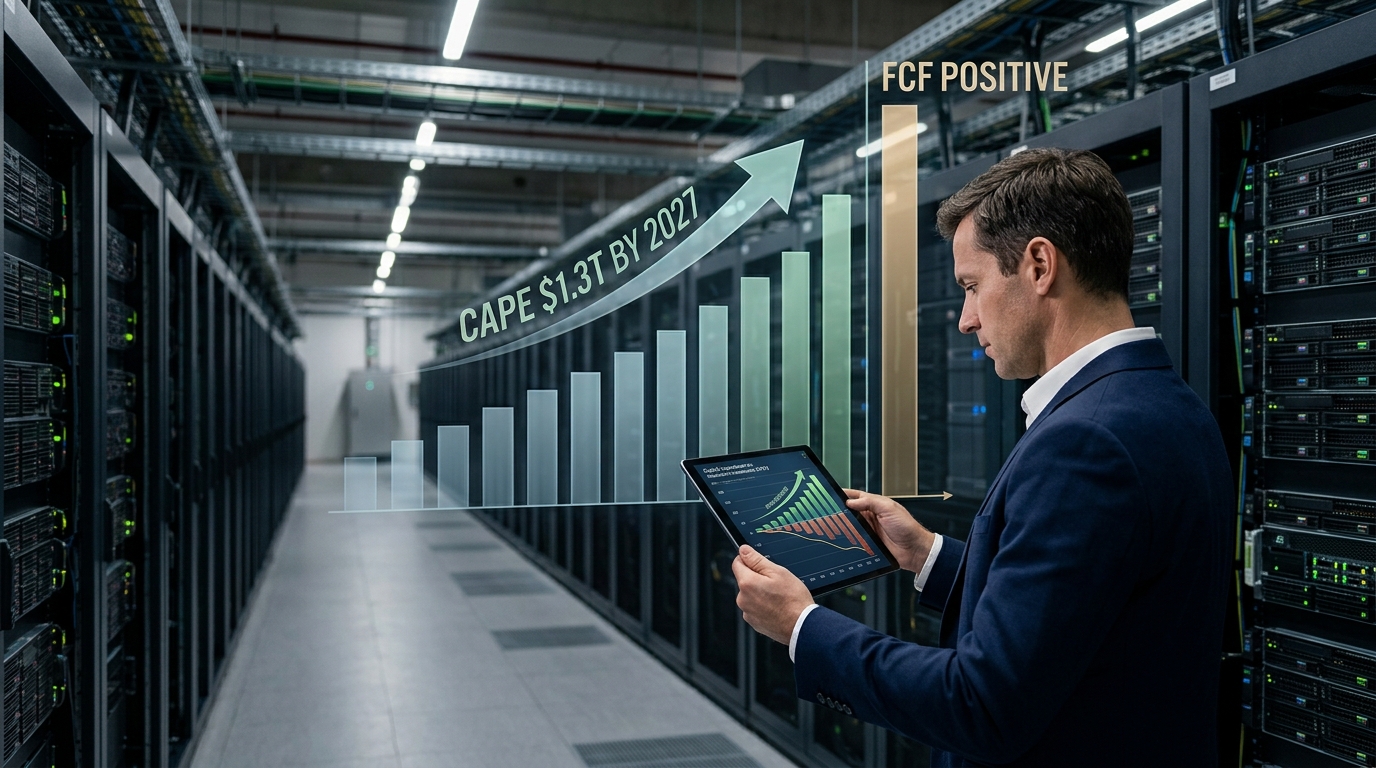
The aggregate numbers are staggering. S&P Global Ratings projects combined capital expenditure from six major hyperscalers will exceed $1.3 trillion by 2027. Alphabet guided 2026 capex to $180 to $190 billion with further increases signaled for 2027. Amazon CEO Andy Jassy said plainly that even at current spending levels, the company still won’t have enough capacity to meet demand in 2026 or 2027. S&P Global Ratings expects all six hyperscalers to generate negative free operating cash flow in both 2026 and 2027, with recovery not projected until 2029.
All six, except one. Microsoft is the sole hyperscaler among the group forecast to remain free cash flow positive through 2027, a commitment Microsoft CFO Amy Hood made explicit. Management expects to stay in positive territory in fiscal 2027 despite a calendar-2026 capex run rate approaching $175 billion. That is not a minor distinction in a peer group burning cash at industrial scale.
The mechanism behind Microsoft’s resilience is worth understanding. Hood has pointed out that the largest share of capex has shifted toward shorter-lived assets, GPUs and CPUs, which the company can throttle if demand softens. That flexibility doesn’t exist with long-duration data center construction. Meanwhile, Azure crossed $100 billion in annual revenue and grew 40% year over year as recently as Q3 FY2026, with commercial remaining performance obligations reaching $678 billion, up 84%. That contracted backlog gives Microsoft a revenue floor most peers don’t have at this point in the cycle. Fiscal 2026 free cash flow still came in at $66.99 billion, down roughly 6%, but it stayed positive while Alphabet reported its first quarter of negative free cash flow since going public in 2004.
The contrast with Alphabet is particularly sharp. Since the end of Q1 2026, Alphabet issued approximately $20 billion of additional debt, pushing its total debt balance to just over $100 billion across six currencies. Then in June it completed an $84.75 billion equity raise, the largest in U.S. corporate history, to fund a capex buildout it cannot fully cover with operating cash flow. Epoch AI’s crossover models put Alphabet’s capex-above-operating-cash-flow date in Q1 2027, Meta in Q3 2027, and Oracle already past it. Amazon crossed around now. Microsoft’s crossover, per the same models, doesn’t arrive until around Q3 2028.
So the question the assignment forces is this: does that free cash flow durability make Microsoft the stock to own, or is Nvidia, the supplier collecting cash from every company in this race, the cleaner trade?
The supplier case is formidable. Nvidia posted $96.2 billion in revenue in its most recent quarter, up 106% year over year, with data center revenue of $89 billion, up 117%. In fiscal 2026, Nvidia generated $96.6 billion in free cash flow and is returning capital aggressively, raising its dividend 25-fold and authorizing $80 billion in additional buybacks. At a forward price-to-earnings ratio below the sector average, Nvidia is not obviously expensive for what it delivers. Every dollar Alphabet borrows and Akamai pre-spends on memory flows through Nvidia first.
The risk is concentration and cycle timing. Nvidia’s business is entirely dependent on the hyperscalers continuing to spend. Bank of America forecasts aggregate free cash flow across major hyperscalers swinging from positive $180 billion in 2025 to negative $144 billion in 2027. If financing conditions tighten or AI returns disappoint before 2029, the first thing pressured is the capex line, and that hits Nvidia directly.
Microsoft carries a different risk profile. Azure growth decelerating below the mid-40% range, or OpenAI reducing its concentrated dependency on Microsoft infrastructure, would pressure both revenue conversion and the free cash flow thesis simultaneously. The stock has lagged the S&P 500 by roughly 900 basis points year to date despite five consecutive earnings beats.
On balance, Microsoft earns the call. The free cash flow durability is real, the backlog is contracted, and management has demonstrated flexibility in capital allocation that the others have not. The lag versus the index is the discount, not the danger. In a cycle where the rest of the group is financing capex with debt and dilution, the company that doesn’t need to is the one worth owning.