
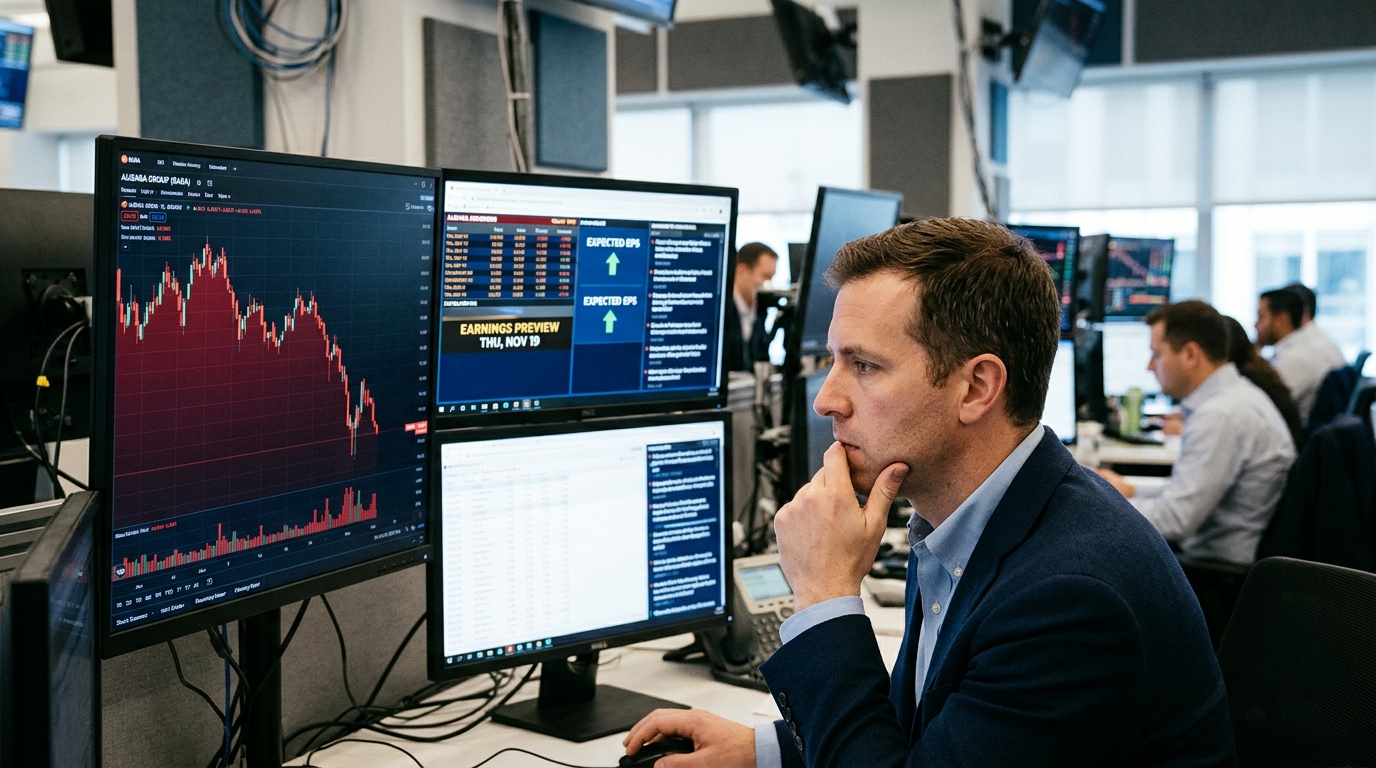
Rarely does a company walk into an earnings report with EPS expectations set to surge year over year while its stock has just taken a 7% hit in a single session. That is Alibaba’s situation heading into Thursday morning.
Alibaba is scheduled to report its results for the quarter ended September 30, 2026 on Thursday, November 19, 2026, before the U.S. market opens. The company is expected to post earnings of about $1.61 per share on revenue of about $40.25 billion. In the same quarter a year earlier, Alibaba reported $0.61 per share on revenue of $34.80 billion. That is a 164% jump in expected EPS. The revenue comparison is a 16% increase. By any fundamental measure, this is a company accelerating, not decelerating.
What the Cloud Business Is Actually Doing
Alibaba saw external cloud revenue rise 45% in the June quarter. Both Citi and Morgan Stanley expect cloud revenue to grow by more than 50% year over year in the September quarter. That is the number to watch Thursday morning, more than the EPS line itself, because it tells investors whether AI monetization is compounding or plateauing.
In the fourth quarter of fiscal 2026, Alibaba’s external cloud revenue rose 40% year over year, with annualized AI-related product revenue surpassing RMB 35.8 billion. During a May earnings update, the company indicated that AI-related product revenue could exceed 50% of Cloud Intelligence Group’s total external revenue within about a year.
Why the Stock Got Hit Anyway
Alibaba sank 7% after The Information reported that the Commerce Department is preparing to finalize a rule barring Chinese AI companies from using advanced chips in data centers outside China. The rule could be announced this month and would extend U.S. chip controls to seven more countries, including Malaysia, Singapore and Thailand. Alibaba is more exposed than most: the Financial Times has reported that Alibaba has been a major customer of Megaspeed, a Singapore-based chip buyer under U.S. scrutiny, though Alibaba is not the target of the probe.
The chip-access pressure on Alibaba does not exist in isolation. Taiwan Semiconductor’s monthly revenue data shows how tightly AI chip demand is concentrated in a single foundry that U.S. export rules can reach.
That overhang is real, and it creates the tension that makes this earnings report worth watching closely. The developments raise questions about Alibaba’s ability to secure the advanced computing resources needed to develop and train increasingly sophisticated AI models if Washington tightens enforcement.
The T-Head Variable
There is a longer-term counterpoint to the chip access problem. Alibaba disclosed on November 10, 2026, that it is pursuing a proposed spin-off and separate listing of T-Head (Shanghai) Technology Co., Ltd. on the Hong Kong Stock Exchange, including a confidential listing application. Analysts value T-Head at $25 billion to $86 billion. A separate listing would allow investors to assess the semiconductor business independently from Alibaba’s broader operations, while potentially giving T-Head more direct access to equity and debt financing. The spin-off does not resolve the near-term chip access concern, but it does signal that Alibaba is building toward semiconductor self-sufficiency rather than waiting for Washington to change course.
What Could Go Wrong
The bull case depends on cloud growth sustaining above 50% and margins improving. Weaker consumer demand continues to weigh on e-commerce, leaving investors to watch whether AI growth can drive stronger profits. Last quarter, Alibaba missed analysts’ consensus estimates by $0.68, reporting $1.26 EPS against expectations of $1.94. A repeat miss Thursday, particularly on cloud margins, would be damaging regardless of the year-over-year comparison.
The export-control rule, if finalized this month as reported, could force Alibaba to revise its AI infrastructure plans and slow the cloud growth trajectory that justifies the current institutional interest.
The Bottom Line
Alibaba carries a Strong Buy consensus rating, with major data providers showing an average analyst price target in the mid-$180s.
The core argument for buying BABA into Thursday is precisely what has suppressed the stock: the export-control overhang keeps the multiple low even as earnings expectations are surging. If the cloud number comes in above 50% growth and management addresses the chip access question with specifics, the gap between fundamental momentum and sentiment-driven price action could close quickly. The risk is that the chip rule lands before the market digests Thursday’s results, compounding the selloff. Position sizing matters here more than the direction of the trade.