
November 6, 2026
Bonus Content: NEE’s $67 Billion Bet Has 130 Gigawatts Behind It
Dear Reader,
$60 trillion.
That’s how much new wealth could pour into U.S. stocks between now and 2029.
It’s a number so huge… it’s hard to imagine.
If you split it up evenly?
Every household in America would get more than $400,000.
It’s enough money to make 60 million people millionaires. That’s more than double the number of millionaires in America today.
But America’s Economist, Dr. Mark Skousen, says – what happens next could be even stranger than that.
Recently, he laid out his thoughts in a new broadcast.
For the time being, you can watch it free, right here.
Good investing,
Rachel Gearhart
Publisher, The Oxford Club
P.S. The last time Skousen was this excited… it was 2009. That’s when he told anyone who would listen to buy stocks with both fists. Those who listened could have turned every $10,000 into more than $77,000 in the years since. And now, the same signal is triggering once again.
NEE’s $67 Billion Bet Has 130 Gigawatts Behind It
The merger gets the headlines. The pipeline tells the more important story.
NextEra Energy is set to acquire Dominion Energy in an approximately $67 billion merger that most investors are tracking as a regulatory event. And it is one: shareholders of both companies approved the transaction in early September 2026, and state and federal regulatory reviews are now underway, with Virginia, South Carolina, and North Carolina reviews carrying real approval uncertainty and a close still expected in the second half of 2027. That is the risk most people are pricing.
What they may be underweighting is what NEE looks like whether the deal closes or not.
NextEra reiterated 2026 adjusted EPS guidance of $3.92 to $4.02, with management still targeting the high end, and it continues to target 8% or better adjusted EPS compound annual growth through 2032, with the same growth target extending through 2035 off the 2025 adjusted EPS base.
The growth engine is not rate cases. It is kilowatts demanded by hyperscalers.
NextEra raised its forecast for data center and other large-load demand at Florida Power and Light to 8 gigawatts by 2032, up from a previous estimate of 6 gigawatts. The company has said it has approximately 21 gigawatts of large-load interest in its pipeline, with about 12 gigawatts in advanced discussions. And its renewables and storage backlog has been running at roughly 36.7 gigawatts.
The Dominion logic fits neatly into this. The companies have said the large-load customer pipeline tied to the deal is more than 130 gigawatts across the United States. That is not a theoretical number. In the first quarter of 2026, hyperscalers accounted for roughly 30% of NextEra Energy Resources’ 4 gigawatts of new contracts.
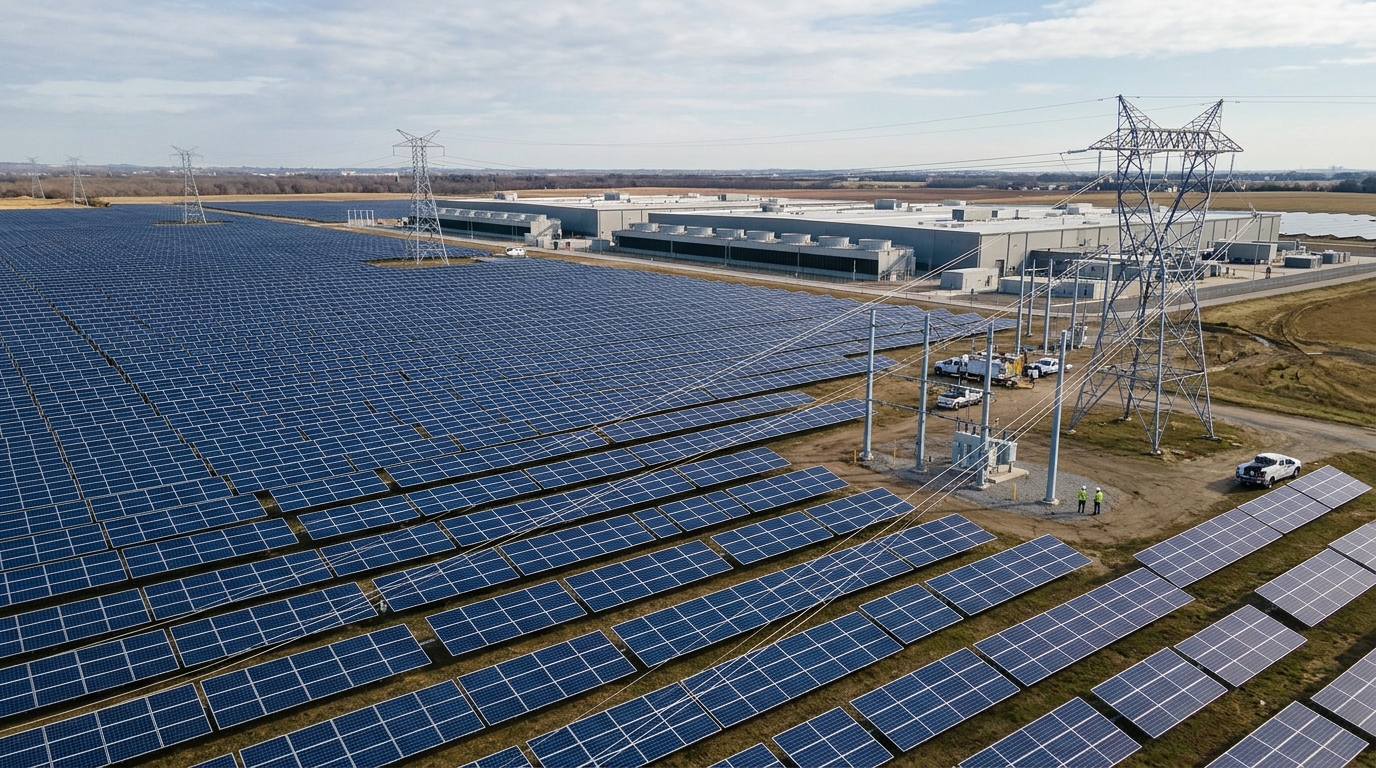
The strategy is multi-fuel and deliberate. NextEra has told investors it expects to develop 15 gigawatts of new generation for data center power-supply hubs by 2035, with the potential to increase to 30 gigawatts, with gas-fired generation a key component. Renewables and storage get projects off the ground fast; gas provides the firm capacity hyperscalers require around the clock. NextEra has also discussed restart options for shuttered nuclear assets in Iowa, but it has not received approval from regulators to restart a shuttered nuclear power plant that will sell electricity to Google.
The equipment needed to build those hubs is itself a constraint. GE Vernova’s $197 billion backlog reflects how utilities racing to add generation capacity are straining the supply chain for transformers and high-voltage gear.
The honest counterargument is execution risk at scale. U.S. electricity demand is expected to grow sharply over the next two decades, and NextEra is effectively betting that it can outbuild every competitor for a generation. The Dominion integration adds complexity before that buildout even begins, and the transaction is still expected to close in the second half of 2027, subject to customary closing conditions and approvals.
The competitive dynamic matters here. AEP’s 20-year Google power purchase agreement shows how hyperscaler contracts are reshaping utility valuation beyond the rate-base model.
But the case for NEE does not require the merger to succeed on schedule. The standalone business is already winning large-load contracts, posting consistent earnings growth, and sitting at the center of the most consequential infrastructure build of the decade. The deal is upside. The pipeline is the thesis.