
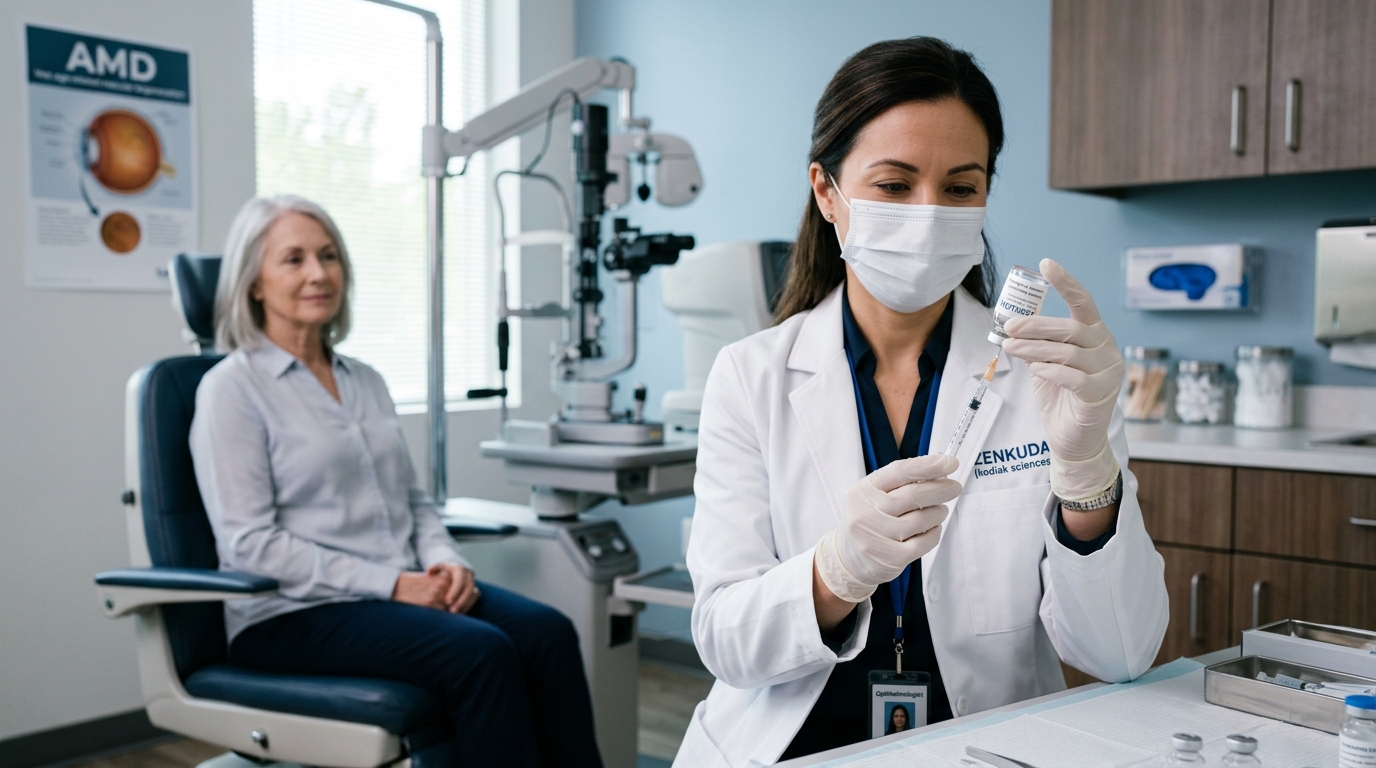
Half the investment thesis in retinal medicine has always been the needle. Patients with wet age-related macular degeneration endure injections directly into the eye, typically every eight weeks on Eylea after the initial monthly doses, sometimes more often. Cutting that burden in half is not a quality-of-life footnote. It reshapes which drug a retina specialist reaches for first. That is the question Kodiak Sciences answered on Monday, and it is what the stock surge is really pricing.
Kodiak Sciences announced that the primary endpoints were met for both Zenkuda (tarcocimab tedromer) and tabirafusp-ted (KSI-501) in the Phase 3 DAYBREAK study in patients with wet age-related macular degeneration. Both Zenkuda and tabirafusp-ted achieved non-inferiority in vision gains compared to aflibercept at year one. The vision math is settled. The durability math is what matters next.
Among Zenkuda patients, 54% reached 24-week dosing intervals at one year under strict criteria requiring retreatment when retinal fluid appeared. That last clause matters. This was not a liberal retreatment protocol designed to flatter the durability numbers. Patients on aflibercept received treatment every eight weeks throughout the maintenance phase. Zenkuda’s majority-on-six-months result was achieved while holding patients to a tighter standard, not a looser one.
The positive results, especially the strong performance of Zenkuda noted by retinal specialist Dr. Charles Wykoff in Kodiak’s announcement, suggest that Kodiak’s Antibody Biopolymer Conjugate platform may deliver longer-lasting treatments than current anti-VEGF therapies. No patients experienced intraocular inflammation after treatment with Zenkuda, and 0.5% experienced cataracts, versus 0.9% in the aflibercept treatment arm. That clean safety profile matters especially because an unexpected increase in cataracts in earlier tarcocimab Phase 3 studies helped derail the program in 2023. The program was resurrected. Monday’s data closes that chapter.
The Commercial Case
Zenkuda and KSI-501 are aimed at the large anti-VEGF market across retinal vascular diseases, which analyst estimates have put at over $15 billion in annual global sales in recent years. If approved, Zenkuda will compete with blockbuster wet AMD sellers like Eylea and Roche’s Vabysmo. Roche’s Vabysmo reached roughly four-month dosing for about half of patients in its pivotal trials. Zenkuda just showed six-month dosing for the majority, under tougher criteria. That differentiation is the core of the commercial argument.
The results bring Zenkuda’s total to five positive Phase 3 studies spanning wet AMD, diabetic retinopathy, and macular edema following retinal vein occlusion, with Kodiak planning to submit Zenkuda data to regulatory authorities in the fourth quarter of 2026, seeking approval across all three conditions. A three-indication BLA plan this quarter is not a minor regulatory step. It is the event that transforms Kodiak from a clinical-stage story into a commercial story.
What Could Go Wrong
Kodiak is still burning cash. For Q2 2026, the company posted a net loss of $65.6 million, driven mainly by research and development expense of $56.1 million. In its 10-Q for the quarter, Kodiak reported net cash used in operating activities of $86.2 million for the first six months of 2026. Kodiak is still precommercial, so the next things to watch are FDA approval, how it funds a launch, and KSI-101’s Phase 3 data in December 2026. Building a retinal sales force from scratch against entrenched Regeneron and Roche franchises is a different problem than winning a clinical trial.
There is also a detail gap. Kodiak has not yet shared detailed DAYBREAK data beyond the topline description, including its description of a strong early clinical effect through the loading phase. Full data presented at a medical conference could push the stock either direction.
What to Watch Next
Multiple Kodiak catalysts cluster into year-end, including an October look at the DAYBREAK dataset at the American Academy of Ophthalmology meeting and December 2026 readouts for KSI-101. The October American Academy of Ophthalmology meeting will be where retina specialists see the full DAYBREAK dataset. Their reception, not Wall Street’s one-day reaction, will determine whether Zenkuda earns prescriptions. FDA approval timelines and the specifics of partnership or financing deals will follow. A drug that requires one injection every six months instead of every eight weeks does not need to take a large share of the market to justify the current valuation. It needs to prove physicians believe those durability numbers hold in the real world.