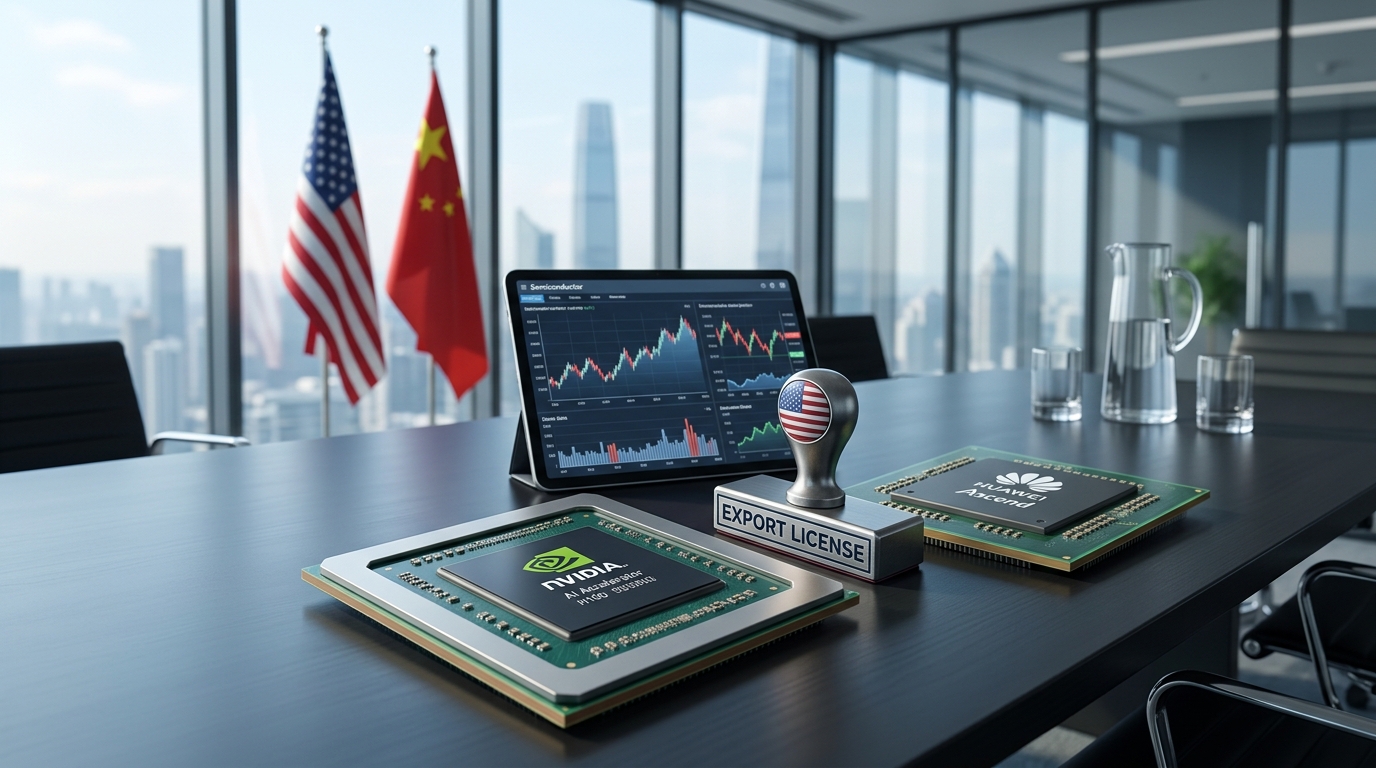
Huawei moved the Ascend 960DT’s release up by three quarters, to the first quarter of 2027, as the company pushes to reduce China’s dependence on Nvidia. The updated schedule was confirmed Thursday during the Huawei Connect conference by David Wang, Huawei’s deputy chairman and rotating chairman. The timing was not accidental. The announcement comes just a week before U.S. President Trump and Chinese President Xi Jinping are set to meet on September 24 in Washington, DC.
The accelerated rollout underscores Huawei’s intensified efforts to compete directly with Nvidia in the global AI semiconductor market, with the firm projecting the new silicon will deliver double the performance of its predecessor while maintaining annual performance increments. There is a legitimate caveat worth noting: China tech analyst Rui Ma pointed out that Huawei had previously said its Atlas 960 SuperPoD would scale to 15,488 Ascend 960 chips, while this week’s announcement referred to a system with only 4,096 chips. “The chip itself is coming WAY earlier, but the SuperPoD they announced is much smaller than what they originally laid out,” she wrote. Faster on the chip, smaller on the cluster. That tension matters when assessing how much real competitive threat this represents beyond China’s domestic market.
NVDA opened Friday’s session around $219 and traded in the $218 to $223 range this week, well off its 52-week high of $236.54. The stock’s inability to reclaim that level despite blowout fundamentals reflects accumulated geopolitical overhang. Nvidia grew revenue 106% year-over-year to $96.2 billion in fiscal Q2 2027, ended July 26. The earnings are not the problem. The policy calendar is.
That calendar is dense. Reuters reported in May that the Commerce Department had cleared around ten Chinese firms to buy Nvidia’s H200, with each approved buyer permitted up to 75,000 units, including Alibaba, Tencent and ByteDance among those approved. Reuters later reported that by mid-July a top U.S. official told Congress that “very few” H200 chips had been shipped to China or Hong Kong to date. The deadlock is mutual and deliberate, with U.S. licenses carrying security and diversion conditions, and Beijing steering buyers toward Huawei and domestic alternatives regardless.
The September 24 summit now sits directly over that stalemate. The Associated Press reported that Jensen Huang and Tim Cook are expected at the state dinner Trump is hosting for Xi. Traders who expect a clean deal by Wednesday are likely to be disappointed again.
The political backdrop has only grown more complicated. CISA, in collaboration with the NSA and FBI, released a joint advisory warning of China-based AI companies targeting U.S. AI firms to systematically extract proprietary models through knowledge distillation campaigns. The advisory says the Chinese government is “likely” aware of distillation campaigns involving DeepSeek, Moonshot AI, Alibaba, MiniMax, StepFun, and Z.AI. That advisory, published September 8, landed sixteen days before Xi’s arrival. Washington is not signaling concessions.
Stocks on the Radar
NVDA is the primary read on how the summit resolves. A genuine license framework that unblocks H200 deliveries would be a sharp catalyst higher. A repeat of May, pleasantries, no agreement, leaves the stock range-bound against a $236 ceiling. The risk is asymmetric to the downside if rhetoric hardens on distillation.
AMD is in a similar position. The Bureau of Industry and Security’s revised license review policy covers the AMD MI325X alongside the Nvidia H200, reviewed on a case-by-case basis subject to security conditions. Any summit outcome that loosens or tightens that framework hits AMD alongside Nvidia.
Alibaba sits on both sides of this story. It is a licensed H200 buyer that has received very few chips industrywide, and it was named in the CISA distillation advisory. Its position in any revised export framework, and any retaliatory Chinese tech policy, makes it a live indicator of summit outcomes.
Trader’s Action Plan
The Huawei accelerated timeline is worth monitoring but is not the week’s primary driver. It confirms that U.S. restrictions have not stopped Chinese chip development, which reduces Washington’s incentive to ease controls. The actionable risk is Wednesday’s summit. Hold existing semiconductor positions with defined stops below recent support levels. Avoid adding aggressively ahead of the meeting. If a license framework deal is announced, the first move in NVDA will likely overshoot. If the summit produces another non-outcome, the range holds and the next catalyst becomes Q3 earnings season.