September 27, 2026
Bonus Content: Restarting Dead Reactors Is Harder Than Signing the Deal
A message from America’s Gold Company
URGENT ALERT
Your Retirement Has a $40 Trillion Problem
America’s debt just reached a level no nation has ever seen, and paper savings sit directly downstream.

If you have a 401(k), IRA, or TSP, and it sits entirely in paper assets, then every dollar of it depends on the strength of a currency now backed by nearly $40 trillion in debt.
According to U.S. Treasury data, the national debt is closing in on $40 trillion. More than any nation has ever owed. And with long term borrowing costs at some of their highest levels in years, Washington is paying real money just to service what it already owes.
But here is what most people are not being told: a government this deep in debt rarely defaults loudly. History suggests it quietly pays its bills with dollars that buy less, year after year. And the savings built on those dollars feel it first.
One bad year. One shock. One crisis of confidence.
History shows how quickly paper savings can give back years of gains, and how long rebuilding can take.
There is a way savers have historically prepared, and it is available to you right now.
Long standing IRS rules generally allow you to move a portion of your retirement savings into physical gold and silver, a time tested store of value, and you may be eligible to do it without triggering taxes or penalties.
Everything you need to know is laid out in the FREE Precious Metals Retirement Guide from America’s Gold Company. Download your free copy here!
Inside, you will learn how the process generally works, who may qualify, and the specific questions to ask before moving a single dollar. The guide is free, with no obligation of any kind.
Yes, Send Me the FREE Precious Metals Retirement Guide!

Free to Claim. Includes Retirement Rollover Basics, Step by Step.
100% free. No credit card. Delivered straight to your inbox.
Or speak with a precious metals specialist at 1-888-691-8238.
Restarting Dead Reactors Is Harder Than Signing the Deal
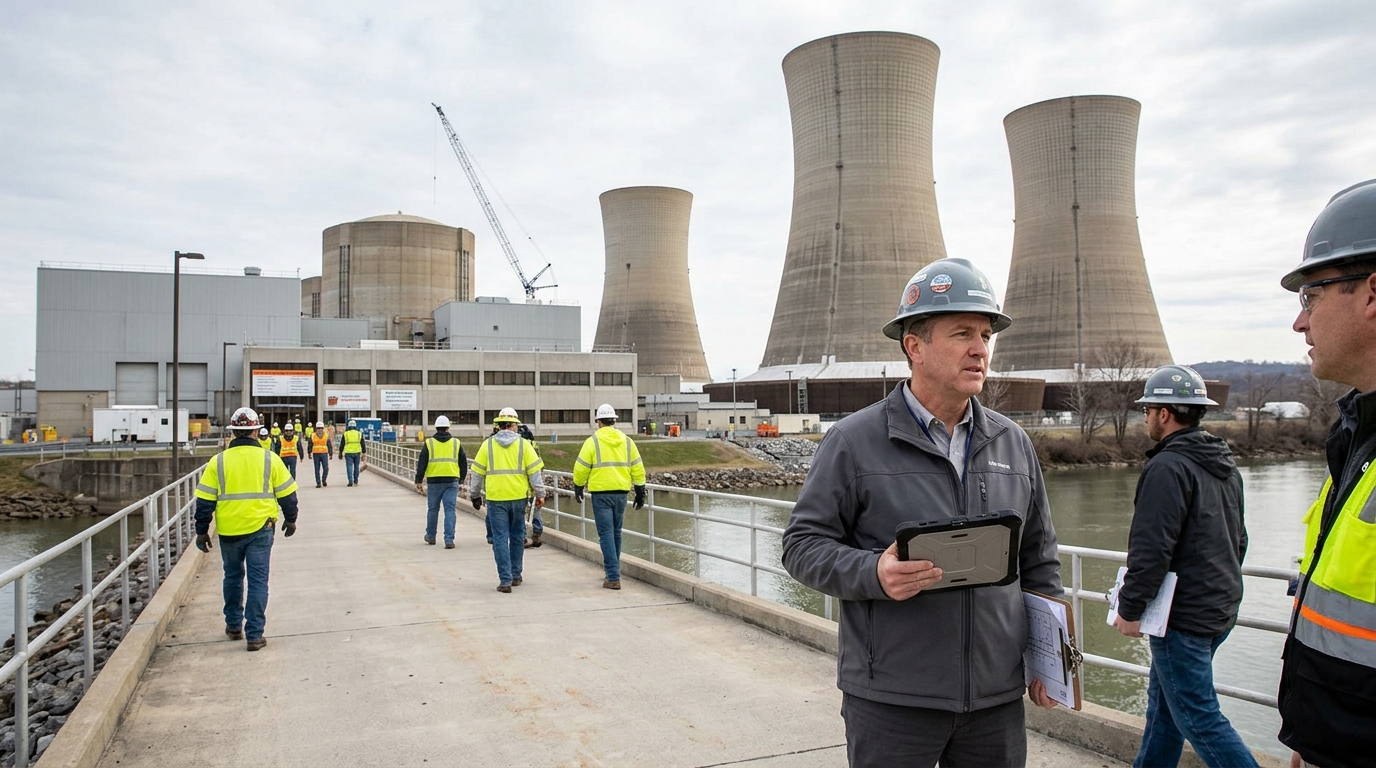
The power purchase agreement is the easy part. When Constellation Energy signed its 20-year deal with Microsoft to revive Three Mile Island Unit 1 in Pennsylvania, the headline wrote itself. Microsoft committed to a 20-year power purchase agreement tied to the restart of the Crane Clean Energy Center (formerly Three Mile Island Unit 1), a roughly 835-megawatt unit that Constellation has said it expects to bring back online in 2028. What got less attention was the list of things that still had to go right before a single electron reached a data center.
Three restarts are now active simultaneously. Palisades Nuclear Plant in Michigan, which closed in 2022, has cleared major regulatory steps, including the NRC issuing a final environmental assessment for the restart application in 2025. Crane in Pennsylvania has advanced through key federal approvals, including an NRC license amendment in July 2026 allowing the site to receive and possess new nuclear fuel. Duane Arnold in Iowa is furthest out, with NextEra Energy materials describing a planned commercial operation date by the first quarter of 2029 under a long-term offtake arrangement.
Federal money is flowing. In November 2025, the DOE closed a $1 billion loan to Constellation to help finance the Crane Clean Energy Center restart, an 835-megawatt reactor that was shut down in 2019. The DOE has also closed a loan of up to $1.9 billion to help NextEra Energy restart the Duane Arnold Energy Center near Cedar Rapids, with Google entering into a 25-year agreement to purchase the plant’s 615-megawatt output that NextEra and trade publications have described as supporting a restart plan announced in October 2025.
The bottleneck nobody talks about is people. Under NRC rules, operator licenses are plant-specific, and an NRC operator license can expire after six years or earlier if employment is terminated or the facility determines the individual no longer needs to maintain a license. When Crane shuttered for economic reasons in 2019, its qualified operating crew scattered. Constellation has said it plans to hire more than 600 employees ahead of the restart. That months-long to years-long operator qualification path, including training and NRC examinations, is not something a tech balance sheet can simply compress on command.
Analysis commissioned by the National Center for Energy Analytics and conducted by the USC Marshall School of Business indicates it will be very difficult to provide the needed workforce based on current trends, with the gap between skilled workers needed and those available widening rapidly. The pool of skilled trades is shrinking, and the nuclear share is the hardest part to fill. The American Welding Society projects roughly 320,500 new welders will be needed by 2029 just to keep pace with retirements.
None of this means the projects fail. Palisades has begun fuel-loading-related activities, with Holtec reporting fuel loading started on August 30, 2026. The regulatory environment is the most permissive it has been in decades. But the gap between a signed PPA and electrons on the grid runs straight through a workforce that cannot be hired faster than it can be trained. That is where the nuclear revival will actually be won or lost.