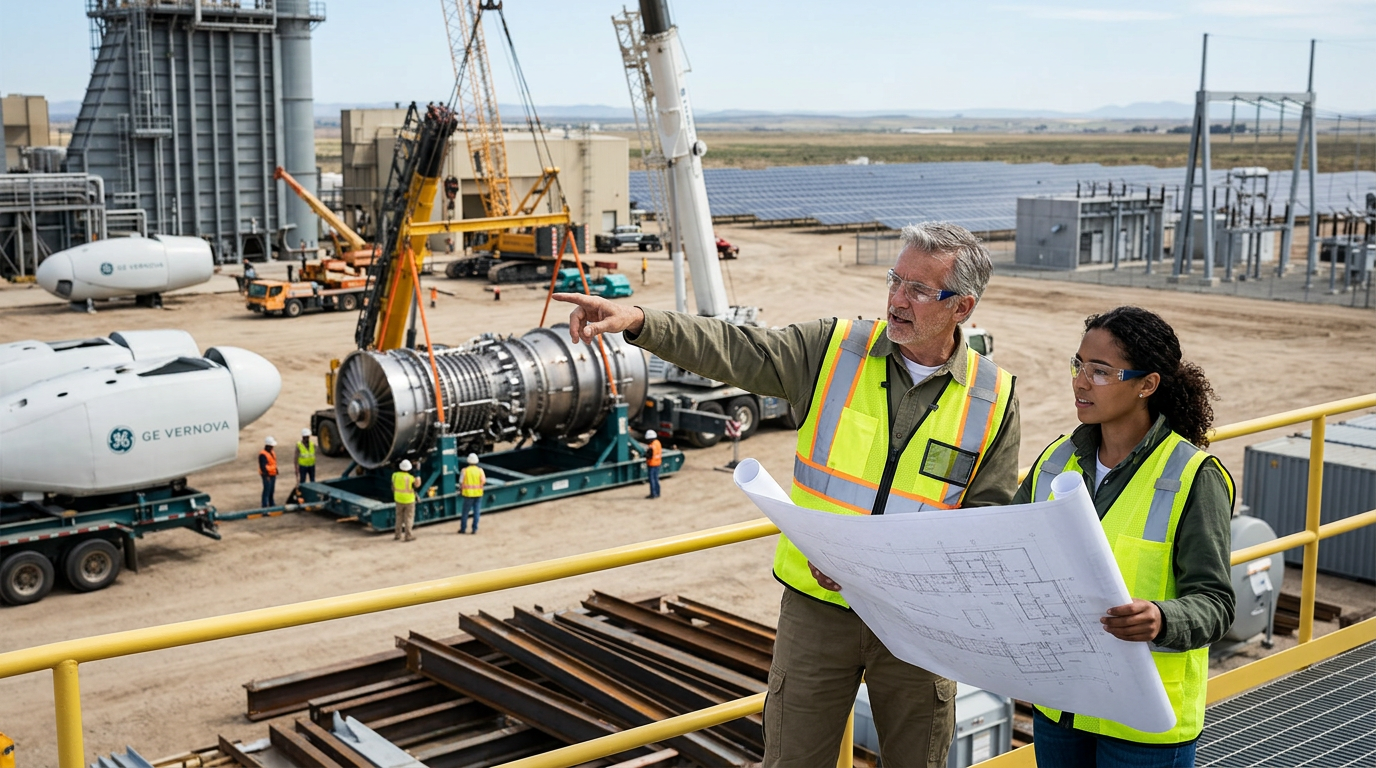
Here’s what happened on June 22, 2026 — the day most people were watching Iran headlines and Fed speculation. Chevron signed a 20-year power agreement with Microsoft for a 2.67 gigawatt data center facility in West Texas. The majority of the generation hardware? GE Vernova turbines.
That’s not a coincidence. That’s a pattern.
GE Vernova (NYSE: GEV) has quietly become the physical backbone of the AI power buildout — and the market is only now starting to price that in. Shares have climbed roughly 127% over the past year, with the stock trading near $1,110 as of June 22. And the case for continued momentum isn’t built on hype. It’s built on a backlog that keeps growing faster than anyone expected.
Let’s start with the numbers that matter. In Q1 2026, GEV reported orders of $18.3 billion — up 71% organically year-over-year. Revenue hit $9.3 billion, up 16%. The company then raised full-year 2026 revenue guidance to $44.5–$45.5 billion, a $500 million increase from prior projections. Free cash flow guidance was lifted to a range of $6.5–$7.5 billion — substantially higher than initial estimates.
What really captured attention was one line in the Q1 filing. GEV’s Electrification segment booked $2.4 billion in data center equipment orders in a single quarter — more than all of 2025 combined.
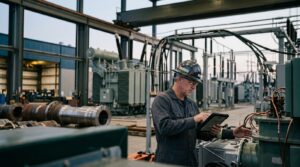
Slight tangent, but it matters: this is exactly how the AI infrastructure theme gets mispriced. Investors track the obvious names — the chip designers, the hyperscalers — and miss the companies that actually have to make the electricity flow. Every megawatt of AI compute needs a turbine, a transformer, a switchgear system. GE Vernova makes all three at scale. It manufactures and services power equipment that produces roughly a quarter of the world’s electricity.
The Backlog Is the Business
At the close of 2025, GEV’s total backlog stood at $150 billion. By the end of Q1 2026, it had grown by an additional $13 billion quarter-over-quarter. The company now expects to reach at least 110 gigawatts of combined gas turbine backlog and slot reservation agreements by year-end 2026 — a target that was already looking conservative as of last week.
Data center operators and utilities are locking in scarce generation and grid capacity years in advance. That’s what a $163 billion backlog actually represents — not just future revenue, but proof that customers believe GEV is one of a small number of companies capable of meeting their needs at hyperscale speed.
Then came June 22. Chevron and Microsoft announced Project Kilby — a 2.67-gigawatt, natural-gas-fired power project in West Texas designed to supply electricity to a Microsoft-operated data center under a 20-year agreement, with power expected to begin in 2028. Chevron has said most of the electricity will be generated by large gas turbines supplied by GE Vernova, with additional turbines supplied by Solar Turbines (a Caterpillar subsidiary).
What the Numbers Say About Where Margins Are Going
EBITDA margins are projected to rise from roughly 6% in 2024 to an estimated 14% in 2026, with analysts expecting further expansion through 2030. The Power and Electrification businesses are scaling into higher-margin services revenue, while the Wind segment — the one drag on the story — is gradually being managed down as a percentage of the overall mix.
Analyst price targets reflect this. Bernstein SocGen initiated coverage with an Outperform rating, citing record backlogs and heavy demand tied to AI and decarbonization. Multiple analysts raised estimates following Q1. The consensus has shifted meaningfully positive, and the institutional money has followed.
The Risks Worth Tracking
The valuation isn’t cheap. GEV currently trades at a meaningful premium to the broader industrial sector, somewhere in the range of 31–39x projected 2026 free cash flow. For a stock priced at perfection, any execution miss — a delayed project, a wind segment writedown, a grid interconnection bottleneck — can trigger a sharp pullback. There’s also been notable insider selling in recent months, worth monitoring.
The offshore wind exposure remains a lingering overhang. Legal and execution risks in that segment haven’t fully resolved. And the broader power grid interconnection backlog at the utility level could slow the conversion of massive turbine orders into recognized revenue.
The Bigger Picture
Morgan Stanley identified the “Future of Energy” as one of their four key investment themes for 2026, noting that “AI is driving unprecedented demand for compute and energy.”
GE Vernova is exactly what that theme looks like when it shows up in an earnings report. The data center power buildout is no longer a forecast — it’s a signed contract. A 20-year, 2.67-gigawatt contract, to be specific. With GEV turbines at the center of it.
The stock has moved a lot. But so has the business.