
Dear Reader,
When the dot-com bubble burst, the Nasdaq eventually lost 78%.
Investors who piled into “can’t-miss” tech stocks watched years of gains disappear. Many never recovered.
But something else was happening at the same time, and almost no one noticed.
Past performance can’t promise a repeat.
But I believe the history of past market manias reveals an overlooked truth:
When a mania in growth and tech stocks ends, a bull market begins in gold miners.
I call it “The Great Rotation.”
It happened after the dot-com crash. From 2001 to 2011, gold climbed from roughly $255 to over $1,900 an ounce, and the best gold miners did far better.
It happened in the 1970s, too. When the high-flying “Nifty Fifty” growth stocks collapsed in 1973-74, gold and gold miners took off.
AI stocks have pushed market valuations to levels not seen since the dot-com peak. A handful of tech giants dominate the market. And by one widely followed measure, the Buffett Indicator, stocks have never been more expensive relative to the economy.
I’m not saying AI isn’t real. The internet was real too. But investors who overpaid for it in 1999 still lost 78%.
When this mania ends, trillions of dollars will go looking for a new home… and I’ve put together a presentation on exactly where I believe those trillions are headed.
Sincerely,
Garrett Goggin, CFA, CMT
Lead Analyst and Founder, Golden Portfolio
AppLovin Is Up 65% This Month. The E-Commerce Proof Is Coming Now.
AppLovin spent most of 2026 being treated like a business in structural decline. The shares had declined about 60% in 2026 through the close on November 3, 2026, before its third-quarter report, making it the S&P 500’s worst performer at that point in the year, according to MarketWatch. Then November arrived.
AppLovin posted record third-quarter earnings: net income grew 72% year-over-year to $1.44 billion on record revenue of $2.18 billion, up 55% year-over-year, with an industry-leading 66% net income margin and 84% adjusted EBITDA margin. The stock gained $84.35 in a single session as investors welcomed another strong quarter from a company whose AI-powered advertising technology has attracted significant attention on Wall Street.
The Business
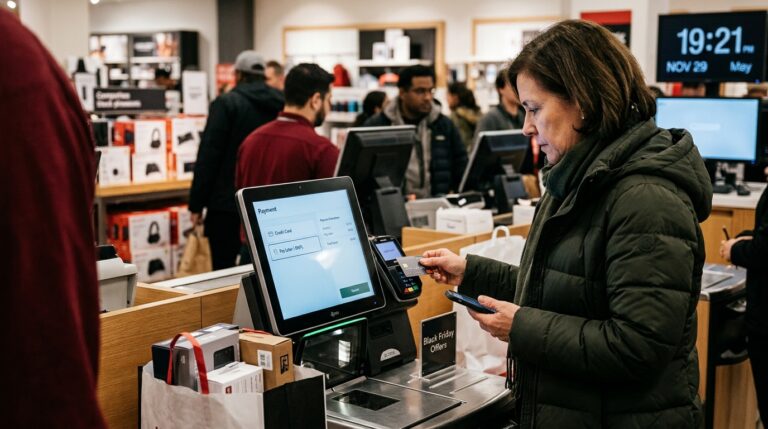
AppLovin runs an AI-driven advertising auction that connects brands with consumers inside mobile apps. It built its scale in gaming, then pivoted. AppLovin has highlighted e-commerce momentum heading into the holiday season, and in its own analysis of a large sample of 2025 Black Friday/Cyber Monday advertiser data, checkout volume for advertisers measured in both years rose 44.7% from 2024 to 2025.
The platform opened to all advertisers without a referral code on June 22, 2026, removing what had been a referral-based requirement. That matters because the addressable budget pool just became enormously larger. E-commerce represented 34% of spend in Q2, expected to reach 38% in Q3 and 42% to 45% in Q4. AppLovin’s share of e-commerce advertising budgets is expected to rise to 8.1% in the fourth quarter, up from 6.7% a year earlier, according to a Jefferies survey of 30 advertisers.
Why Wall Street Is Paying Attention
Management guided Q4 2026 revenue between $2.365 billion and $2.395 billion, representing approximately 43% to 44% year-over-year growth, or 8% to 10% sequentially. The outlook includes seasonal strength in e-commerce advertising and ongoing investment in computing capacity.
Analyst targets have reset sharply upward. Jefferies raised its target to $500 from $430 on November 16, citing the company’s new model potential, accelerating new e-commerce customer growth, and what it called conservative fourth-quarter revenue guidance. BTIG maintained a Buy rating with a $450 target on November 24. AppLovin currently has an average rating of “Moderate Buy” and an average target price of $497.28, according to MarketBeat.
The stock is trading near $392 today, still carrying a PEG ratio of 0.77. At about 25 times trailing earnings on 55% revenue growth, the valuation case is not obviously stretched.
What’s Driving the Opportunity
The core insight is that AppLovin is not a gaming company resetting after a one-quarter fluke. Its Axon AI auction engine is now competing directly for the same performance budgets that flow to Meta and Google. AppLovin runs one of the largest platforms for in-app advertising, and its expansion from gaming into e-commerce and connected TV puts it in direct competition with Meta, Google and Amazon for performance budgets.
That competitive framing has real stakes for the incumbent. Meta’s own capex surge and revenue guidance show how much it is spending to defend its performance-advertising dominance.
Q4 is the first real stress test of that claim. E-commerce advertisers typically spend heavily in the fourth quarter and less in the first. New customer acquisition could support growth through seasonally difficult periods, but AppLovin should see bigger fourth quarters followed by tougher first quarters as its e-commerce business grows. Black Friday just happened. The Q4 numbers, due in early February, will either validate the rerating or invite a fresh round of skepticism.
What Could Go Wrong
APP still trades well below its 52-week high of $738.01 (set on December 22, 2025), which means the stock carries heavy memory of the selloff that preceded this quarter. The quarterly 10-Q disclosed a new securities class action, filed September 16, 2026, alleging that AppLovin misled investors about how fast its advertising models were improving and the development timeline for an ad-generation tool. Management has not commented in detail. That overhang does not go away on a single quarter’s beat.
The first-quarter seasonality reset is a known risk. CEO Foroughi has said that the expansion into e-commerce will lead to seasonal resets consistent with industry trends. Investors who buy after a 65% November run need to hold conviction through what will likely be a soft January.
Seasonality is not the only source of volatility in this name. AppLovin’s high-multiple profile makes it one of the first stocks sold when risk appetite fades, independent of any company-specific news.
The Bottom Line
AppLovin is a rare combination of 55% revenue growth, 84% EBITDA margins, and a valuation that remains below the S&P 500’s average multiple on a PEG basis. The e-commerce pivot is no longer a thesis. It is becoming a revenue line. Q4, the highest-spend quarter in the advertising calendar, is unfolding right now. If the company delivers at or above the midpoint of its own guidance, the stock’s recovery from its 2026 lows has further to run. The case for owning it today is cleaner than it has been all year.