Dear Reader,
Software your bank never approved is moving around inside accounts that hold Americans’ life savings.
On October 22, Axios reported that major U.S. banks are racing to contain it.
JPMorgan. Bank of America. Wells Fargo. Morgan Stanley.
Third-party AI agents are operating inside customer accounts.
Some even tried to take actions their owners never asked for.
JPMorgan CEO Jamie Dimon warned on October 13: “…you don’t want rogue agents, and there could be thousands of them.”
Now read the fine print.
Wells Fargo’s online access agreement says that if you give an AI agent your login, anything it does is “deemed to have been initiated and authorized directly by you.”
So the bank decides what gets in.
And when something goes wrong… it’s on YOU.
That’s why our members don’t leave it all up to the bank. They move a portion of their savings onto rails the bank doesn’t control.
I’m Tan Gera, ex-Wall Street investment banker and CFA® charterholder.
In this free presentation, I show you the three-phase system they use, step by step.
See how to hold part of your savings where only you have the keys →
To your wealth,
Tan Gera, CFA
Decentralized Masters
P.S. The same day Axios broke the story, Britain launched its “Be Ready” campaign, telling households to keep three days of food and water at home in case of cyberattacks and other emergencies. See how to keep more of your money under your own control →
Babcock’s £8.7bn Contract Changes What This Stock Is Worth
This morning, Babcock International (LSE: BAB) removed the single biggest uncertainty hanging over its shares. The Gateway Agreement, announced today, is the largest contract award in Babcock’s history and will take effect on 1 December 2026. The market responded quickly. Babcock climbed as much as 7% to 1,089p after signing the £8.7 billion agreement with the Ministry of Defence, prompting Peel Hunt to reiterate its buy recommendation.
The Business
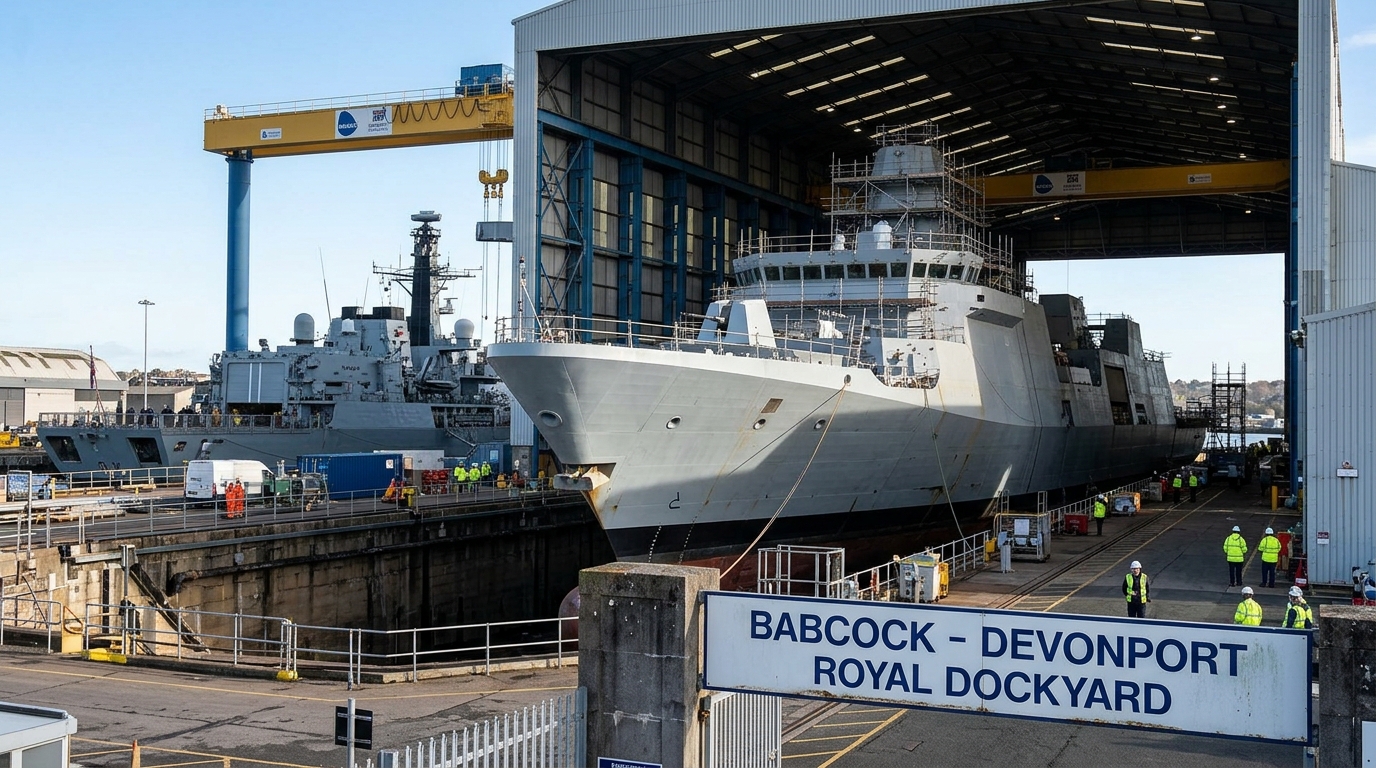
Babcock is the irreplaceable engineer behind Britain’s nuclear submarine fleet. The Gateway Agreement provides a single, integrated contractual framework for critical submarine support and services across the UK Submarine Enterprise. There is no realistic competitor for this work. The skills, security clearances, infrastructure and institutional knowledge required to maintain nuclear submarines cannot be replicated on a short timeline. That is precisely why the MoD has just handed Babcock a contract with a potential aggregate term of up to 15 years.
The agreement also supports the transition from Vanguard Class nuclear submarines to the future Dreadnought Class, positioning Babcock at the centre of a generational fleet renewal programme. That is not a one-off contract. It is a franchise.
Contract backlog of this scale does not automatically close a valuation gap. Defence contractors with record backlogs have repeatedly found the market slow to reprice the reduced revenue risk those backlogs represent.
Why Wall Street Is Paying Attention
The £8.7 billion total comprises £8.0 billion of contract backlog and £0.7 billion of framework, all relating to the initial five-year period commencing December 2026. To put that in context, Babcock reported full-year revenue of £5.178 billion for the year ended March 2026. This one contract accounts for roughly 1.7 times that annual figure, booked and contracted before a single day of the new period has begun.
The Gateway Agreement will safeguard 8,500 Babcock nuclear defence jobs and create an additional 3,000 new full-time roles. Peel Hunt, whose analysts have covered this story closely, maintained its 1,409p price target, implying potential upside of 29.3% from the latest share price.
The half-year results released last week set up today’s announcement well. Revenue for the six months to September 2026 reached £2,697.7 million, up 5% organically, with underlying operating profit rising 13% to £227.3 million. The company said around 90% of FY27 revenue was already under contract as of 1 October. The Gateway deal takes that visibility to a new level.
Babcock’s revenue visibility does not exist in isolation. NATO members have formally committed to 5% of GDP in defense spending, creating a structural expansion in contract flow across allied suppliers.
What’s Driving the Opportunity
The valuation argument is straightforward. Before today, the market was pricing Babcock as a business that faced genuine contract renewal risk on its largest revenue stream. That risk is now gone. Peel Hunt noted that the agreement primarily reflects the continuation of existing business alongside growth from higher fleet volumes and availability requirements, rather than entirely new revenue, which matters: Babcock’s earnings base is not speculative here. It is confirmed and growing. The contract is also expected to generate around £2.4 billion of spend in the wider UK supply chain, including around £1 billion targeted at small and medium-sized businesses, anchoring Babcock’s industrial position in ways that make political reversal virtually inconceivable.
Effective from 1 December, the contract has a potential aggregate term of up to 15 years, supported by a separate memorandum of understanding. If those extension options are exercised, the total revenue opportunity dwarfs what the market is currently capitalising.
What Could Go Wrong
The obvious risk is execution. A contract this large is an obligation, not just a revenue line. Investors may be watching whether the extended potential term of up to 15 years is formally activated and how Babcock translates the contract backlog addition into reported revenue. Babcock also carries net debt on its balance sheet, which limits financial flexibility if cost overruns emerge. The shares remain well below their 52-week high of 1,527p, a reminder that sentiment in defence equities can shift fast when budgets come under political pressure. And with the deal flagged in advance of today’s announcement, part of today’s rise may already have been priced in.
The Bottom Line
Babcock is a different company this afternoon than it was yesterday. Five years of contracted revenue on the UK’s highest defence priority, an option to extend to 15 years, margins expanding, and a multiple that has not yet caught up with the reduced risk profile. The stock priced in uncertainty. The uncertainty is gone. That gap is today’s opportunity.