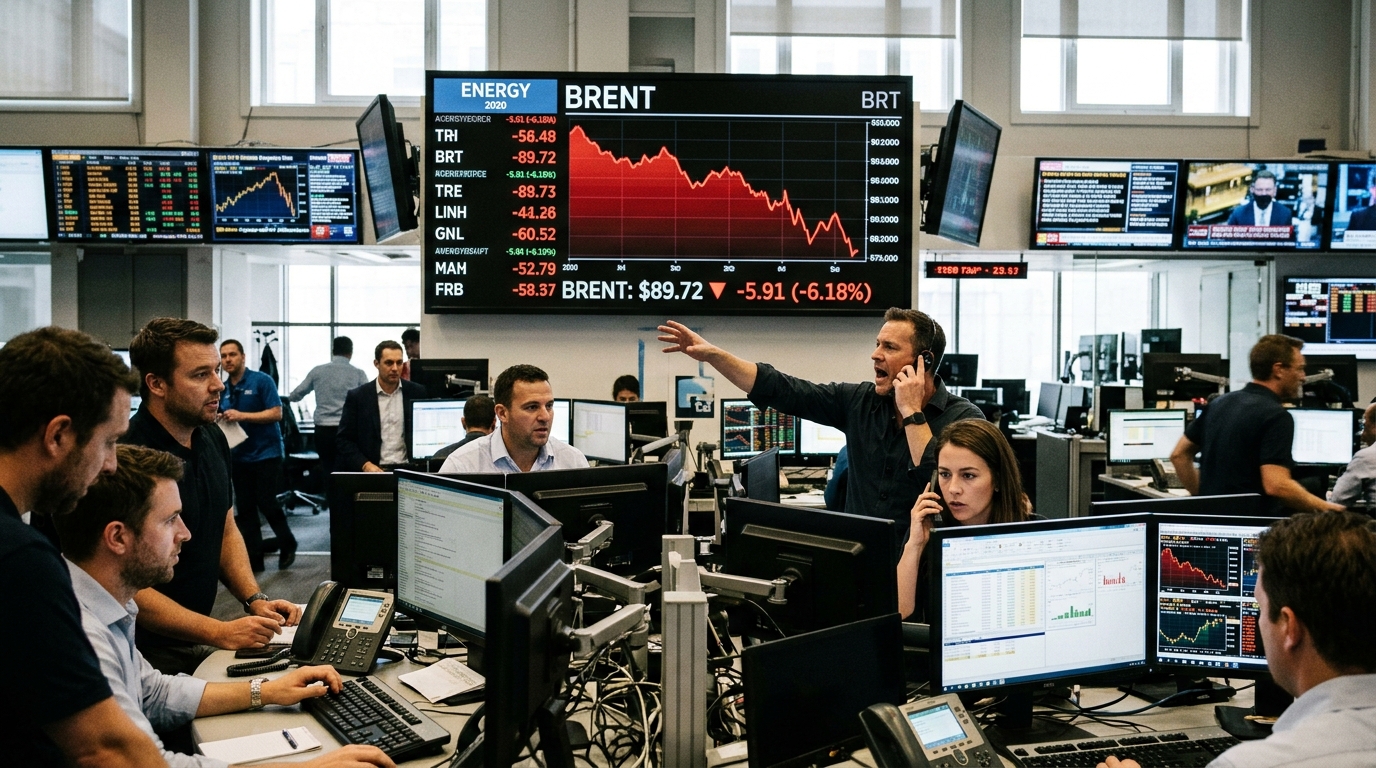
Brent crude has broken below $90 for the first time since late August, and the speed of the collapse is the story. Brent has retreated more than 20% from the six-month high near $118 it touched on October 30 as fears that Trump might step up attacks on Iran following the US midterms have eased. Monday’s session alone was brutal: Brent fell as much as 7.9% to $90.56 a barrel before settling 5.9% lower at $92.57. By Tuesday morning, prices were lower again, with Brent briefly trading below $91 per barrel.
The trigger is well-known by now. Trump said on Monday he plans to hold off on new military strikes against Iran for the time being after appeals from countries in the region, including from Qatar’s prime minister in White House talks. He indicated he would refrain from additional strikes “at this point” while maintaining a naval blockade in the Strait of Hormuz. The war premium that pushed Brent to $118 is gone, and then some.
But here is the tension that matters for positioning: Trump and his secretary of state are not saying the same thing. Secretary of State Marco Rubio tempered expectations of an imminent deal late Sunday, saying talks are not “on the verge of a breakthrough” because Iran’s demands are “unacceptable.” Rubio’s caution is worth weighing. He has been the administration’s most consistent skeptic of Iranian intentions throughout the war, and when the president is talking up momentum while his secretary of state is talking it down, the honest read is that a framework is closer than it was, but a signed and enforced deal is not imminent. US strikes have again been reported around Qeshm Island, tankers are still being attacked in the Strait of Hormuz, and the region remains volatile.
The Bifurcated Trade
That diplomatic gap creates two distinct opportunities, and they cut in opposite directions.
On the beneficiary side, refiners and airlines are the clearest winners from sub-$90 Brent. Valero’s recent headlines include a $320.5 million Houston-area refinery asset acquisition from LyondellBasell, alongside a market that has been rewarding downstream leverage as crude prices unwind. Watch crack spreads: the gap between refined-product prices and crude costs matters more than crude alone, so the trade only holds if product prices do not fall as fast as crude.
Airlines are responding similarly: lower crude tends to ease near-term fuel-cost anxiety across the group. The fuel cost arithmetic for Delta is worth tracking closely, but the baseline matters: Delta reported an average fuel price of $3.61 per gallon in Q3. A sustained move lower in crude and refined jet fuel can still flow quickly into the earnings model, but the 10% to 15% figure depends on how much of the oil move translates into jet fuel and on the time lag in procurement.
The other side of the trade is the producers. Energy has been one of 2026’s top-performing sectors, and the Energy Select Sector SPDR remains up about 40% year to date even after the recent drawdown. That is exactly why the oil drop matters: if Brent keeps sliding, the market has to compress forward cash-flow assumptions, not just headline spot prices. Specific single-stock performance and valuation claims move daily, so focus on the mechanism: higher realized pricing has been doing a lot of heavy lifting in 2026, and that leverage runs in reverse when crude breaks.
Risk Dashboard
The core risk to the refiner and airline trade is a diplomatic reversal. If Iran diplomacy stalls, oil could rebound quickly and undo the relief lifting those stocks. Technically, Brent has dropped below the 50-day EMA and Supertrend indicators, with the next key level the 61.8% Fibonacci retracement near $88.12. A failure to hold there opens the door to $85, which would extend gains for airlines and refiners but signals genuine demand destruction, not just a peace premium unwinding.
For producers, the risk cuts the other way: any hawkish headline out of Tehran, a major Strait of Hormuz incident, or a Rubio-driven policy reset toward escalation could snap Brent back above $95 within a session. That is not a low-probability outcome given the gap between Trump’s public optimism and the actual state of talks.
Trader’s Action Plan
The highest-conviction read today is long refiners and airlines against short upstream producers, sized to reflect that the ceasefire is a pause, not a peace deal. Valero and the airline group have the clearest near-term earnings tailwind from sub-$90 crude. XOM and CVX carry the most downside if Brent extends toward $85. OXY has an earnings call this week that will force management to address realized pricing and guidance in real time, that is the most immediate catalyst to monitor. Watch Rubio’s remarks around the G7 meetings in Paris for any shift in tone. That is where the next move in Brent gets its instructions.