
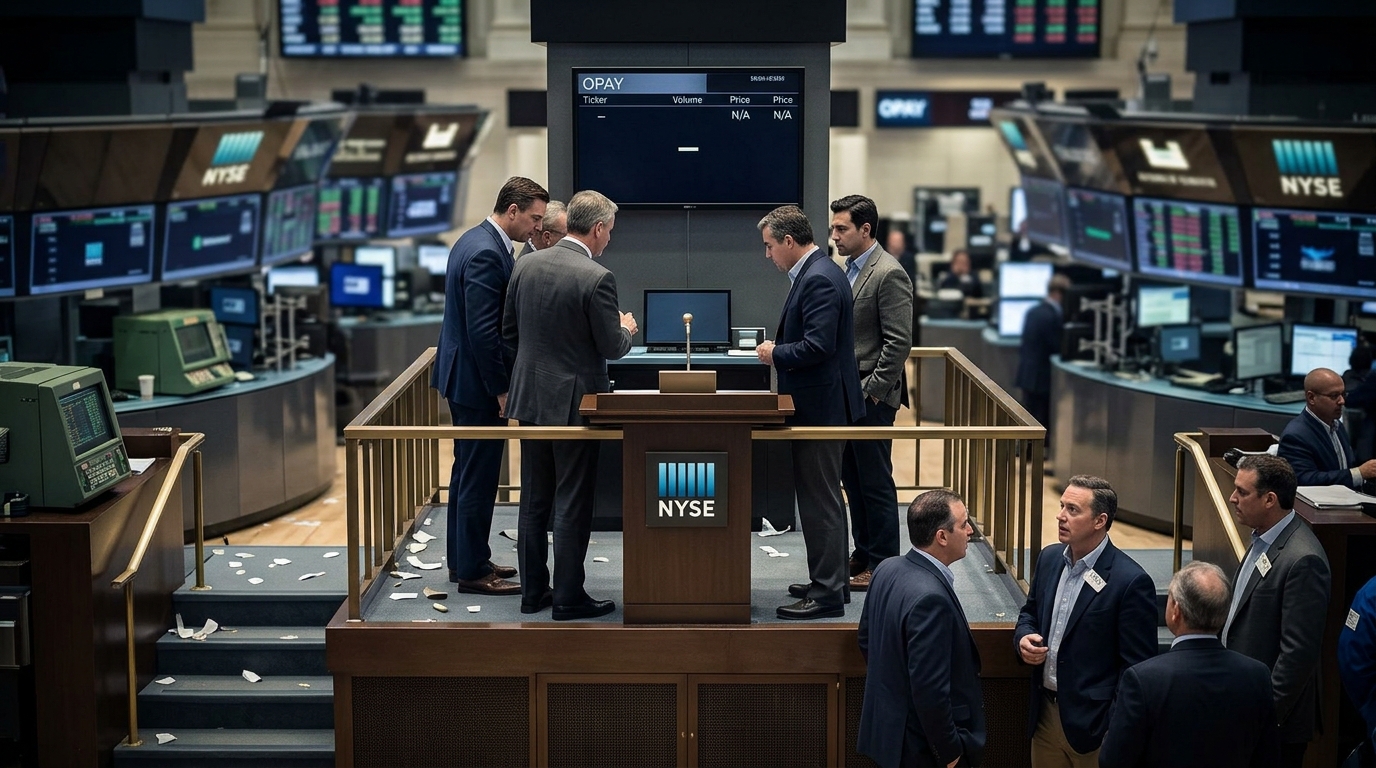
Friday’s sequence at the NYSE was close to unprecedented. OPay priced 16 million American depositary shares at $19 and rang the opening bell, and then pulled its $304 million listing before a single share traded, citing a regulatory inquiry in an unnamed foreign jurisdiction. The company and its underwriters mutually agreed to terminate the underwriting agreement dated October 29, deciding that not proceeding with the offering at this time would be the most prudent course of action. The ADSs will not trade. A deal that was certified, priced, and ceremonially launched is now a press release.
The mechanics matter here. The NYSE had certified its approval of OPay’s ADSs for listing on October 27, and Citigroup, Deutsche Bank, and Standard Bank were among the underwriters. When OPay set its price range on October 23, nine investors had indicated interest in up to $270 million of the shares, and Stanbic Africa Holdings had agreed to buy up to $200 million in new shares through a concurrent private placement. The collapse also puts that $200 million Stanbic investment on hold. This was not a deal that fell apart in the book-building stage. It cleared every gate, then stopped.
What OPay Actually Said
The company’s explanation was short on specifics. OPay described the jurisdiction at the centre of the inquiry as immaterial to its core business operations but did not disclose where the inquiry is taking place or what it concerns. It said that “not proceeding with the offering at this time would be the most prudent course of action” and that it “is confident that the inquiry will be concluded satisfactorily in the near future.” OPay’s own registration statement had already disclosed that Indonesia does not currently have a regulatory regime that expressly recognizes or affirmatively endorses the contractual arrangements through which it controls its Indonesian lending business, creating what the filing called regulatory uncertainty. The company has not connected those dots publicly.
A planned secondary listing on the Nigerian Exchange was meant to follow the NYSE debut, and OPay has not said whether it will relaunch the offering or on what timeline. Investors who had been allocated shares at $19 are now holding nothing. The IPO window, which many market participants had been watching as a gauge of risk appetite, just slammed shut on a fully priced deal.
Why This Changes the Week’s Calculus
The lesson is not that OPay is a bad business. Revenue more than doubled to $467.1 million in the first half of 2026 from $197.5 million a year earlier, and net income rose to $90.9 million from $21.7 million; the company earned $72.5 million in 2025 after losing $50.8 million in 2024. The fundamentals were real. What the company could not control was an unnamed regulator in an unnamed country raising a question at the worst possible moment.
Regulatory risk landing on strong fundamentals is not unique to new issues. Trip.com’s antitrust fine showed how a one-time regulatory charge can distort the market’s read on a genuinely growing business.
That is precisely the risk that makes new issues a poor hunting ground right now. IPO investors absorb every unknown the company brings to market, including jurisdictions it calls immaterial. There is no trading history to study, no prior earnings call to replay, no analyst who has watched management navigate a crisis.
The IPO market’s risk appetite does not exist in isolation from broader credit conditions. Credit markets spent much of October charging AI companies sharply higher borrowing costs, a repricing that reached even the strongest pre-IPO financials on record.
This week’s best opportunity sits in stocks that already trade, where price history, institutional positioning, and management track records are observable. Companies with multiple earnings cycles on the books and established analyst coverage give investors something OPay’s prospectus never could: evidence of how the business actually handles pressure. When a priced deal can evaporate in hours over a regulatory question the company itself calls minor, the risk-adjusted case for chasing the IPO calendar weakens considerably. Patience, applied to businesses with trading histories, is the more disciplined posture today.