Blane Markham here.
Alert!
If you still haven’t saved your copy of Options Trading Made Easy…
… do it right now before the download link expires.
We’ll be moving this book behind a paywall in the near future so grab it now while you still can.
You’ll thank me.
FREE: Options Trading Made Easy
To your success,
Blane Markham
Markham Trading Team
Reminder:
Grab your copy of Options Trading Made Easy before we move it behind a paywall.
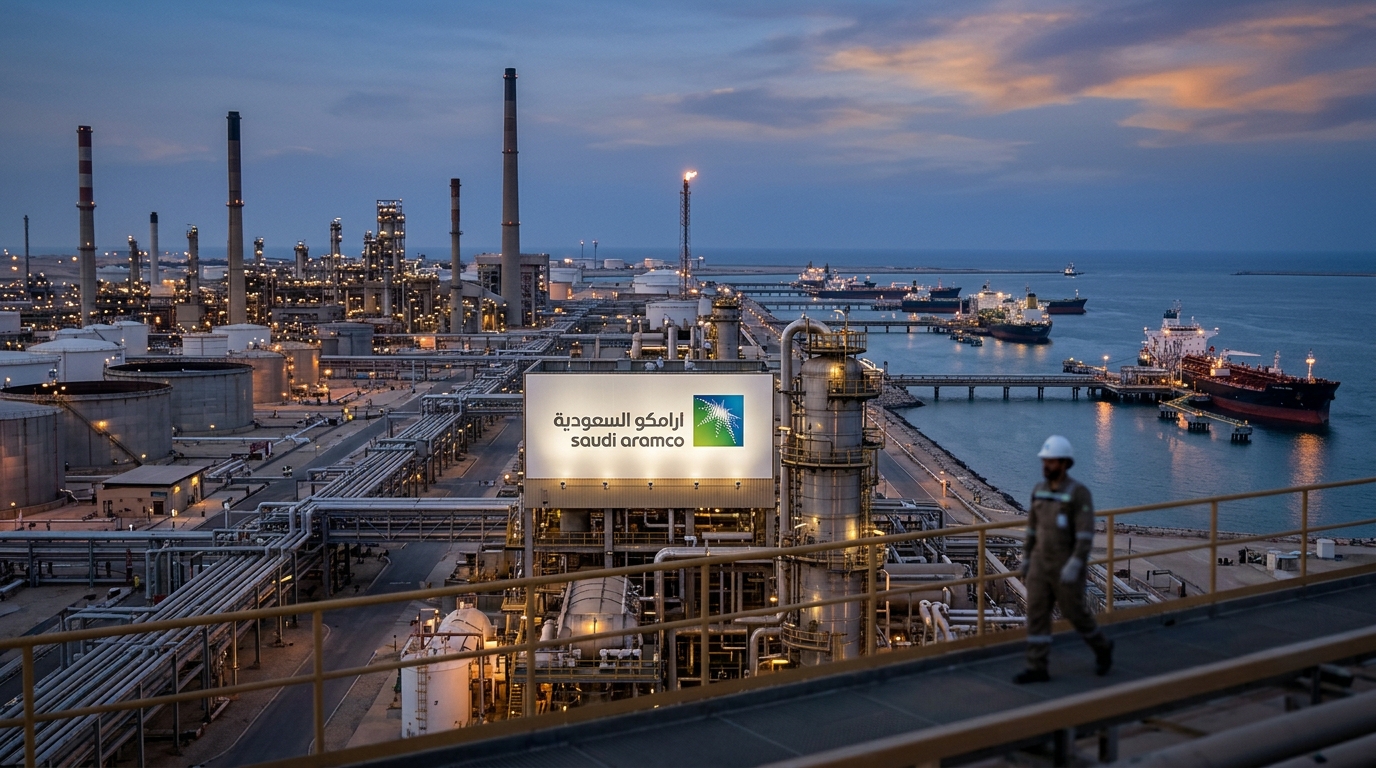
Aramco’s $21.9 Billion Quarterly Dividend Is Bigger Than Its Free Cash Flow
Saudi Aramco reports third-quarter results on Tuesday, November 3. The headline number will almost certainly look like a step backward: net income is forecast to fall about 17% from the previous quarter to roughly $27 billion, according to estimates compiled by S&P Global. Brent finished October on a different note entirely, rising 13.6% in October to settle at a six-month high of $117.64 a barrel, according to Reuters.
The real question heading into Tuesday is not the profit figure. It is the dividend.
Aramco is likely to maintain its roughly $22 billion quarterly base dividend despite a tumultuous three months. The company also launched its first-ever share buyback program: up to $3.0 billion of repurchases over 18 months, announced with full-year 2025 results in March 2026. Together, that is roughly $25 billion leaving the company every quarter. The arithmetic matters because Aramco’s cash generation has not kept pace.
In the second quarter, Aramco generated $12.3 billion of free cash flow and declared a $21.9 billion base dividend. The resulting coverage ratio was approximately 56%, meaning free cash flow covered barely half the dividend that quarter. The first quarter was only marginally better: Aramco generated $18.6 billion of free cash flow while paying $21.9 billion in base dividends, roughly 85% coverage. The company’s gearing ratio climbed to 6.2% by the close of June, up from 4.8% three months earlier.
Free cash flow coverage is the metric that separates durable payouts from borrowed ones. ExxonMobil’s $17 billion free cash flow result shows what full dividend coverage looks like in the same oil-price environment, providing a direct benchmark for evaluating Aramco’s shortfall.
The political economy of the dividend makes borrowing the default response to a cash shortfall: the base distribution is the primary fiscal transfer mechanism from Aramco to the Saudi state, and a cut would require the Ministry of Finance to explain a revenue gap it has no other channel large enough to fill. But Aramco borrowing to fund a dividend while the sovereign simultaneously borrows to fund expenditure the same dividend is supposed to cover is leverage built on leverage, individually manageable at today’s gearing levels, but compounding in ways the headline ratios do not capture.
That is the crux of the income investor case. Aramco’s yield is genuinely large. For 2026, the base dividend rose 3.5% to about $21.9 billion a quarter, implying roughly $87.6 billion for the year. No other company on earth writes a check that size four times a year. Compared to ExxonMobil or Shell, the absolute scale of the payout is in another category. But absolute scale is not the same as sustainability, and the Q3 result will tell us whether the gap between earnings and distributions is narrowing or widening further.
The dividend comparison to peers is worth stress-testing from the other direction. Shell’s record Q3 earnings rested heavily on a single refining margin that analysts expect to normalize quickly, raising the same sustainability question Aramco investors face from a different angle.
CEO Amin Nasser has emphasized longer-term investment in energy security and export resilience, a posture that keeps capital expenditure elevated precisely when free cash flow is already strained. Meanwhile, Aramco has monetised midstream infrastructure since 2021 and has indicated additional transactions are under consideration, effectively recycling assets to help support cash demands.
For income-focused investors, Aramco is not a simple yield trade. The dividend will almost certainly be declared Tuesday. Whether it is being earned or borrowed is the harder call, and Q3 will sharpen that answer considerably.