October 29, 2026
Bonus Content: Shell Earned $10.8bn. Now Ask Where That Money Came From.
Dear Reader,
You’ve been paying a toll your whole life.
Every time you fill your tank… heat your home… or flip on a light, the energy behind it had to travel to reach you. Much of it through somebody else’s pipe.
And whoever owns that pipe gets paid to move it.
Most of us never think about it. We just pay.
But as Managing Editor of Growth Investor, I see Louis Navellier’s research before almost anyone. And his newest work is about switching sides – from paying the toll to collecting it.
Louis explains how in his free interview.
Here’s why the timing matters.
Louis believes President Trump is, in effect, taking America public. Foreign governments are lining up to buy American energy on 20-year contracts. AI data centers are driving new demand for power here at home. Louis calls it America’s $31.5 TRILLION IPO.
And every bit of that energy has to move.
So Louis went looking for the toll collectors.
He found four companies sitting on the routes this energy has to travel. Together, they control more than 236,000 miles of pipeline – enough to circle the Earth roughly 9 times. One of them touches nearly 1 in 5 units of the natural gas produced in America.
Click here to see why Louis is watching these four companies.
As Louis puts it: “I don’t want folks guessing which driller will hit the next giant well. I’d rather own the toll roads.”
He calls this the part of the story he’d be comfortable owning for years – “something I might eventually hand down to my children or grandchildren.”
He walks through all of it in a new interview with John Burke – along with something even more surprising: the government calendar he keeps on his desk.
|
Sincerely,
Luis Hernandez
Chief Content Officer, InvestorPlace
P.S. You’ll keep paying the toll either way. The question is whether you collect any of it.
Here’s how Louis would start.
Shell Earned $10.8bn. Now Ask Where That Money Came From.
Shell posted adjusted earnings of $10.814 billion for the third quarter of 2026, its strongest result since 2022, and lifted its quarterly share buyback to $5 billion from $3 billion. On the surface, this looks like exactly the kind of report that earns a stock a closer look. Dig one level deeper, and a single line item changes the conversation considerably.
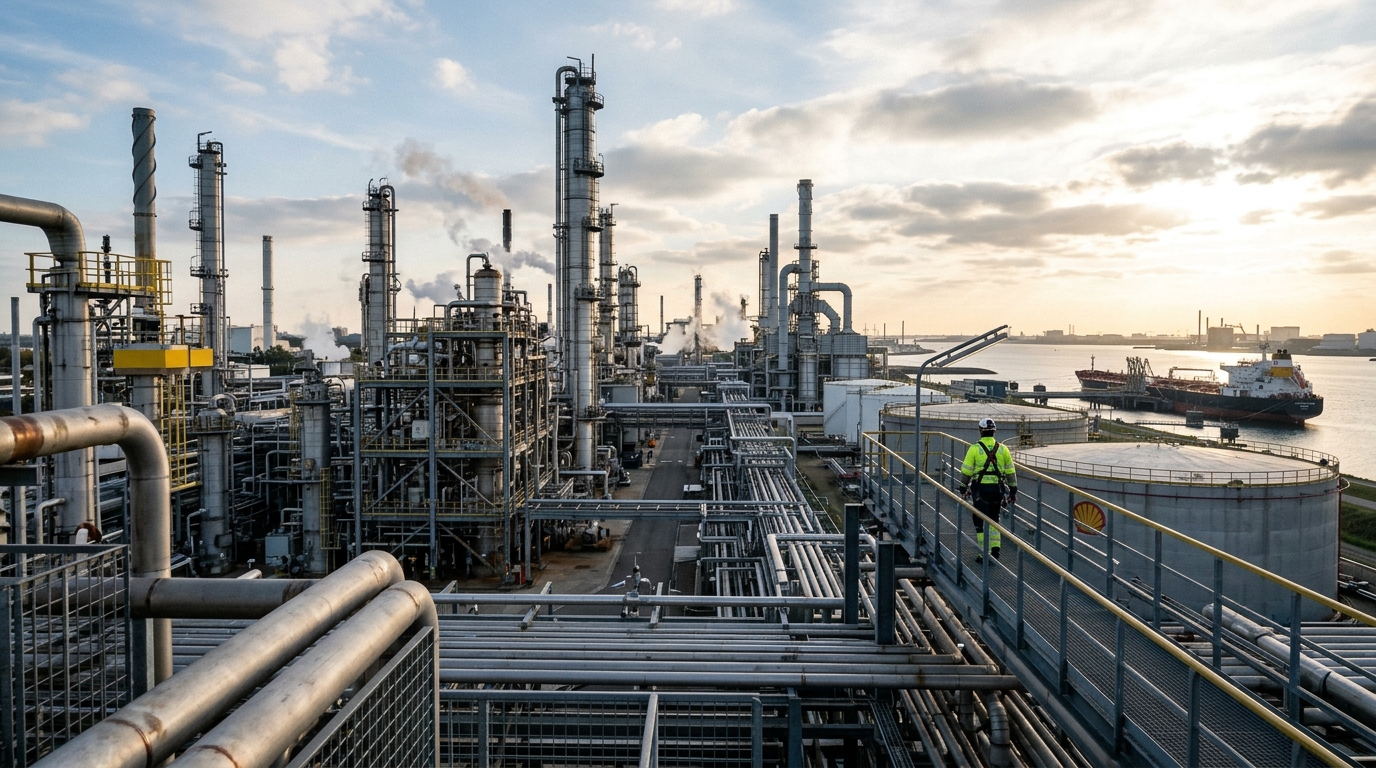
The standout was refining: Shell’s global indicative refining margin for turning crude into fuels like gasoline and diesel hit a record $42 a barrel, up from $11.6 a year ago and $24 last quarter. The chemicals and products division was the main driver, delivering adjusted earnings of $3.855 billion. Strip that division out and the rest of the business, while solid, would not have generated a headline that moves markets.
Why the Margin Matters So Much
Shell reported record global indicative refining margins of $42 a barrel. The company attributed the quarter to strong operational performance in a volatile and elevated commodity-price environment. Both geopolitical risk and refinery operations can move this number sharply. Neither is permanent.
This step-up is being financed by an unusually rich refining margin, a part of the business that tends to normalize quickly when fuel markets loosen. The $42 margin exceeds the previous record of $28.04 per barrel in mid-2022, a period that did not last long before retreating sharply. Today’s dislocation is geopolitically driven rather than demand-driven, which arguably makes it harder to sustain. Refineries in conflict zones get repaired; once capacity comes back, spreads compress.
TotalEnergies reported the same morning and delivered its own version of this story. TotalEnergies’ third-quarter adjusted net income rose 51% to $9.10 billion from $6.03 billion in the second quarter, driven by record European refining margins and surging gas prices. European refining margins surged year-on-year, with the European Refining Margin Marker jumping to $33.2 per barrel in Q3 from $8.4 a year earlier. When every major in the sector is telling a similar story, it is worth asking how much of the upside is already reflected in share prices across the group.
The Structural Offset
Shell’s integrated gas business is the segment investors hold the stock for over a cycle, and that division spent much of 2026 under pressure. Total oil and gas production for the first nine months of 2026 decreased 17%, mainly due to the impact of the Middle East conflict on Qatari volumes.
The acquisition of ARC Resources, which closed on September 2, helps offset that hole. Total oil and gas production for the third quarter increased 22% versus the second quarter, mainly due to the acquisition of ARC. That is a genuine structural addition. It does not fix the Qatar problem, but it diversifies around it.
What the Buyback Really Signals
The company announced a $5 billion share buyback program for the next three months. Cash flow from operating activities came in at $21.0 billion, and it is genuinely strong.
Exxon, Chevron, and BP all report tomorrow, and the refining margin story will repeat across each set of numbers. Jefferies maintains a Buy rating on Shell with a price target of 4,500 pence, while Mizuho holds a Neutral rating but raised its price target to $103 from $98, citing an improved outlook for near- and long-term refining margins.
The Bottom Line
Shell’s Q3 report is genuinely impressive, and the $5 billion buyback reflects real cash generation. The honest question for investors is not whether this quarter was good, but whether Q4 can sustain it. Investors are implicitly watching one variable: whether margins stay closer to $42 than last year’s $11.6. Given that both geopolitical supply disruptions and seasonal demand patterns can pull spreads back down, that is not a bet to make blindly. Shell belongs on any energy shortlist. Buy it knowing that the number that made this quarter exceptional is also the one least likely to repeat.