
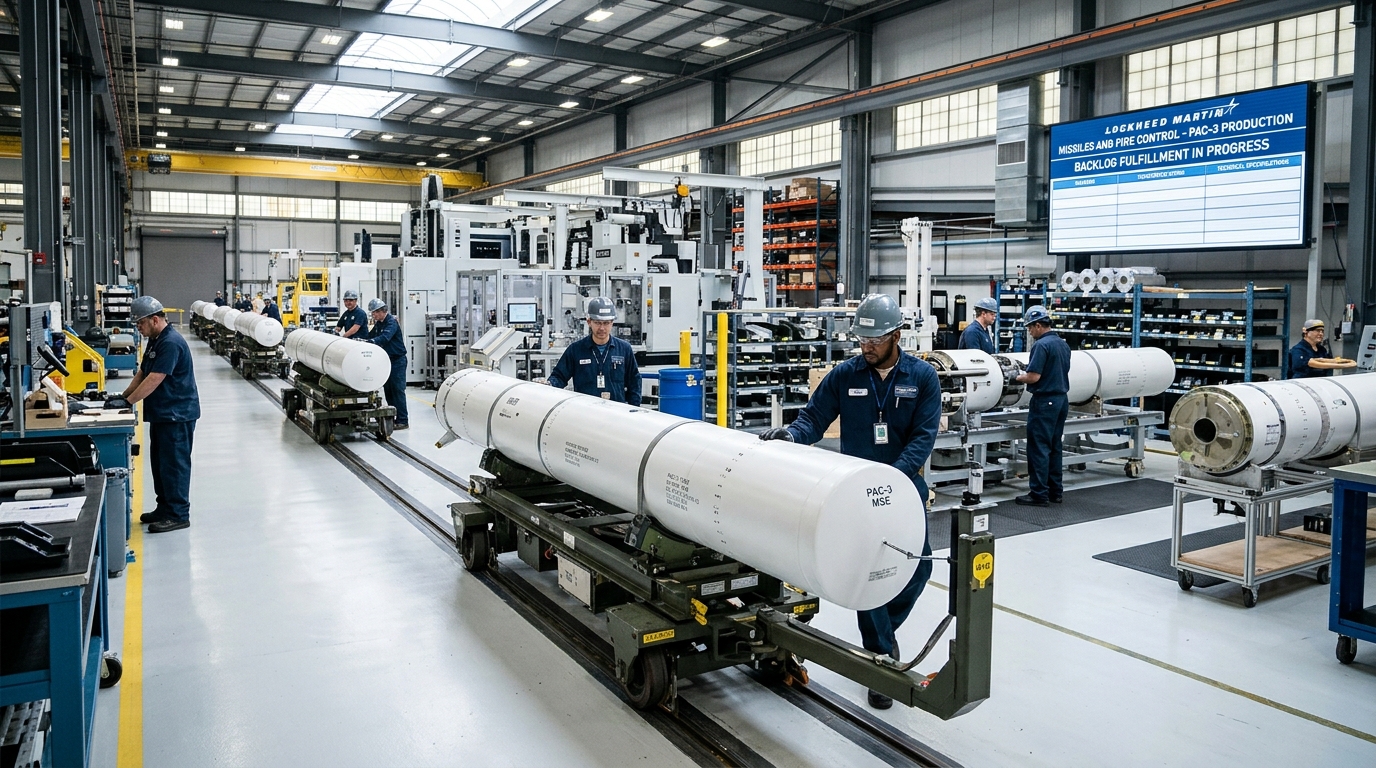
The number that stopped trading desks Wednesday morning was not the earnings beat. It was the backlog. Lockheed Martin ended the third quarter with a record $292 billion in orders, including $52.5 billion associated with the multi-year award to produce PAC-3 Missile Segment Enhancement interceptors. That figure is up $113 billion year over year, with a book-to-bill ratio of 4 times. For context, the entire annual revenue base sits around $80 billion. The backlog now covers roughly three and a half years of sales at current run rates.
The underlying quarterly results left little to argue about. Each of Lockheed’s four segments posted year-over-year growth, with sales topping $20.7 billion and net earnings exceeding $1.8 billion, increases of 11% and 14% respectively. Free cash flow came in at $3.0 billion for the quarter and $5.6 billion year to date. Management raised its outlook for sales, earnings per share, and free cash flow, the second consecutive quarter it has done so.
Why Institutions Are Still Debating Entry
The bull case runs through the PAC-3 contract. A seven-year PAC-3 agreement is designed to raise annual production capacity from roughly 600 interceptors to 2,000. A backlog of this size and duration gives Lockheed substantial visibility into future performance, with much of next year’s work already under contract and in progress, providing a strong foundation regardless of how near-term budgets unfold. For any portfolio manager running a defense sleeve, that kind of revenue certainty is unusually rare.
The bear case is quieter but not absent. Lockheed’s forward P/E recently sat around 16, which looks modest against the backlog, but the stock has already moved hard. Some analysts had flagged, before this quarter, that valuation was fair to stretched for new investors given the pace of re-rating. The question is whether the PAC-3 award changes that calculus or simply confirms what the market had already begun to discount.
The Evidence from Across the Sector
Lockheed is not operating in isolation. The major defense primes have largely been beating expectations in 2026 and several have raised guidance, with record backlogs reported across parts of the group. RTX separately entered 2026 with its own record order book driven by Patriot and AMRAAM demand. Defense contractors broadly are positioned within a large replenishment cycle, with U.S. rearmament cited as a continuing tailwind. That shared backdrop matters: it means Lockheed’s results reflect a sector condition, not just company execution.
The largest single contributor to the backlog jump was the PAC-3 seven-year contract, which brings that multi-year contract to a total value of up to $58.6 billion. The broader demand, though, was not concentrated. Beyond PAC-3, demand was broad-based across all four segments, including a selection to establish Australia’s combat systems integration capability for its future Virginia-class submarines.
What Investors Are Missing
The conversation around Lockheed has focused almost entirely on the size of the backlog. The more interesting question is production capacity. Management said the business is benefiting from large multi-year contracts, rising production rates, and improved working capital. Getting from a $52.5 billion interceptor award to actual delivered units requires factory throughput that did not exist 18 months ago. The companies that supply Lockheed’s missile production lines, and those competing to expand them, may be earlier in their own re-rating than the prime itself.
The cycle-timing debate among institutional investors tends to resolve around visibility, and on that metric Lockheed just handed the bulls their clearest data point of the year. The company raised its 2026 outlook to approximately $80 to $82 billion in sales, $30.35 to $30.75 in diluted EPS, and $7.8 to $8.0 billion in free cash flow. The stock is not cheap on an absolute basis. But a forward multiple below 17 times, against a backlog that covers years of revenue, is a harder case to dismiss than it was six months ago.
Stocks to Watch
- LMT: The direct read-through. Raised guidance twice in a row, 4x book-to-bill, PAC-3 production ramping. The risk is execution at scale, not demand.
- RTX: Patriot system demand is the mirror image of PAC-3 growth. RTX entered 2026 with its own record backlog and remains the broadest-diversified missile and radar play among the large primes.
- NOC: B-21 Raider production scaling and Golden Dome contract activity give Northrop distinct exposure to the stealth and space layers of the same geopolitical spending cycle.
- GD: Virginia-class submarine demand, referenced directly in Lockheed’s own commentary this year, benefits General Dynamics most directly. Columbia-class is a decade-long revenue stream only beginning to accelerate.