September 30, 2026
Bonus Content: Boeing Is 21% Below Its High With Q3 Four Weeks Away
Editor’s Note: What if you could go for $1,000 in the markets, no matter which way stocks are going? Long-time friend and colleague Larry Benedict is revealing the strategy he used to make hundreds of millions of dollars for his Wall Street clients. Read more below.
Dear Reader,
New record highs?
Armageddon?
I’ve been trading the markets for four decades, and I’ve seen the markets do this exact song-and-dance before.
My name is Larry Benedict, and I’m here to tell you…
It’s all noise.
And today, I’m releasing an interview I just recorded to show you why none of the extreme movements matter.
All-time highs, or complete meltdown.
Best,
Larry Benedict
40-Year Wall Street Veteran
Boeing Is 21% Below Its High With Q3 Four Weeks Away
Boeing shares sit near $212, about 21% below the 2026 high. The company has spent the year arguing its recovery is real. The September pullback sets up a specific bet: that wing production gets fixed before the October 28 earnings call, and the market hears it directly from CEO Kelly Ortberg.
The Business
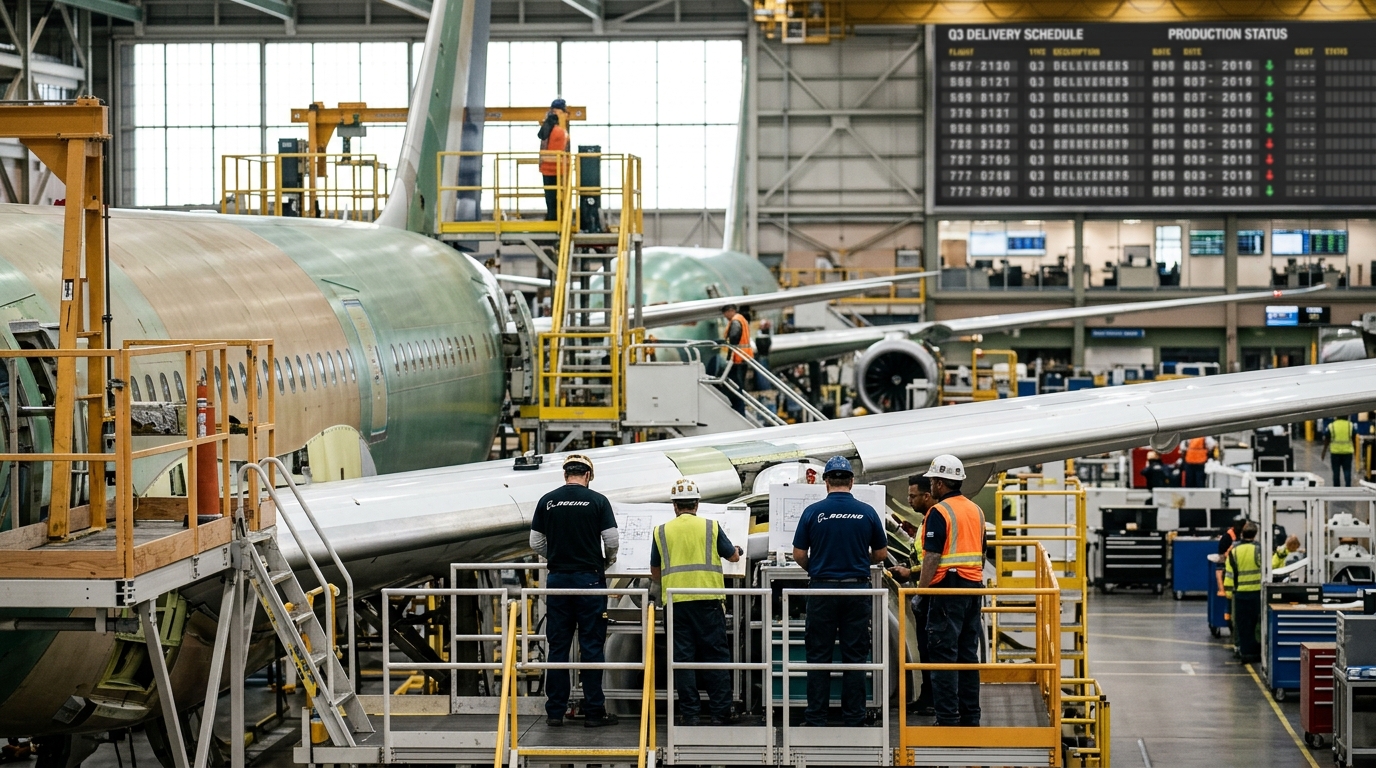
Boeing builds commercial aircraft and defense systems. Its recovery reduces to one question: how fast can it produce and deliver the 737 MAX? Every delivered jet converts backlog into cash. The backlog is not the problem. Boeing’s total order book stands near $715 billion, with approximately $597 billion at Commercial Airplanes alone.
Why Wall Street Is Paying Attention
Through August 2026, Boeing delivered 418 aircraft, its highest total for that period since 2018. The 737 MAX is now producing at a rate of 47 per month, up from 42 at the start of the year. In Q1 2026, the Defense segment posted a 21% revenue increase, booked $9 billion in new orders, and holds an $86 billion backlog.
Order momentum is strong on paper. Korean Air finalized a $36.2 billion order for 103 aircraft in September. Turkish Airlines finalized up to 150 737 MAX jets. Akasa Air in India is reportedly in talks for more than 200 MAX planes. Boeing booked 453 net orders through August. Bank of America argues the September selloff overstates the production delay. The Wall Street consensus target sits near $273, about 29% above the current price.
What’s Driving the Opportunity
The clearest catalyst is what happens at the 737 wing shop and the new 737 line in Everett. Ortberg told investors in mid-September that a move to 52 jets per month depends on stabilizing wing production and getting the Everett line qualified. Fix that bottleneck and monthly delivery volumes step up mechanically, pulling free cash flow with them. Boeing has reaffirmed $1 billion to $3 billion in free cash flow for full-year 2026, with management pointing to results near the midpoint of roughly $2 billion. That would still be positive, and it would be a major shift after years of cash burn tied to the MAX crisis and the later delivery disruptions.
Operating margins were 2% in Q1 2026. Revenue is growing faster than the cost base. That spread widens with every incremental increase in 737 production rate.
What Could Go Wrong
Net debt near $26 billion is the structural overhang. Until Boeing consistently generates free cash flow and reduces that figure, the balance sheet constrains flexibility. The wing bottleneck is real, not hypothetical, and the stock fell 4.5% on September 16, 2026 after Ortberg discussed it publicly. Oil prices and other cost pressures can squeeze airline margins, reducing carriers’ urgency to accelerate new-aircraft spending. The 777X, still awaiting certification for a 2027 first delivery, continues to consume cash without contributing revenue.
The Bottom Line
Boeing’s demand is genuine. Its competitive position against Airbus is intact. The recovery is real but slower than originally advertised, and Ortberg has been honest about that. At 21% below the high, with the Street’s $273 target 29% above current levels, the risk-reward is not about whether the recovery happens. It is about the pace. October 28 is when Ortberg either shows wing production is stabilizing or concedes another delay. The bottleneck is the trade.