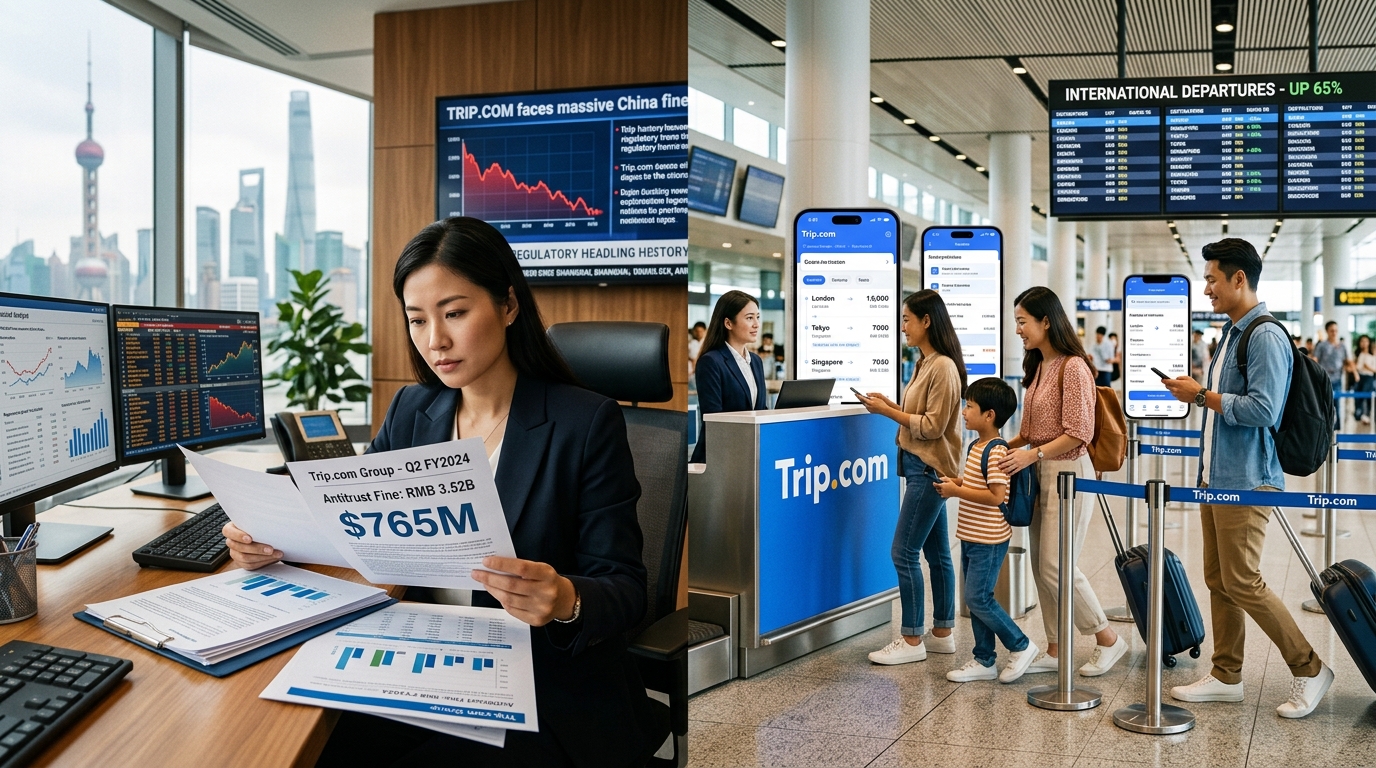
Trip.com Group reports Q2 and first-half results after the close Tuesday, September 15, and the quarter is not pretty on its face. The company faces significant short-term headwinds from a RMB 3.521 billion antitrust fine and RMB 1.658 billion confiscation, impacting Q2 results. The combined penalty is the most significant platform fine China has imposed since it sanctioned Alibaba with a $2.8 billion penalty in 2021. The question investors need to answer before Tuesday’s close: does a business growing international bookings at 65% year over year deserve to trade at a distressed multiple because of a one-time regulatory charge?
The Business
Trip.com is China’s dominant online travel platform, operating under Ctrip, Qunar, Trip.com, and Skyscanner. Hotel reservations, transportation bookings, and travel management solutions sit at the core of its business model. The international operation is the growth engine that separates it from domestic peers. Gross bookings on the international platform increased approximately 65% year over year in Q1, while inbound travel bookings surged approximately 90% year over year. Those are not numbers that suggest a platform losing relevance.
Why Wall Street Is Paying Attention
One bullish view on the stock has upgraded TCOM to a cautious buy, citing eased regulatory uncertainty and a valuation around 9x FY2027 earnings. Wall Street consensus expects Trip.com to report adjusted EPS between $0.87 and $0.98, alongside quarterly revenue of approximately $2.29 billion. The overall Street consensus is generally described as a “Moderate Buy,” with average price targets near $60 to $64.
The macro backdrop adds its own variable. China’s August activity data lands the same day as the earnings release, and Xi Jinping’s planned September 24 state visit to Washington is now days away. Any thaw in U.S.-China relations tends to loosen outbound travel sentiment. That is a potential tailwind the market has not fully priced.
What’s Driving the Opportunity
The antitrust penalty itself, while large, is now a known quantity. The penalty includes the confiscation of RMB 1.658 billion in illegal gains and a fine of RMB 3.521 billion, the latter equivalent to 7.5% of the company’s domestic sales in 2025. Trip.com said it accepted the decision and committed to carrying out rectification. That acceptance matters: regulatory certainty, even costly certainty, is easier to model than open-ended investigation risk.
Trip.com entered the quarter with Q1 revenue of RMB 16.2 billion and a cash and investments balance of RMB 104 billion, or US$15.1 billion. A company sitting on that much liquidity can absorb a RMB 5.2 billion penalty without touching its operating capacity.
What Could Go Wrong
The structural remedy is where the real long-term risk lives. Regulators ordered the company to stop requiring exclusivity deals with hotels, remove lowest-price-across-all-platforms requirements, discontinue certain pricing tools, and refrain from changing room rates without hotel consent. If the new model cuts commission rates or forces greater spending on hotel subsidies and marketing, margins in the accommodation business could be squeezed even if volumes keep growing.
Hotel operators previously tied to exclusive Trip.com arrangements may now list rooms on Alibaba’s Fliggy, Meituan, or Douyin without fear of algorithmic retaliation. That is a real competitive opening for rivals. A putative securities class action lawsuit was filed in the U.S. in March 2026, adding legal and compliance uncertainty on top of existing competitive pressure, and could influence how investors weigh the company’s current low valuation metrics against its growth track record.
The Bottom Line
Tuesday’s report absorbs a one-time charge that is ugly but finite. The structural hotel remedy cuts into take rate over time, and that is a genuine earnings headwind, not a short-term accounting event. But the international business running at 65% growth is building a revenue base that does not depend on domestic hotel exclusivity to compound. At roughly 9x forward earnings, the stock prices in a lot of bad news. Investors willing to distinguish between a cash penalty and a broken franchise may find tomorrow’s sell-off, if there is one, more useful than alarming.