September 14, 2026
Bonus Content: Seagate Is 27% Off Its High. Its Storage Contracts Say That Gap Is Wrong.
Dear Reader,
In less than 100 days, Americans will head to the polls.
And the man CNBC dubbed “The Prophet” believes the 2026 midterm elections will create a major once-in-a-generation opportunity for investors who position themselves early today.
In this special briefing, he reveals:
- The major catalyst he believes could drive this wealth-creation opportunity.
- Why Wall Street may be overlooking it.
- And why he believes investors should consider positioning themselves before Election Day arrives.
But that’s not all.
Whitney is also revealing one stock he believes you should consider buying now…
And one stock he believes you may want to dump before Election Day.
Click here now to watch the full presentation today.
Regards,
Matt Weinschenk
Publisher and Director of Research, Stansberry Research
P.S. This could be the most consequential briefing you see regarding your wealth this year. Inside, Whitney shares why he believes some investors will enjoy exponential wealth – while others could lose half their wealth within the next six months. Don’t wait… election day is fast-approaching. Click here to watch their briefing now.
Seagate Is 27% Off Its High. Its Storage Contracts Say That Gap Is Wrong.
Seagate Technology closed at roughly $830 on September 13, sitting 27% below its 52-week high of $1,145. The irony is that the underlying business has rarely looked this clean. The company just ended fiscal 2026 with $12.2 billion in revenue, up 34% year over year, and guided its September quarter to $4.1 billion, implying 56% year-over-year growth at the midpoint. If that guide holds, this is a business accelerating, not peaking.
The source of the selloff is a common one: insiders selling into strength. Seagate executives have filed several stock sales over the past month, and the market has treated each filing as a reason to reduce exposure. But insider selling at a company whose nearline supply is largely allocated into calendar 2028 and whose customers are already discussing 2029 planning horizons deserves context. Executives monetize. That is not the same as the thesis breaking.
The Business
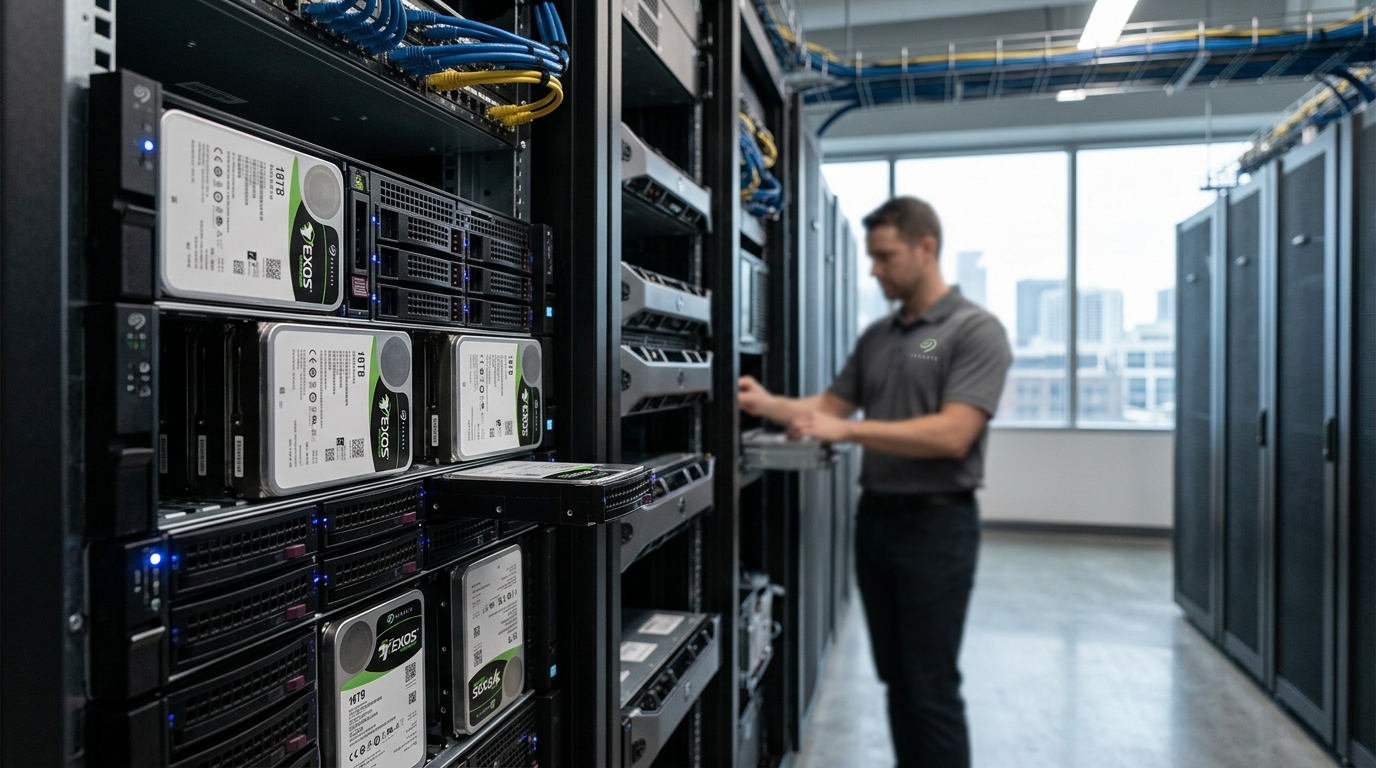
Seagate makes hard disk drives. That sounds unremarkable until you understand what AI data centers are doing to demand. Data center customers now account for approximately 90% of Seagate’s exabyte shipments, and the company’s nearline drives are the preferred medium for the massive cold-storage layers that sit behind AI training clusters. Every new foundation model generates petabytes of training data that someone has to store cheaply, at scale, for years. HDD is that solution.
The technology running beneath all of this is called HAMR, heat-assisted magnetic recording, which Seagate has branded as Mozaic. HAMR-based products now represent about 40% of nearline exabyte shipment run rate, and the Mozaic 4 platform, supporting drives of up to 44 terabytes, is already ramping with the world’s two largest cloud providers. Mozaic 5 is on track for qualification in late 2027. Each generation drops cost per terabyte, which is how Seagate grows margin even as prices stabilize.
Why Wall Street Is Paying Attention
The Q4 fiscal 2026 numbers removed most of the doubt about the trajectory. Non-GAAP gross margin hit 52.7%, up from 37.9% a year earlier, while adjusted operating margin jumped to 44.6% from 26.2%. Free cash flow for the quarter exceeded $1.1 billion, the strongest in over a decade. Fiscal 2026 net income was $1.3 billion, up from $488 million a year earlier.
Management expects sequential revenue and margin expansion throughout fiscal 2027, with pricing expected to contribute to sequential improvement as demand continues to outpace supply. Among 25 analysts covering the stock, the average rating is Strong Buy and the consensus 12-month target sits at $1,125, roughly 35% above Friday’s close.
What’s Driving the Opportunity
The supply contract picture is the underappreciated piece. Seagate’s nearline supply is largely allocated into calendar 2028. Customers are not spot-buying; they are locking in multi-year agreements because the HDD shortage is structural. AI server shipments are consuming DDR and NAND at rates that divert manufacturing capacity away from high-capacity nearline drives, tightening the supply side just as the demand side accelerates.
Debt has also improved materially. Seagate reduced gross debt during fiscal 2026 and exited the year with record free cash flow generation. The balance sheet no longer requires the same risk premium it did in prior cycles.
What Could Go Wrong
The primary risk is a faster-than-expected shift toward solid-state drives in the data center. Flash costs have been declining, and at some price point SSDs become competitive with HDDs even at mass capacity. Seagate argues the crossover remains years away given the total cost of ownership math, but that debate is not settled. The elevated stock multiple relative to a hardware company’s historical range also gives less margin for any guidance miss. A single weak quarter in this environment could erase several months of recovery.
The Bottom Line
Seagate is not a legacy storage story. It is one of the clearest direct beneficiaries of the AI data build, with supply visibility extending into 2028, margins expanding, and a technology roadmap that extends through the end of the decade. The 27% pullback from the high has produced an entry that the forward revenue guide, the contract picture, and the margin trajectory all argue against. The insiders selling does not change the fact that the customers are buying more storage every quarter with no sign of slowing.