
September 4, 2026
Bonus Content: Three Regional Banks Worth Watching Right Now
Here’s what it isn’t:
Not oil.
Not solar. Not wind. Not nuclear.
It doesn’t come from a mine, a well, or a foreign country.
It runs 24 hours a day. Produces zero carbon. Needs no fuel, no batteries, and no sunlight.
The International Energy Agency measured it at 140 times global electricity demand.
So why has it stayed under the radar?
Then a crew near the Grand Canyon drilled through in 16 days. The Department of Energy had projected the same milestone would take 64.
Google signed a 15-year contract the following quarter. Bill Gates committed $100 million. The Pentagon designated it a priority infrastructure asset.
On October 20th, Washington extends this energy source a policy advantage it has not granted solar or wind — a structural benefit running through 2033.
One company holds the core technology. Sixty years of built infrastructure. No direct competition on the horizon.
See the energy source redefining domestic infrastructure >>
“The Buck Stops Here,”
Kelly Maguire
Behind the Markets
Three Regional Banks Worth Watching Right Now
Regional banks were supposed to be the easy call in 2026. The Fed had cut rates 175 basis points across 2024 and 2025, deposit costs were falling, and asset yields were still repricing higher from the pandemic era. Then the ceiling came down. The industry’s net interest margin slipped 8 basis points to 3.31% in Q1 2026, while net interest income declined $1.6 billion from the prior quarter. Three banks, however, are not following that script.
That margin compression does not exist in a vacuum — it is partly a function of where the Fed has parked rates and, more importantly, where the long end of the Treasury curve has decided to go on its own. how the 30-year yield is defying the Fed’s hold and what it means for rate-sensitive lenders is worth understanding before drawing conclusions about any bank’s margin trajectory, because the spread environment regional banks are repricing into is not the one the Fed alone controls.
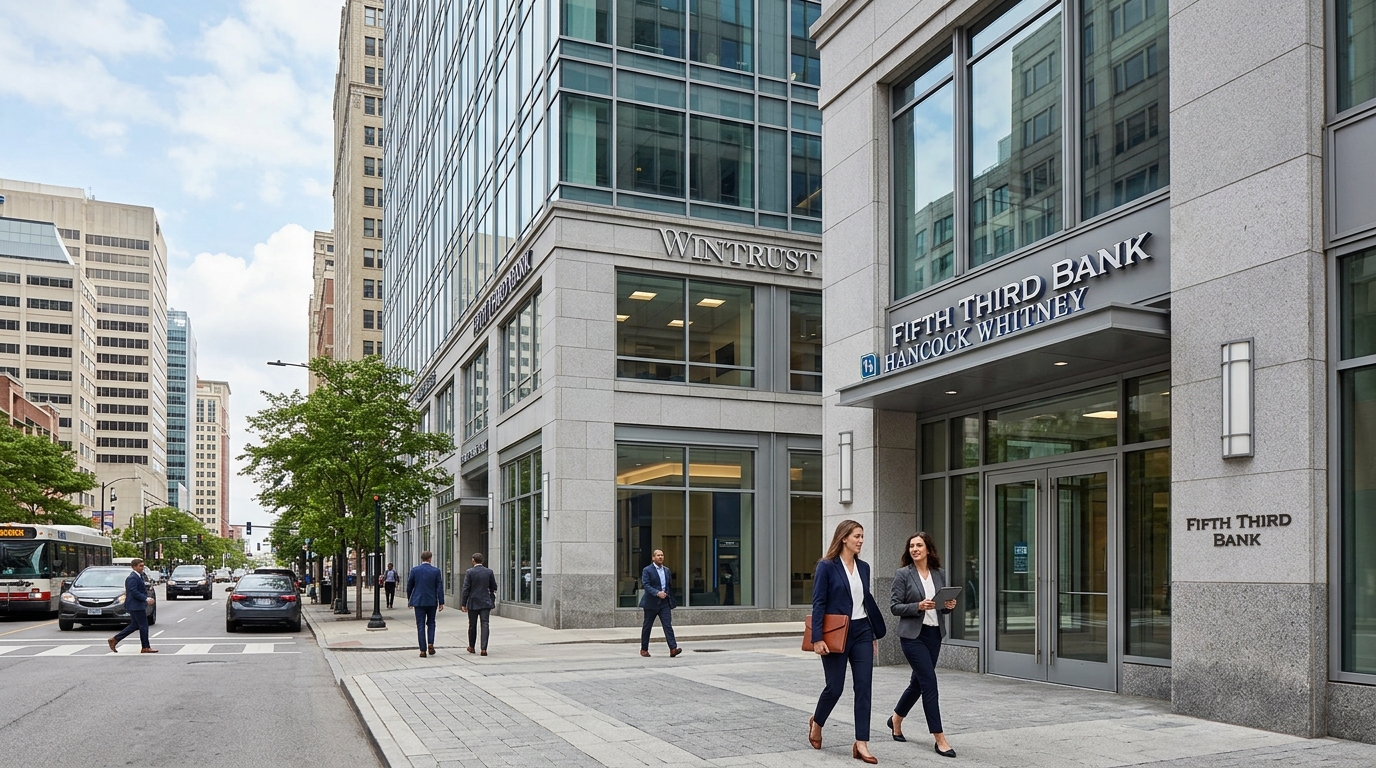
Fifth Third (FITB): The Comerica Payoff
Q2 2026 marked an important milestone for Fifth Third, surpassing $300 billion in total assets and formally becoming a Category III institution. The Comerica acquisition, which Fifth Third says legally closed on February 1, 2026, is driving the bulk of that scale. Fifth Third reported Q2 adjusted EPS of $1.02, beating consensus by four cents, with results benefiting from solid growth in net interest income and fee income, along with higher loan and deposit balances.
The real catalyst is still loading. CEO Timothy Spence said the Labor Day systems conversion is expected to unlock the last large wave of synergies, including real estate, personnel, and systems elimination. The company continues to cite $850 million in expected annual pre-tax cost synergies from the merger, with that conversion positioned as the final step to unlocking the full run-rate. Fifth Third also highlighted a $2.5 billion delivery of consumer deposits from its Comerica Southwest marketing campaign and 7% legacy Fifth Third consumer household growth in the Southeast. The risk: integration is not complete, and rising non-interest expenses already clipped the stock nearly 3% on earnings day.
That reaction is a reminder that for bank stocks, the reported number is rarely the whole story — what management says about the path forward carries as much weight as the beat or miss itself. why bank management commentary on costs and credit matters more than the headline EPS print lays out the framework for reading these reports, and it applies directly to how investors should weigh Fifth Third’s synergy timeline against its near-term expense drag.
Hancock Whitney (HWC): Florida Is the Bet
Hancock Whitney completed its acquisition of One Florida Bank on August 1. The deal, announced in May, was described by CEO John Hairston as a significant step in the long-term growth strategy, expanding the bank’s footprint into one of the most dynamic and high-growth markets in the country. Hancock Whitney disclosed that at June 30, 2026, OFB Bancshares had $2.1 billion in total assets, $1.7 billion in total loans, and $1.8 billion in total deposits.
The acquisition carries projected high single-digit EPS accretion with a four-year tangible book value earnback. Full-year 2026 guidance was updated to include the One Florida Bank acquisition, with management projecting low double-digit growth in loans and deposits. Margin is ticking up slowly: net interest margin improved modestly to 3.56%, benefiting from higher bond portfolio yields following a Q1 restructuring and reinvestment of principal cash flows. Net charge-offs fell to 16 basis points for the quarter, and the company said criticized commercial loans improved again. The concern is capital dilution: management has said the OFB deal is expected to reduce the common equity Tier 1 ratio by roughly 170 basis points near-term.
Wintrust Financial (WTFC): Six Straight Records
Wintrust reported its sixth consecutive record quarter of net income, with Q2 net income reaching $233.7 million, up from $227 million in Q1. The company reported strong loan and deposit growth, with deposits increasing approximately $2.2 billion and loans growing $1.6 billion during the quarter. Credit quality is holding. Nonperforming loans decreased to $179.3 million, or 0.32% of total loans, and charge-offs fell to 10 basis points for the quarter, down from 14 basis points the prior quarter.
Wintrust also announced an agreement to purchase the guardianship services business of Northern Trust, expanding its Wealth Management franchise. The stock and return figures in this draft are not dated or sourced to a specific measurement point, so they have been removed. At roughly 12x earnings based on recent trading levels, the valuation is reasonable but not cheap for a Midwest community-focused bank.
The common thread across all three is execution inside a macro that is not cooperating. While bigger banks were the early beneficiaries of the shifting rate regime, regional and community banks are now positioned to realize the lagging benefits of lower rates across their predominantly spread-based business models, alongside an accelerating M&A wave. None of these three are slam-dunks. But they each have identifiable reasons to be different from the index.
The macro that is not cooperating, however, may be more complicated than a simple rate-hold story. the structural forces pushing global yields higher beyond what the Fed controls — including sovereign borrowing pressures and synchronized fiscal expansion — are the same forces that will determine whether the lagging spread benefits regional banks are counting on actually arrive on the timeline management is projecting.